AF099 · Lesson 15 of 71
Squadron Commander's Arrival Briefing
Table of ContentsShow
- Overview
- Professional / Unprofessional Relationships
- Unprofessional relationships are strictly prohibited
- Zero tolerance for sexual harassment and sexual assault
- Hazing
- Decency
- Wingman Concept
- Sexual Crimes Prevention
- Reporting Sexual Crimes or Attempted Sexual Crimes
- Two reporting methods
- Special Interest Items
- Resolving and Handling Problems
- Commander's open door policy
- Student Leaders Rules of Engagement
- Bottom line
- Family Care Plans
- Worship Services
- Trainee Hotline Phones
- Victim's Counsel
- Maltreatment and Maltraining
- Military Training Instructor Tools
- Feedback System
- Trainees Giving Constructive Feedback
- Summary
Most companies have an orientation before you can start working - so you understand the culture. During that orientation, someone from leadership will come in, welcome you, and discuss the values of the company, what to expect, and what to do if you're treated unfairly.
Basic Military Training (BMT) operates the same way. The values of our company are our Core Values:
- Integrity First
- Service Before Self
- Excellence In All We Do
In the Air Force, you're expected to be accountable for your actions and to be an information seeker so you don't find yourself in an unfavorable position. This brief covers the issues we have in the Air Force and BMT, and how to best handle them.
Overview
Objective: Participate as a high-functioning Airman during basic military training leadership familiarization.
Learning Outcomes
- Understand the difference between professional and unprofessional relationships.
- Describe the wingman concept as it pertains to BMT.
- Understand the importance of sexual crimes prevention.
- Recognize special interest items and what to do if you're a victim of harassment or assault.
- Explain resolving and handling problems while in BMT.
- Understand the importance of a Family Care Plan.
- Recognize the worship services BMT has to offer.
- Understand the purpose of Trainee Hotline Phones and Special Victim's Counsel.
- Recall basic facts regarding MTI Tools, the Feedback System, and trainees giving constructive feedback.
Foundational Competencies
- Accountability - Accepts full responsibility for self and team; displays honesty and truthfulness.
- Information Seeking - An underlying curiosity; a desire to know more about things, people, oneself, the mission, or issues; an eager, aggressive learner.
Summary
- Professional / Unprofessional Relationships
- Wingman Concept
- Sexual Crimes Prevention
- Special Interest Items
- Resolving and Handling Problems
- Family Care Plans
- Worship Services
- Trainee Hotline Phones
- Special Victim's Counsel
- Military Training Instructor Tools
- Feedback System
- Trainees Giving and Receiving Feedback
Professional / Unprofessional Relationships
From the moment you raised your hand to take the Oath of Enlistment, you were accepted into the Profession of Arms. All professions, including the military, have rules regarding professional conduct and professional relationships.
The Military Equal Opportunity (MEO) program promotes an environment free from personal, social, and institutional barriers that prevent Air Force members from rising to the highest level of responsibility possible. It guarantees Airmen will be evaluated only on individual merit, capability, and performance.
Later, you'll have in-depth classes on Human Relations and Sexual Assault Prevention and Response. For now, here's the critical information you need.
Unprofessional relationships are strictly prohibited
Unprofessional relationships between permanent party personnel (instructors and staff) and trainees are strictly prohibited.
- Trainees and permanent party personnel will not date or engage in sexual or social relationships.
- You will not establish, develop, attempt to develop, or conduct a social, personal, intimate, or sexual relationship with MTIs.
- You should not be contacted by your MTI by phone or social media - Facebook, X (formerly Twitter), texts, etc.
- Ensure your relationships with MTIs are professional.
- Trainees are not allowed to be alone with a person of the opposite sex - either another trainee or permanent party personnel. This includes opposite-sex dormitories without an MTI present, closed-door office counseling, or riding in a motor vehicle.
Permanent party personnel must report any prohibited personal or social media contact from any trainee/student - or the family member or friend of any trainee/student - to their chain of command immediately. If the personal contact involves an item (card, letter, gift, etc.) that arrived in the mail or was left behind, the MTI must submit it to their chain of command immediately.
If an MTI attempts to contact you for other than official business, immediately contact your squadron commander, first sergeant, or the Sexual Assault Response Coordinator (SARC) by using the Trainee Hotline Phone.
Zero tolerance for sexual harassment and sexual assault
The Air Force has zero tolerance for sexual harassment and sexual assault. The Air Force is committed to deter sexual assault through robust education and training programs, appropriate supervision, and policies.
An essential element of a good government is compassion. Caring for others is the counterbalance against the temptation to pursue the mission at any cost.
The Air Force's goal is to sustain an environment in which our Airmen feel secure enough to report assaults as they occur. The Air Force swiftly and thoroughly investigates all allegations and punishes perpetrators when results dictate.
No one - including other trainees or permanent party personnel - should:
- Make unwelcome sexual advances toward you.
- Request sexual favors from you.
- Engage in verbal conduct, physical contact, or gestures of a sexual nature.
Hazing
Hazing causes another person to suffer or be exposed to activity that is cruel, abusive, humiliating, oppressive, demeaning, or harmful. Hazing will not be tolerated.
All Air Force customs and courtesies are conducted with the highest degree of professionalism and dignity. Secret initiation rites are not allowed. BMT is your only indoctrination into the Air Force and the Profession of Arms.
Immediately report any instances of maltreatment, maltraining, or hazing using your chain of command.
Decency
While living in close quarters - here or in a deployed environment - everyone is expected to show common courtesy and respect by demonstrating modesty. What was once acceptable prior to Air Force life may not be acceptable now.
With the exception of the shower and drying areas, trainees will not walk around unclothed. Show respect by properly covering yourself as you walk through the dormitory.
Wingman Concept
The wingman concept was developed when pilots noticed a need to watch out for each other while in flight. It provides you with a personal contact for assistance in adapting and coping with training.
You'll spend the first few weeks adjusting to the military lifestyle. Having someone you can talk to and count on may ease the tension during your transition. Your assigned wingman will be your bunk mate in your respective bays.
The wingman concept is simple: you look out for your fellow Airmen to ensure they're able to accomplish the mission safely. The fundamental idea is teamwork.
Working with others allows you to learn and implement team-building skills to succeed in BMT and your Air Force career.
Sexual Crimes Prevention
Sexual crimes such as rape or sodomy involve forcing a person to submit to sexual intercourse and can happen to both males and females. In the unlikely event you find yourself in a threatening situation, rely on your judgment. Some recommended actions:
- Reason with your attacker - it may turn their attention to something else.
- Be assertive by loudly yelling "No!" and screaming for help.
- Physically resist by stomping on the attacker's foot or kicking them in the groin.
Reporting Sexual Crimes or Attempted Sexual Crimes
As you go through BMT you'll receive training on sexual assault at various points in the program - which may trigger difficult emotions. You always have the option to meet with a Sexual Assault Response Coordinator (SARC) anonymously - without anyone in your flight (including your MTI), your wingman, or anyone in the chain of command knowing the specific reason.
Follow the guidance in fig 45-1 to meet anonymously with a SARC representative. You may also use the Trainee Hotline Phones, available 24/7.
Two reporting methods
Restricted (Confidential) Reporting
When you access the SARC directly - or a medical provider - without discussing the specific details of your situation with your military supervisors, you reserve the right to keep your information confidential and not prompt a formal investigation. Anonymous reporting is one way to do that.
You may also tell any of your military supervisors that you want to see the SARC - without providing any details. They'll know you're seeking help, but they will not know - or seek to know - the specifics of your situation.
This is important: if you want to maintain confidentiality, do not discuss details beyond asking to see the SARC.
The advantage: you can report an allegation of sexual assault and get access to medical care, supply forensic evidence, and receive victim advocacy counseling without triggering an investigative process.
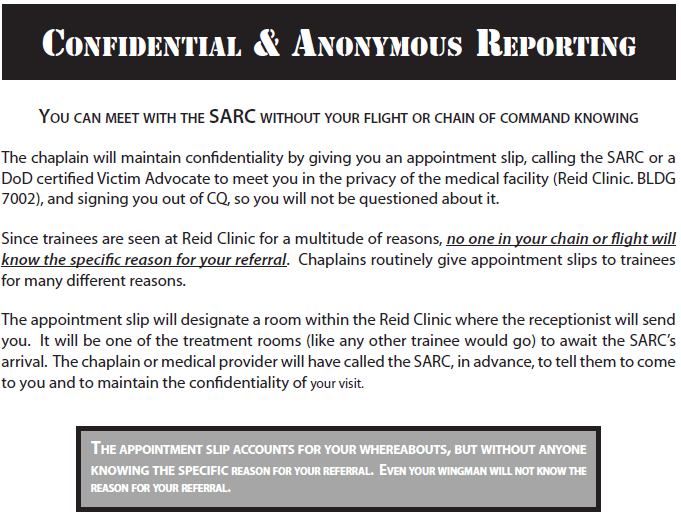
How the Confidential & Anonymous Reporting flow works:
- You can meet with the SARC without your flight or chain of command knowing.
- The chaplain maintains confidentiality by giving you an appointment slip, calling the SARC or a DoD-certified Victim Advocate to meet you in the privacy of the medical facility (Reid Clinic, BLDG 7002), and signing you out of CQ so you won't be questioned about it.
- Since trainees are seen at Reid Clinic for a multitude of reasons, no one in your chain or flight will know the specific reason for your referral. Chaplains routinely give appointment slips for many different reasons.
- The appointment slip will designate a room within Reid Clinic where the receptionist sends you. It'll be one of the treatment rooms (like any other trainee) to await the SARC's arrival. The chaplain or medical provider has called the SARC in advance to come to you and maintain confidentiality.
- The appointment slip accounts for your whereabouts without anyone - even your wingman - knowing the specific reason.
Unrestricted Reporting
You provide the details of your sexual assault or attempted sexual crime to anyone in your chain of command or any of the offices below:
- MTI
- Instructor supervisor
- Senior Enlisted Leader (SEL)
- First sergeant
- Director of Operations (DO)
- Commander
- Office of Special Investigations (OSI)
- Security Forces
- DoD SAFE Helpline
- SARC
This triggers a law enforcement investigation through Security Forces or the Office of Special Investigations (OSI). The advantage: when cases are investigated, offenders can be pursued through prosecution and held accountable - which may include being discharged from the Air Force.
Special Interest Items
Your chain of command is here to provide you with the help and support you need.
If you feel you were sexually harassed or assaulted during your recruitment, you may report it now:
- For an unrestricted report (which starts an investigation) - see your commander after this briefing.
- For a restricted report (confidential) - notify your MTI that you'd like to speak to a SARC representative.
When notifying an MTI (safety first), do not discuss any details regarding your assault. Doing so violates your confidentiality and your report immediately becomes unrestricted.
If you are a victim of a sexual crime, remember:
- The sooner you report, the greater the chances the attacker will be caught.
- Do not bathe, shower, or change clothes before being examined - these actions destroy valuable evidence.
- The first concern when a sexual assault is reported is for the well-being of the victim.
- Regardless of which type of report you choose, your needs as a victim remain the top priority.
If an MTI attempts to contact you for other than official business, refer to Trainee/Student Hotline information in the First Week Briefing. You may not have social contact with any MTI until 180 days after completing technical training
- or after being separated from the Air Force before completing entry-level training.
You're not allowed to be alone with a person of the opposite sex - another trainee or permanent party personnel. This includes opposite-sex dormitories without an MTI present, closed-door office counseling, or riding in a motor vehicle.
BMT is safe - your safety and well-being are your commander's number one priority.
Resolving and Handling Problems
The chain of command allows Air Force members to resolve problems at the lowest possible level. Always start with your supervisor (MTI) when you need help solving a problem. If your supervisor is the problem, then start at the next level in your chain.
If your chain of command does not resolve your problem, other options:
- Chaplain
- SARC
- Medical provider
- Someone else in the chain of command
Student leaders (SLs) are NOT in the chain of command. Your MTI is the first person in your chain of command.
Commander's open door policy
The commander's open door policy is designed to assist you in resolving problems. The commander and the first sergeant are always available - and you can notify an MTI (safety first) or instructor supervisor / flight commander any time you want to use the open door policy.
Student Leaders Rules of Engagement
SLs are appointed based on expected maturity and skill in helping fellow trainees accomplish tasks, as directed by your MTI.
- SLs are NOT in the chain of command. Your MTI is.
- You're welcome to discuss problems with a chaplain, SARC, medical provider, or someone else in the chain of command.
- Attempt to solve problems at the lowest level first - but if that doesn't work, let your MTI know.
Bottom line
Your health, safety, and training success is your MTI's priority. Your training is designed to be tough and stress your ability to do things you never thought you could do.
Professionalism is simple: treat everyone with respect and dignity. Break unprofessional habits NOW. Be professional even when your MTI is not around - this is the core of INTEGRITY.
Be professional at all times and do not accept unresolved unprofessional treatment from a fellow trainee - to include an SL. Report it to your MTI.
Family Care Plans
Air Force members responsible for the care of their family must make family care arrangements that reasonably cover all situations - both short and long term. The Air Force is an air, space, and cyberspace expeditionary force. We must be able to deploy at a moment's notice.
A written family care plan on file with your commander or first sergeant is required for:
- Single parents
- Dual-military couples with dependents
- Members with civilian spouses or other dependents that have unique family situations
If you fall into these categories, when you get to Technical School you'll be required to complete an AF Form 357, Family Care Certification. Notify your commander or first sergeant of any changes in your family status.
Air Force agencies that can help:
- Commander or First Sergeant
- Military & Family Readiness Center
- Child Care Centers
See your first sergeant if you have any questions about whether you need a Family Care Plan.
Worship Services
You have the right to attend the worship service of your choice. You also have the right NOT to attend religious services if that is your choice.
No one will force you to attend or prohibit you from attending worship services. Respecting everyone's right to religious freedom is essential to good order and discipline.
Trainee Hotline Phones
These phones are located in your dormitory. You're provided unrestricted access to these phones without fear of reprisal. They have a direct menu feature and no outside dialing features.
Menu Options:
- SARC Hotline
- Chaplain
Victim's Counsel
The Victim's Counsel (VC) represents your legal interests. Legal advice and assistance is confidential - your rights and privacy interests are protected. They attend interviews, hearings, and courts-martial with you.
If you need their services, contact your local VC at (210) 671-4748 / 4740.
Other resources:
- Military Personnel Section
- Staff Judge Advocate
- Financial Services Office
Maltreatment and Maltraining
Your MTIs will be tough but fair. No MTI should engage in any type of maltreatment. All training is based on required training objectives that will always be made clear to you. Verbal and physical abuse by other trainees, staff, or MTIs will not be tolerated.
- No person should use language that degrades, belittles, demeans, ridicules, or slanders anyone based on color, national origin, race, religion, age, ethnic group, sex, or physical stature.
- The use of profanity or disrespectful language is prohibited.
- Unnecessary physical contact is not authorized (no one should hit, poke, thump, push, or grab another person).
- No one should threaten to physically harm another person.
- No one should order anyone to perform degrading or humiliating tasks in the name of training.
BMT is safe - your safety and well-being is your MTI's number one priority.
Military Training Instructor Tools
MTI Tools are designed to achieve a desired behavioral change during and beyond BMT. They must be judiciously applied to uphold Air Force standards in ways that are firm, fair, and demanding.
Feedback System
In BMT, the Feedback Form is another avenue you can use to help resolve your problems. It's designed for you to voice your concerns through the Lackland AFB Form 133, Feedback Form.
- Forms are located in the BMT Course Library, Feedback Submission Form course.
- Forms are also available in the dining hall and other places around base.
- You will not be harassed, punished, or intimidated by instructors for using the feedback form.
Feedback Forms are intended to address issues - positive and negative. These forms are picked up by personnel not attached to your training squadron several times each week and allow you to communicate directly with your squadron leadership. It's one additional way to pass along issues you may have using the chain of command, the open-door policy, or hotline phone.
The Chaplain and first sergeant are also available to assist you in handling problems.
Trainees Giving Constructive Feedback
We take all feedback seriously and welcome it - we learn, develop, and improve from it. Both positive and constructive improvement feedback. To ensure feedback can be submitted without fear of reprisal, anonymous reports will remain anonymous.
When providing feedback:
- Be clear - so we can read it.
- Be constructive - think "What do I hope to accomplish?"
- Be fair / honest - your comments reflect your character, credibility, maturity, and commitment to Airmanship / Wingmanship principles.
No feedback method is better than another - use what you're most comfortable using.
Summary
This section highlighted proper conduct of training and expressed first-hand expectations for your behavior. Practice your Core Values to keep you on the right path - and be that wingman who can help others avoid the temptations that await in BMT, Tech School, and throughout their career.
The best way to succeed here and beyond is to be a team.