AF099 · Lesson 9 of 71
Memory Work and Rank Recognition
Table of ContentsShow
- Chain of Command
- U.S. Air Force Emergency Notification Signals
- Air Force Rank Recognition
- Enlisted ranks (E-1 through E-4) - Junior Enlisted / Specialist Tier
- Enlisted ranks (E-5 through E-9) - NCO and Senior NCO Tiers
- Special Enlisted Positions
- Officer ranks
- Sister Service Ranks
- Enlisted Ranks (All Services)
- Officer Ranks (All Services)
The Memory Work section is the part of BMT that you actively rehearse on a schedule. Three things to learn cold: your chain of command (by the end of Week 1), the U.S. Air Force emergency notification signals (by the end of Week 1), and the enlisted and officer rank insignias (by the end of Week 2).
You'll fill in your specific instructor team and squadron leadership during your first day at BMT. The rest of the chain - wing, group, and major-command leaders - is fixed and worth getting familiar with before you ship.
Chain of Command
Your chain of command runs from the President all the way down to your Military Training Instructor (MTI). The titles below are what you're expected to know. The names tied to each title are filled in when you arrive - you'll receive an updated roster from your MTI team during the first day of training.
Senior leadership (memorize by end of Week 1):
- President of the United States (POTUS)
- Secretary of Defense (SECDEF)
- Secretary of the Air Force (SECAF)
- Chief of Staff of the Air Force (CSAF)
- Chief Master Sergeant of the Air Force (CMSAF)
Air Education & Training Command (AETC) leadership:
- Commander, AETC
- Command Chief Master Sergeant (CCM), AETC
- Commander (CC), 2nd Air Force
- Command Chief Master Sergeant, 2nd Air Force
37th Training Wing (your training wing at JBSA-Lackland):
- Commander, 37 TRW
- Vice Commander, 37 TRW
- Command Chief Master Sergeant, 37 TRW
737th Training Group (your training group):
- Commander, 737 TRG
- Deputy Commander, 737 TRG
- Superintendent, 737 TRG
Your Training Squadron and immediate leadership (filled in at BMT):
- Squadron Commander
- Squadron Director of Operations (DO)
- Squadron Superintendent
- First Sergeant
- Section Commander
- Senior Enlisted Leader (SEL)
- Instructor Supervisor (IS)
- Military Training Leader (MTL)
- Your MTI team
You'll also be issued a trainer weapon and asked to memorize its serial number - that's a separate accountability requirement on top of the chain.
U.S. Air Force Emergency Notification Signals
The Air Force uses standardized siren tones and voice announcements to warn the base of disasters and attacks. You're required to memorize what each signal means and what to do when you hear it, by the end of Week 1.
There are three conditions you'll learn:
- Disaster Warning - a 3-to-5-minute steady tone on a siren or similar device, or a voice announcement. Indicates a disaster (tornado, flash flood, hazardous material release, wildfire) is imminent or in progress.
- Attack Warning - a 3-to-5-minute wavering tone on a siren or similar device, or a voice announcement. Indicates a hostile act (vehicle bomb, terrorist release of chemical/biological/radiological material) is imminent or in progress.
- All Clear - a voice announcement only (no siren). Indicates the immediate threat or attack has ended.
For each signal you'll need to know your individual actions: take cover, evacuate to a safe location, conduct personnel accountability, report fires/injuries/hazards, and so on.

During an actual disaster, take immediate cover; when told to do so, take the shortest possible route to your assigned shelter location.
Air Force Rank Recognition
Rank insignias identify each member of the Armed Forces. The Air Force and Space Force have two major categories - officer and enlisted - with pay grades that begin with "O" (officer) or "E" (enlisted). For enlisted ranks, the pay grade number is one more than the number of stripes on the chevron - so an E-2 (Airman) wears one stripe.
The enlisted force is divided into three tiers:
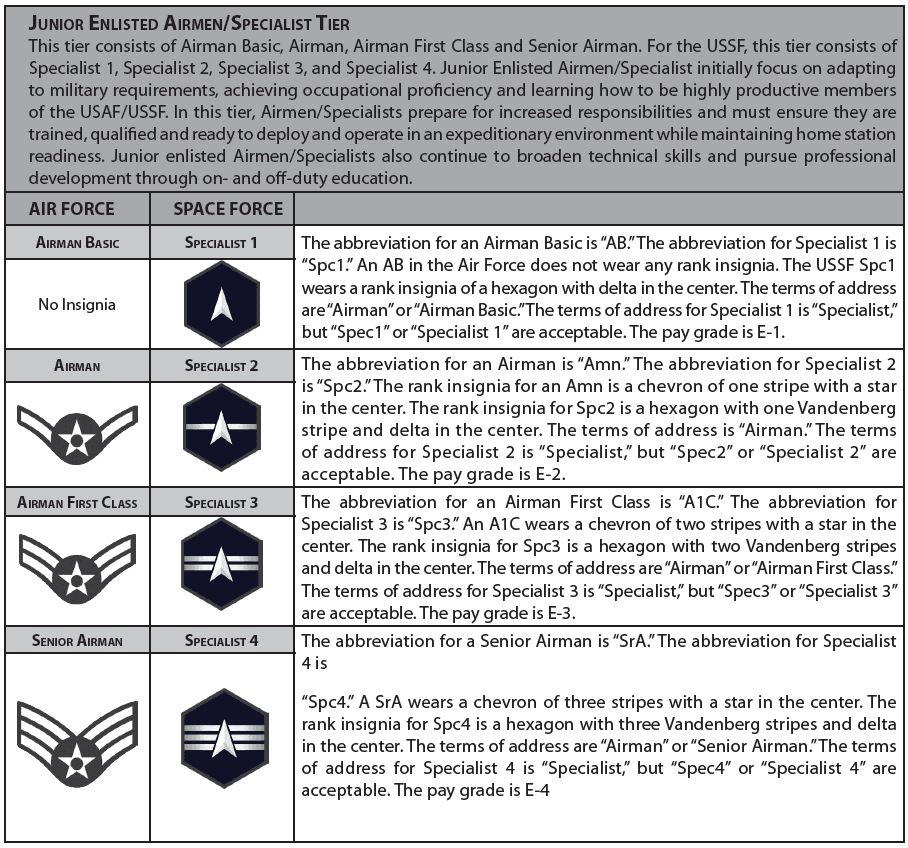
- Junior Enlisted / Specialist Tier (E-1 to E-4) - adapting to military life, achieving occupational proficiency, learning to be a highly skilled technician.
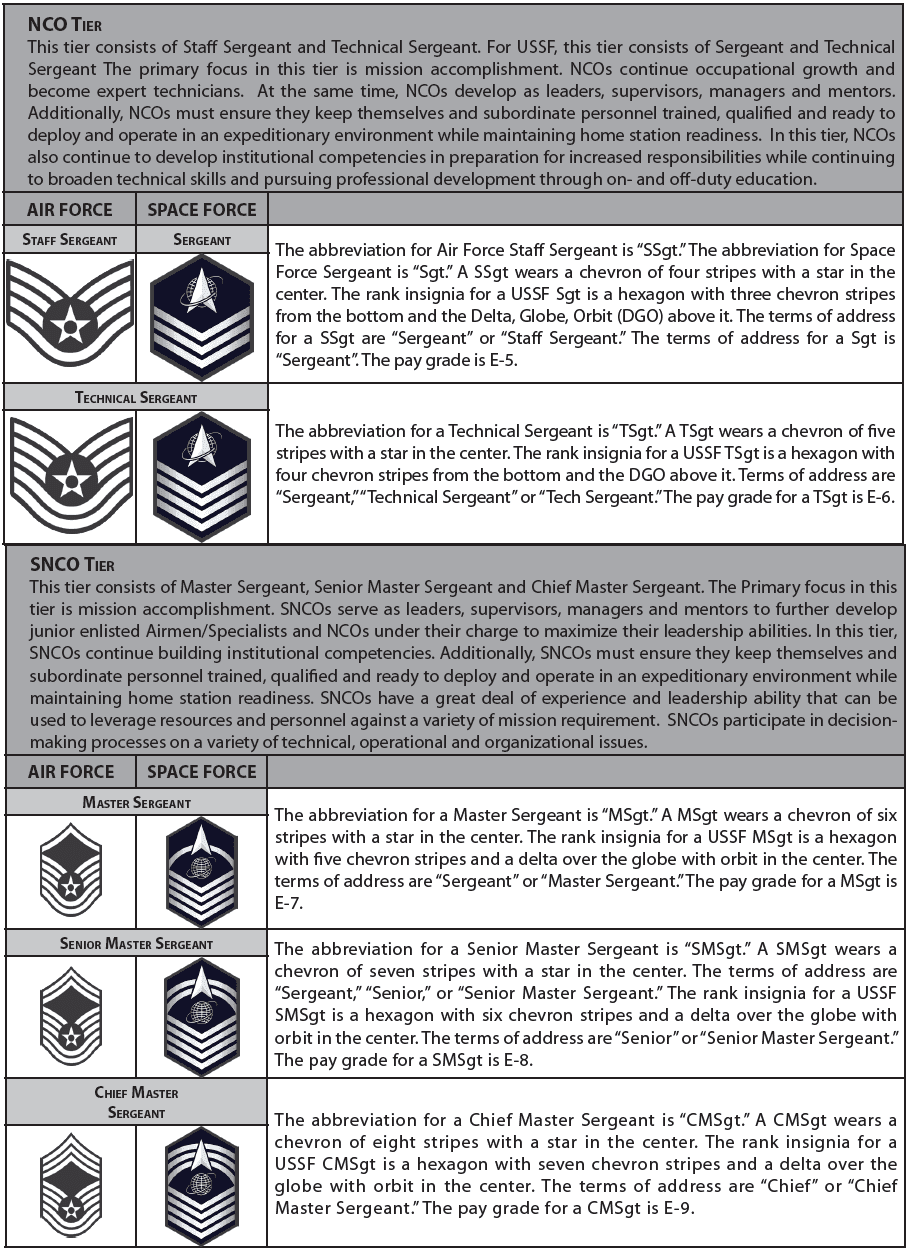
- Noncommissioned Officer (NCO) Tier (E-5 to E-6) - mission accomplishment; becoming an expert technician while developing as a leader, supervisor, and manager.
- Senior NCO (SNCO) Tier (E-7 to E-9) - broad leadership, mentoring, and resource management; serving on key decision-making processes.
For all enlisted ranks except Airman Basic / Specialist 1, the insignia is a chevron (Air Force) or a hexagon with chevron stripes and a delta-globe-orbit device (Space Force). On the service uniform the chevron has a blue background with silver stripes; on the OCP (Operational Camouflage Pattern) combat uniform, AF chevrons are spice brown and USSF insignia are subdued.
Enlisted ranks (E-1 through E-4) - Junior Enlisted / Specialist Tier
| Pay Grade | Air Force | Space Force | AF Insignia |
|---|---|---|---|
| E-1 | Airman Basic (AB) | Specialist 1 (Spc1) | No insignia |
| E-2 | Airman (Amn) | Specialist 2 (Spc2) | Chevron of one stripe with star |
| E-3 | Airman First Class (A1C) | Specialist 3 (Spc3) | Chevron of two stripes with star |
| E-4 | Senior Airman (SrA) | Specialist 4 (Spc4) | Chevron of three stripes with star |
Terms of address (E-1 to E-4): "Airman" works for any of these in the Air Force; "Specialist" (or Spec1/Spec2/Spec3/Spec4) for the Space Force.
Enlisted ranks (E-5 through E-9) - NCO and Senior NCO Tiers
| Pay Grade | Air Force | Space Force | AF Insignia |
|---|---|---|---|
| E-5 | Staff Sergeant (SSgt) | Sergeant (Sgt) | Chevron of four stripes with star |
| E-6 | Technical Sergeant (TSgt) | Technical Sergeant (TSgt) | Chevron of five stripes with star |
| E-7 | Master Sergeant (MSgt) | Master Sergeant (MSgt) | Chevron of six stripes with star |
| E-8 | Senior Master Sergeant (SMSgt) | Senior Master Sergeant (SMSgt) | Chevron of seven stripes with star |
| E-9 | Chief Master Sergeant (CMSgt) | Chief Master Sergeant (CMSgt) | Chevron of eight stripes with star |
Terms of address: "Sergeant" or the full title (Staff Sergeant, Technical Sergeant, etc.). For E-8 use "Senior" or "Senior Master Sergeant"; for E-9 use "Chief" or "Chief Master Sergeant."
Special Enlisted Positions
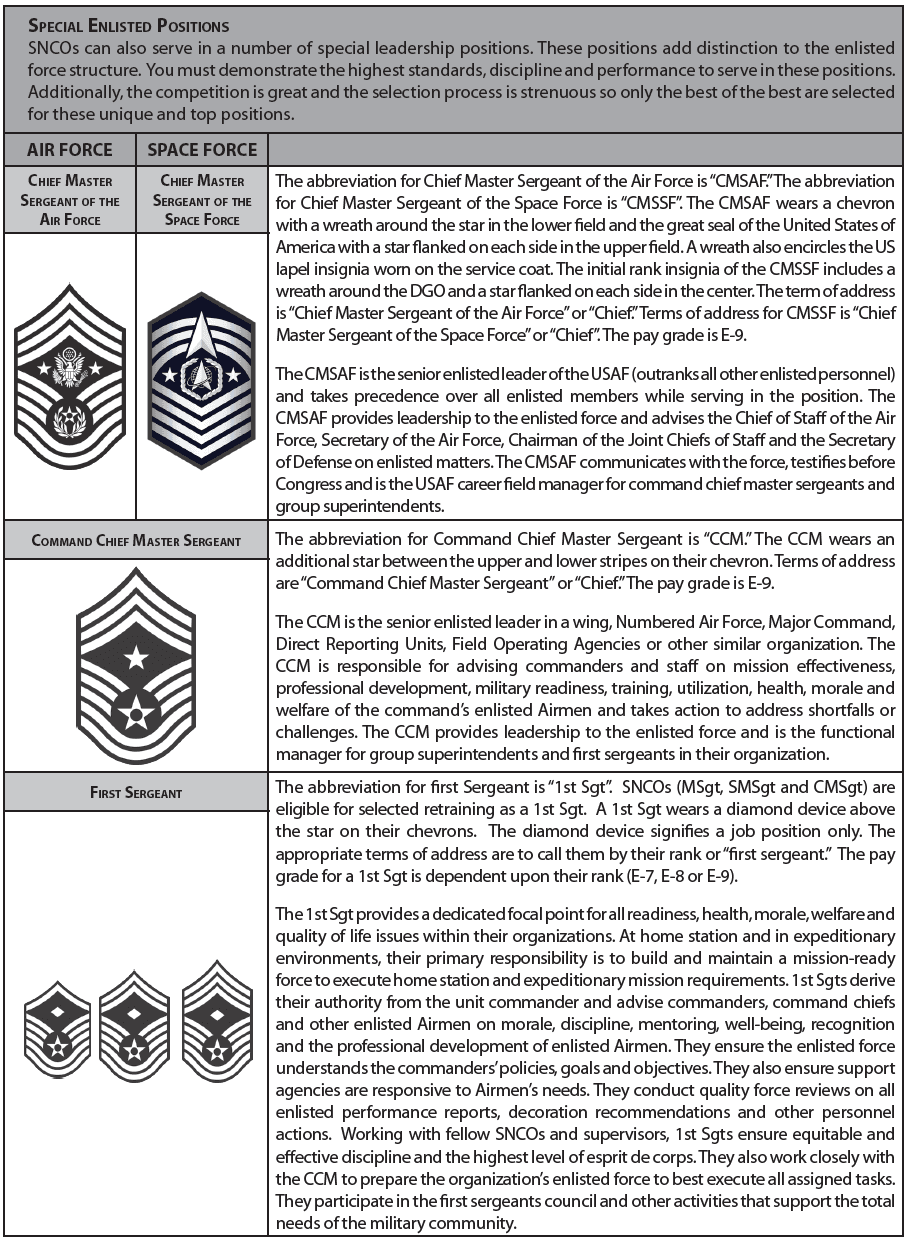
A handful of E-9s serve in distinct senior leadership roles. The insignia for each is a variation of the standard CMSgt chevron.
- Chief Master Sergeant of the Air Force (CMSAF) - the senior enlisted member of the entire Air Force. Outranks all other enlisted personnel and advises the CSAF, SECAF, Chairman of the Joint Chiefs, and SECDEF on enlisted matters. Insignia is a CMSgt chevron with a wreath around the star and the Great Seal of the United States flanked by stars in the upper field. Address as "Chief Master Sergeant of the Air Force" or "Chief." Pay grade E-9.
- Chief Master Sergeant of the Space Force (CMSSF) - the USSF equivalent. Hexagon insignia with a wreath around the DGO and a star on each side.
- Command Chief Master Sergeant (CCM) - the senior enlisted leader in a wing, Numbered Air Force, Major Command, Direct Reporting Unit, or similar organization. Advises the commander on mission effectiveness, professional development, military readiness, and morale of the command's enlisted Airmen. Insignia is a CMSgt chevron with an additional star between the upper and lower stripes. Address as "Command Chief Master Sergeant" or "Chief." Pay grade E-9.
- First Sergeant (1st Sgt) - a job position (not a rank) filled by a selected MSgt, SMSgt, or CMSgt. Provides the focal point for readiness, health, morale, welfare, and quality-of-life issues within an organization. Insignia is the standard chevron for the member's rank with a diamond device above the star. Address by rank or "first sergeant." Pay grade matches their rank (E-7, E-8, or E-9).
Officer ranks
Commissioned officers exercise command over military units. To become an officer in the USAF or USSF you need at least a bachelor's degree (some specialties - medical, civil engineering - require specialized degrees). Commissioning paths include the Air Force ROTC program, the Air Force Academy, and Officer Training School (OTS).
On the service uniform, the rank insignia is a metal device worn on the epaulets. On OCP combat uniforms the insignia is spice brown - except First Lieutenant and Lieutenant Colonel insignias, which are black for visibility.
Officers are organized into four categories.
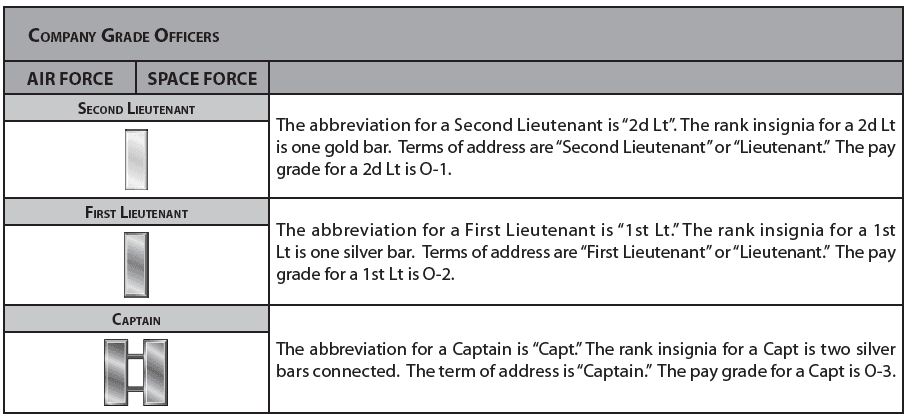
Company Grade Officers (O-1 to O-3)
| Pay Grade | Rank | Abbreviation | Insignia |
|---|---|---|---|
| O-1 | Second Lieutenant | 2d Lt | One gold bar |
| O-2 | First Lieutenant | 1st Lt | One silver bar |
| O-3 | Captain | Capt | Two silver bars connected |
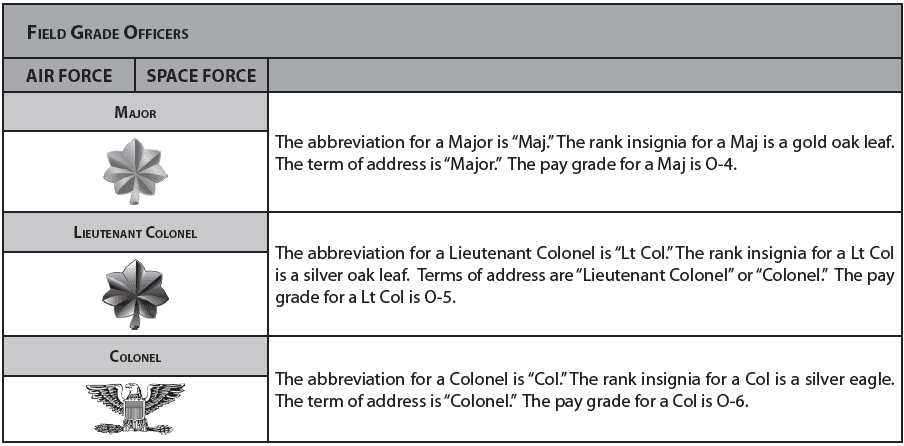
Field Grade Officers (O-4 to O-6)
| Pay Grade | Rank | Abbreviation | Insignia |
|---|---|---|---|
| O-4 | Major | Maj | Gold oak leaf |
| O-5 | Lieutenant Colonel | Lt Col | Silver oak leaf |
| O-6 | Colonel | Col | Silver eagle |
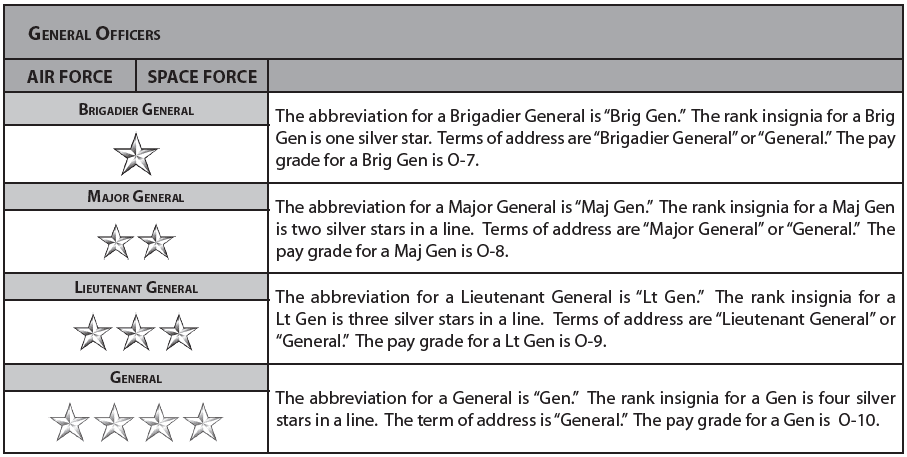
General Officers (O-7 to O-10)
| Pay Grade | Rank | Abbreviation | Insignia |
|---|---|---|---|
| O-7 | Brigadier General | Brig Gen | One silver star |
| O-8 | Major General | Maj Gen | Two silver stars in a line |
| O-9 | Lieutenant General | Lt Gen | Three silver stars in a line |
| O-10 | General | Gen | Four silver stars in a line |
Terms of address for officers: Use the full rank or its short form ("Lieutenant" for 1st/2nd Lt, "Colonel" for Lt Col or Col, "General" for any flag-rank officer).
Special Officer Positions
- Chaplain - addressed as "Chaplain" regardless of rank. May also be addressed by traditional or denominational titles (Father, Rabbi, Imam, etc.). Chaplain insignia varies by religion.
- Doctor - addressed by their military rank or "Doctor."

Sister Service Ranks
You'll cross paths with members of all the U.S. military branches at JBSA-Lackland and throughout your career. Rank insignias are standardized in pay grade (E-1 through E-9 enlisted, O-1 through O-10 officer), but the symbols and titles each service uses differ. The two charts below give you the full picture across the Army, Marine Corps, Navy, Air Force, Space Force, and Coast Guard - useful for rendering correct courtesies and identifying who you're addressing when you're outside the Air Force.
Enlisted Ranks (All Services)

Officer Ranks (All Services)

The pay-grade column is your anchor - once you can map a rank to its grade, you know how it compares to ranks in other services even if the title differs (e.g., a Navy Petty Officer Second Class is E-5, the same grade as an Air Force Staff Sergeant or an Army Sergeant).