AF099 · Lesson 13 of 71
MTI's First Week Briefing
Table of ContentsShow
- Overview
- Air Force Core Values
- Integrity First
- Service Before Self
- Excellence In All We Do
- Airman's Foundational Competencies
- Developing Self
- Developing Others
- Developing Ideas
- Developing Organizations
- BMT Measurements
- Weekly Core Value Rating (CVR)
- Training Objectives
- BMT Honor Graduate Program
- Appointments
- General Rules
- Accountability checks
- Sign Out and Sign In
- Routine Medical Appointments and Emergency Medical Care
- Types of Appointments
- Flag Conditions
- Heat-Related Illness and Injury
- Heat Cramps (mild)
- Heat Exhaustion (severe)
- Heat Stroke (most severe)
- What to do if you or another trainee shows any of these signs
- Risk Management
- Marching Procedures
- General rules
- If a trainee gets sick or injured while marching without an MTI
- Crossing intersections, roadways, and driveways
- Crossing walkways and bridges
- Hours of darkness
- Marching in Units
- Emergency Management Program
- Natural Threats
- Man-Made Threats
- General Instructions
- MEDEVAC Procedures - Code Blue (Critical Emergency)
- Feedback Form
- Student Leader Rules of Engagement
- Your immediate chain of command
- Other accessible BMT support personnel
- Where Student Leaders fit in
- General SL Rules
- Dorm Chief (DC) Responsibilities
- Element Leader (EL) Responsibilities
- SL Reports
- Your responsibilities to your fellow flight members
- Accessing Sexual Assault Counselors Anonymously
- Trainee Hotline Phones
- Summary
This is the longest briefing of your first week, and for good reason - it covers the framework you'll be measured against for the rest of training (Core Values, Foundational Competencies), the rules for going anywhere on your own (appointments, marching, road guards), and what to do when conditions change (flag conditions, heat illness, emergency management). Until now you couldn't go anywhere without your flight; after this briefing you can travel to appointments and other locations with just a wingman at the right times.
Overview
Objective: Demonstrate and connect with members of the Air Force team through Basic Military Training indoctrination.
Learning Outcomes
- Identify the three Air Force Core Values and the values under each.
- Understand the BMT Measurements, BMT graduation requirements, and the Honor Graduate Program.
- Outline the rules and procedures for appointments.
- Recognize the five flag conditions and where to find them.
- Understand the concepts of Risk Management and the Emergency Management Program.
- Recall basic facts about marching responsibilities and positioning.
- Identify basic facts and the purpose of the Feedback Form.
- Understand the Student Leaders' rules of engagement.
- Recall how to access sexual assault counselors anonymously, plus the use of the Trainee Hotline.
Foundational Competencies
- Accountability - Accepts full responsibility for self and team; displays honesty and truthfulness.
- Change Management - Adapts, helps others adapt, or implements change to keep unit goals aligned with the desired end state.
- Resilience - Negotiates, manages, and adapts to significant sources of stress or trauma.
Summary
- Air Force Core Values
- Airman's Foundational Competencies
- BMT Measurements
- BMT Honor Graduate Program
- Appointments
- Flag Conditions
- Risk Management
- Marching Procedures
- Emergency Management Program
- Feedback Form
- Student Leader ROEs
- Accessing Sexual Assault Response Coordinator Anonymously
- Trainee Hotline Phones
Air Force Core Values
The Air Force Core Values are the heart of how Airmen behave - the backbone of military discipline and the foundation of how the Air Force interacts with itself and the public to fulfill its mission. The three Core Values are:
- Integrity First
- Service Before Self
- Excellence In All We Do
Behavior - not stated belief - is what proves the presence or absence of these values.
Integrity First
The willingness to do what is right even when no one is looking. Integrity is the foundation for every other value and the cornerstone of trust. It's the single most important part of character - as much a part of an Airman's professional reputation as their ability to fly, fight, and win.
Integrity isn't a suit you take off at night or on weekends, or wear only when you need to look good. People judge Airmen by their actions. A person of integrity acts on conviction with self-control, without acting rashly.
The values that promote Integrity First:
- Courage - Do what is right even when the personal cost is high.
- Honesty - Your word must be your bond.
- Responsibility - Acknowledge your duties and act accordingly.
- Accountability - Never shift blame to others or take credit for others' work.
- Justice - Similar actions get similar rewards or similar punishments.
- Openness - Encourage free flow of information; seek feedback from all directions.
- Self-respect - Respect yourself as a professional and a human being.
- Humility - Be sobered by the awesome task of defending the Constitution.
Service Before Self
Your commitment to the security of this nation, the preservation of freedom, and the values we believe in must take precedence over your personal desires.
Service Before Self is selfless dedication to duty - at all times, in all circumstances, including putting your life at risk if called to do so. It means accepting deployments and assignments without scheming for face time while others do the mission.
Service Before Self does not mean service before family. Airmen have a duty to their family as strong as their duty to the Service. The difference is that the Service and Nation will sometimes require you to be away from home - and your responsibility to your family includes preparing and providing for them when you're deployed or otherwise on duty.
The values associated with Service Before Self:
- Rule Following - Duty is most commonly expressed through rules.
- Respect Others - Always act on the certain knowledge that all people possess fundamental worth as human beings.
- Maintain Discipline and Self-Control - Strike a tone of confidence and forward-looking optimism for the people you lead.
- Refrain from Anger - Apply reasoning and understanding; refrain from expressing hostility in the work environment.
- Control Appetites - Don't let desire for temporary pleasure cloud your judgment. Sexual overtures toward subordinates, excessive alcohol, and similar behaviors cast doubt on your ability to lead.
- Practice Religious Toleration - Worship, or not, is an individual choice. No one should force their religious views on another. Public prayer (outside special ceremonies), evangelizing, proselytizing, or overtly religious messages in official communications can be divisive - be professional and respectful.
- Have Faith in the System - To lose faith is to place self before service.
Excellence In All We Do
Demands that Airmen constantly strive to perform at their best. Continuous self-improvement plus innovation in how the mission gets done is what propels the Air Force into a long-term upward spiral of accomplishment.
Excellence shows up across several dimensions:
- Product or service excellence - Focus on services and products that fully respond to and anticipate customer needs.
- Personal excellence - Seek out and complete Professional Military Education (PME); stay in good physical and mental shape.
- Community excellence - Members of an organization working together toward a common goal.
- Mutual respect - Viewing others as having fundamental human worth.
- Benefit of the doubt - Reserving judgment until you have the whole story.
- Resources excellence - Aggressively implementing policies for the best possible cradle-to-grave resource management.
Airman's Foundational Competencies
There are 24 Airman's Foundational Competencies that apply to every Airman - Officer, Enlisted, or Civilian. A competency is a combination of knowledge, skills, abilities, and other characteristics that show up as an observable, measurable pattern of behaviors.
The 24 competencies are grouped into four categories.
Developing Self
- Accountability - Demonstrates reliability and honesty; takes responsibility for self and team.
- Perseverance - Displays grit toward difficult long-term goals; works through failure, adversity, and plateaus.
- Communication - Effectively presents and prioritizes ideas through active listening, clear messaging, and audience-appropriate delivery.
- Decision Making - Makes well-informed, timely decisions that weigh constraints, risks, and benefits.
- Information Seeking - Curious; eager and aggressive learner who wants to know more.
- Flexibility - Adapts to and works with a variety of situations, individuals, and groups.
- Resilience - Negotiates, manages, and adapts to significant stress or trauma.
- Initiative - Does more than is required; acts appropriately without prompting.
- Self-Control - Keeps emotions under control and restrains negative actions under stress.
Developing Others
- Teamwork - Collaborates effectively to achieve a common goal.
- Develops People - Invests in others through feedback and learning opportunities.
- Service Mindset - Desires to help or serve others; focuses efforts on meeting others' needs.
- Leadership - Inspires, builds, and sustains motivation and morale to accomplish the mission.
- Fosters Inclusion - Creates a culture where every member can make their fullest contribution.
Developing Ideas
- Analytical Thinking - Identifies problems, evaluates alternatives, and recommends courses of action.
- Digital Literacy - Uses technology to identify, evaluate, and synthesize data; manages digital content responsibly.
- Creative Thinking - Develops new insights into new situations; questions conventional approaches.
- Fostering Innovation - Builds a culture that encourages, champions, and rewards creativity and informed risk-taking.
- Influence - Persuades, convinces, or impresses others to elicit support.
Developing Organizations
- Resource Management - Carefully and responsibly administers resources to maximize readiness and lethality.
- Results Focused - Demonstrates concern for working well or competing against a standard of excellence.
- Change Management - Adapts, helps others adapt, or implements change to align with the desired end state.
- Strategic Thinking - Considers and organizes activities and resources to achieve a desired goal - large and small scale, long and short term.
- Precision - Concern for order, quality, and accuracy with an underlying drive to reduce uncertainty.
BMT Measurements
BMT spans 7.5 Weeks of Training (WOT). You're evaluated in two key areas across that time.
Weekly Core Value Rating (CVR)
A weekly score for behavior, performance, and overall ability to adapt to military life - measured against the Core Values and Foundational Competencies. Each week you'll receive:
- S - Satisfactory rating, or
- U - Unsatisfactory rating (you'll be counseled on the deficiency).
Training Objectives
You're trained and evaluated against several specific objectives:
- First and Second Issue Recruit Living Area (RLA)
- Tactical Combat Casualty Care (TCCC) and Foundational Airman Skills Training (FAST)
- Combat Skills; Chemical, Biological, Radiological, and Nuclear (CBRN) training; Combat Arms Tactics and Maintenance (CATM) live-fire
- Individual Drill Movements, Reporting Procedures, Rank Recognition, Rendering Courtesies, Dress and Appearance, Physical Training (PT), Trainer Weapon, and the End of Course (EOC) Written Test
BMT Honor Graduate Program
The Honor Graduate program is grade- and point-based. Recognition includes a distinctive ribbon (only earned in BMT) and a certificate. Only the top 10% of graduates are selected.
To compete:
- Receive a satisfactory grade on every trainee performance area: Recruit Living Area (RLA), Core Values, M-4 Trainer Weapon, Drill Movements, Military Skills Development, FAST, Dress and Appearance, and Tactical Combat Casualty Care (TCCC).
- RLA evaluation is based on item failures and points - fewer failures means more points.
- Complete CBRN, CATM, and PACER FORGE.
- Score 90% or higher on the EOC Test.
- Meet or exceed Air Force standards on the PT evaluation.
Appointments
General Rules
Before going on an appointment, you (or the person in charge) must have one of:
- AETC IMT 50, Appointment Slip
- AF Form 490, Medical/Dental Appointment Slip
- Any other issued appointment slip
Only permanent party personnel can sign an appointment slip. You may only stop at the buildings listed on the slip. While on an appointment, don't use vending machines, pay phones, or government phones unless given specific permission.
You must carry the following on every appointment:
- Military ID
- Backpack with hydration source (worn or carried)
- Flashlight
- Reflective belt
Uniform: uniform of the day during duty hours; OCP uniform after duty hours. PT gear is allowed only if you're taken to a medical facility by ambulance during PT.
Accountability checks
You must conduct accountability checks every 2 hours by notifying the squadron CQ to update your status / location. The check is extended to 3 hours when you attend a religious service with a follow-on religious education event.
Sign Out and Sign In
Before leaving the squadron area, sign out in the eBMT automated appointment / trainee tracking log to record your location. Use only black or blue ink. Don't fill in the last two columns until you return.
Routine Medical Appointments and Emergency Medical Care
Don't be afraid to ask to go to sick call. If you're sick or injured, let your MTI know so they can ensure you get proper care. If a flightmate is sick or injured, inform your MTI.
- Weekday sick call: Satellite Dispensary, hours and building posted at your squadron.
- Saturday sick call: Reid Clinic (BLDG 7002), hours posted at your squadron.
- After dark return: call the CQ before departing the Medical Treatment Facility.
- Emergency medical care: available 24/7. Notify your MTI (safety first) or CQ - they'll call an ambulance.
When going to sick call, take:
- Military ID card
- Backpack
- Hydration source
- Flashlight (after dark)
- Reflective belt
- Unused / expired prescription medications
- Personal hygiene items
- Money and Pay Card
- Shower shoes and running shoes (only if you have foot problems)
Types of Appointments
Medical
When you return from a medical appointment, return your medical records (if applicable) and sign back in. Immediately show your MTI or the CQ any paperwork or medications you receive - but don't leave documents on your MTI's desk. Comply with your waiver instructions; if directed to do something that conflicts with your waiver, report it to your MTI immediately.
Eye / Eyeglasses
For eye problems or glasses issues, inform your MTI. Eye appointments go to Reid Clinic Optometry Section, BLDG 7002, Monday through Friday during posted hours. Wear your civilian glasses until your issued glasses arrive - you'll need a waiver to wear civilian glasses in place of issued glasses.
Dental
For dental problems, inform your MTI. Routine dental sick call:
- Weekdays: 0700-1030 and 1200-1430, BLDG 6418, Dunn Dental Clinic.
- After hours / weekends / holidays: report to your MTI or CQ to be sent. Care provided at BLDG 4602, MacKown Dental Clinic.
If your shuttle bus wait exceeds 30 minutes, contact your CQ for transportation advice.
Flag Conditions
Flag conditions are dictated by the Wet Bulb Globe Temperature (WBGT) - a heat index used to determine activity restrictions. There are five flag colors, each tied to a temperature range and specific guidance for trainees.
Where flags are posted: near all drill pads, under the overhang of all Recruit Housing & Training (RH&T), at the Airmen Training Complex (ATC), the Pfingston Reception Center (BLDG 6330), and BMT HQ (BLDG 6420). Flags may also appear at Airey Processing Center (BLDG 5725), Reid Health Clinic (BLDG 7002), and the Mini-Mall (BLDG 7037).
Your MTI guides physical activity based on flag conditions to keep you hydrated and safe.
| Flag | WBGT (°F) | Affects | Guidance |
|---|---|---|---|
| White | 78-81.9° | 2 WOT & below | Supervise closely. |
| Green | 82-84.9° | 2 WOT & below | Supervise closely. |
| Yellow | 85-87.9° | 2 WOT & below | Drill & PT under overhang. |
| 3 WOT & above | Continue details using work/rest cycle. Monitor PT closely. | ||
| Red | 88-89.9° | All WOT | Drill & PT in covered area using work/rest cycle. |
| 3 WOT & below | Continue details using work/rest cycle. | ||
| 4 WOT & above | May conduct fire drills (monitor closely). | ||
| Black | 90° & above | All WOT | NO PT; drill in covered area using work/rest cycle. |
| 4 WOT & above | May conduct fire drills (monitor closely). | ||
| 4 WOT & below | Details in covered area using work/rest cycle. | ||
| 5 WOT & above | Continue details using work/rest cycle. |
Heat-Related Illness and Injury
Three levels of heat illness, in order of severity:
Heat Cramps (mild)
Spasms in the leg or arm muscles caused by loss of salt during strenuous exercise.
Treatment:
- Cold water with salt or electrolyte mix.
- Move the victim to a cool place and let them rest.
Heat Exhaustion (severe)
Signs include fatigue, weakness, profuse sweating, rapid pulse, dizziness, nausea, and headache. Usually preventable through good hydration and meals (with electrolytes). The most common heat-related illness.
Heat Stroke (most severe)
If someone exercising develops altered mental status, this is a sign of heat stroke. It's a true medical emergency. The person may be confused, disoriented, agitated, have slurred speech, or pass out.
What to do if you or another trainee shows any of these signs
- Notify an MTI or any other permanent party member immediately.
- If possible, get the victim into a shaded area and send a runner for help. If alone, yell for help. Do not administer first aid.
- If you don't feel well yourself, notify an MTI (safety first).
Risk Management
Risk Management (RM) is the Air Force's approach to safety in everything it does. The guiding principles:
- Accept no unnecessary risk.
- Make risk decisions at the appropriate level.
- Accept risk when the benefits outweigh the costs.
- Integrate RM into operations and planning at all levels.
- Apply the process cyclically and continuously.
RM is a five-step decision-making process:
- Identify the hazards.
- Assess the hazards.
- Develop controls and make decisions.
- Implement controls.
- Supervise and evaluate.
In BMT, the Dorm Chief (DC) serves as the RM and Ground Safety Representative for the flight. The DC attends all risk management meetings with squadron leadership and reports all hazards to an MTI or supervisory personnel.
Marching Procedures
You'll march in formation everywhere you go. Sizes vary, but the general rules are constant.
General rules
- Use walkways and bridges when available.
- Never march in the street. Avoid routes without sidewalks or walkways.
- March against the direction of vehicular traffic when possible.
- Stay clear of construction sites.
- When two or more trainees march together, stay two abreast.
- Be properly sized.
- March at the position of attention and follow appropriate work / rest cycles for heat.
- Stay in step with each other.
- Use appropriate cadence and drill commands.
If a trainee gets sick or injured while marching without an MTI
- Stop a passing vehicle and ask for assistance.
- Send a runner to the nearest building for help.
- Stay with the trainee until help arrives.
Crossing intersections, roadways, and driveways
- Halt and check for traffic before entering.
- If equipped with a crosswalk signal, the person in charge pushes the button. If alone, push it yourself.
Crossing walkways and bridges
For Luke Boulevard or Selfridge Avenue walkways: march at ease, column of twos. Don't reform until completely across.
For all other Warrior Airman Walkways and bridges: march at the position of attention.
Hours of darkness
- Travel in a group of two or more.
- Two trainees of the opposite sex never march alone, regardless of time of day.
- Trainees on the left side of the formation carry their flashlights in the left hand; trainees on the right side carry them in the right hand.
- Carry your flashlight and wear your reflective belt if it's dark or might be dark by the time you return.
Marching in Units
The trainee in charge is responsible for command, control, and safety. Procedures vary by unit size.
Units of 4 or fewer trainees (a "Detail")
- Form up in column formation, two abreast.
- The entire unit salutes officers and staff cars.
- Stop at all intersections, roadways, and driveways; the trainee in charge checks for traffic before proceeding.
- Road guards are not required. The trainee in charge remains part of the unit while marching through the intersection.
Units of 5-12 trainees in two elements (a "Flight")
- The trainee in charge marches at the rear and outside of the unit, even with the last rank, on the side of nearest traffic or hazard.
- Salute officers and staff cars for the unit.
- At intersections, roadways, and driveways:
- Halt the unit.
- March to the edge of the roadway and check for traffic.
- Once clear, post in the center of the roadway to stop traffic. Raise arms to stop traffic if necessary.
- Once traffic stops, assume position of attention and perform facing movements to face the unit.
- Give the command "FORWARD, MARCH".
- As the unit moves through, perform facing movements to keep the unit in your line of sight to monitor hazards.
- Once the entire unit clears, give "FLIGHT, HALT" then "COVER".
- Rejoin the flight in the appropriate position and proceed.
Units of 13 or more trainees in two elements (a "Flight")
Same procedures as 5-12 trainees, plus road guards at intersections, roadways, and driveways:
- After halting the unit, determine how many road guards you need to cover the lanes of traffic and confirm they know where to post.
- After checking traffic and posting in the center of the roadway, give "ROAD GUARDS OUT".
- For two lanes:
- Front road guards double-time into the street, centered in their respective lanes, facing oncoming traffic.
- Road guards assume position of parade rest with one arm extended, palm facing traffic. (After dark: an operational flashlight in that hand, light pointing down.)
- Once posted, give "FORWARD, MARCH".
- As the unit moves through, the rear road guards double-time into the street and tap the front road guards on the shoulder to relieve them.
- The relieved (front) road guards double-time to the front of the unit and resume position.
- After the unit clears, give "FLIGHT, HALT, COVER" then "ROAD GUARDS IN".
- Rear road guards double-time to their original position.
- For three or four lanes:
- Before "ROAD GUARDS OUT," move one or both rear road guards to the front to join the front road guards.
- On "ROAD GUARDS OUT," all front road guards double-time into the street, centered in their lanes, facing oncoming traffic.
- Use the same positioning and marching procedures as for two lanes.
- On "ROAD GUARDS IN," all road guards double-time to their original positions.
If a vehicle fails to observe RM, report it to your MTI or supervisory personnel with as much detail as possible: time, location, vehicle description, license plate, and a description of the violation.
Emergency Management Program
The "Be Ready" training aid (U.S. Air Force Emergency Notification Signals) is posted on the dormitory bulletin board and in the Communication and Military Skills (Block 1) Memory Work module of the Learning Management System (LMS). You memorize the signals by the end of 1 WOT.
Potential threats in the San Antonio area include both natural and man-made hazards.
Natural Threats
Severe Thunderstorms / Lightning
If outdoors, seek shelter immediately. If you can't get indoors, avoid metal objects, get to an open space, and squat low to the ground as quickly as possible. Do not seek shelter under a tree. All walkways and bridges are off-limits during lightning storms.
Tornadoes
If outdoors, seek shelter immediately. If you can't get indoors, go to the lowest-lying area you can find (culvert, ditch). In the squadron area, go to your shelter - any "A" level RH&T dormitory, Level II ATC dormitory, or designated classroom. Out of the squadron area, find the nearest permanent concrete structure and shelter in an inner-most room with the fewest or no windows until "all clear" is declared. Once clear, assist injured personnel within your abilities and seek help as needed.
Heavy Winds / Rains and Flash Floods
Seek shelter immediately. Stay out of low-lying areas and avoid low-water crossings.
Earthquakes
San Antonio occasionally experiences low-magnitude earthquakes (less than 4.0). If outdoors, move away from buildings, streetlights, utility wires, and trees. If indoors, stay away from glass, windows, outside doors and walls, and anything that could fall (light fixtures, tall file cabinets, furniture).
Wildfires
The most likely place you'd be threatened by a wildfire while at BMT is the combat skills training site. Don't try to fight the fire. Leave the area in an upwind or crosswind direction and stay out of the smoke or fire path. If possible, notify an MTI (safety first), squadron personnel, or fire department of the location, then proceed to a safe location for accountability.
Geomagnetic Storms
Disturbances mainly affect electrical systems, communications, technological systems, and critical infrastructure. Effects may last hours to several days. Your MTI or squadron personnel will direct you per 502 ABW guidance.
Man-Made Threats
HAZMAT Spills
Possible anywhere chemicals are stored or transported (squadron HAZMAT storage area, chemical closet, PT Supply office). If outdoors near a spill, move upwind or crosswind. If indoors and the spill is outside, stay indoors and evacuate only if directed by your MTI, squadron personnel, or emergency responders.
Active Shooter (AS) and Lockdown
A lockdown is a security measure that confines and restricts movement on the installation. No one enters or exits until "all clear" is broadcast, unless movement is required to escape.
The three primary response options against an active shooter (in no particular order) are:
- Escape. A viable option if not directly confronted with the shooter. Consider all points of egress (windows, doors). Be aware of threats, be ready to fight, and notify others.
- Barricade. Brace with heavy objects. Stay quiet, observe noise discipline, silence electronic devices. Contact emergency services if possible. Hide in a place that reduces observation by the shooter. Develop a strategy to fight in case you can't prevent entry.
- Fight. Fight back when it offers the best chance of survival.
The decision is based on proximity to the shooter and accessibility of routes. Follow any instructions from your instructor, leadership, first responders, or the base "giant voice" system.
Aircraft Accidents
JBSA installations have active flying operations - Kelly Field, adjacent to JBSA-Lackland, has training, tactical, and mobility aircraft over the area. If you witness an aircraft accident, report the location to your MTI or squadron personnel. If the accident is near you, move away from the crash site and any hazards, going upwind or crosswind of any smoke.
Terrorist Use of Weapons of Mass Destruction (WMD)
JBSA prepares the installation through education and exercises. Your MTI or squadron personnel will direct you on actions and measures. Listen for emergency notifications and follow the directions provided.
General Instructions
During any emergency, follow directions from emergency responders, your MTI, or squadron personnel. If you're outside the squadron area when something happens, have a permanent party person contact your CQ as soon as it's safe to inform them of your location.
MEDEVAC Procedures - Code Blue (Critical Emergency)
During PT, an Independent Duty Medical Technician (IDMT) decides whether an incident is a critical emergency. If it is, the IDMT calls a Code Blue.
The IDMT directs the PT Supply NCO (or other designee) to signal Code Blue by engaging the air horn for at least 20 seconds. All personnel clear the track / PT pad, form up at a designated location, and return to the ATC / RH&T immediately. You may need to come back later to retrieve gear. Squadron leadership and the PT Supply NCO stay on scene to assist the IDMT.
Feedback Form
You have the right to fill out the Lackland AFB Form 133, Feedback Form at any time.
Where to find them:
- Electronic versions in the LMS Library as Feedback Submission Forms.
- Blank forms in dorm stairwells, the DFAC, and other places around base.
Feedback Forms address issues - positive or negative - or pass along ideas that may improve BMT. They give you another way to communicate with squadron leadership for help with concerns. You may submit anonymously.
Disclaimer: The LMS and feedback drop-off boxes are not monitored 24/7. If you need immediate help, contact someone in your chain of command (MTI, Instructor Supervisor, Flight Commander, First Sergeant, Charge of Quarters) or any permanent party personnel.
Student Leader Rules of Engagement
Student Leaders (SLs) are appointed based on expected maturity, resilience, communication and social skills, emotional stability, energy, teamwork, and ethical values.
A few facts to anchor everything:
- SLs are not in the chain of command.
- Your MTI is the first person in the chain of command for every flight member, regardless of position.
- SLs are equal in rank to all other trainees - until graduation.
Your immediate chain of command

SLs assist the MTI by carrying out and following up on specific tasks. But all trainees have equal access to go to the MTI directly with concerns about training. You are expected to go to the MTI directly if you observe or experience Trainee Rules of Conduct violations - like profanity, bullying, or unwanted touching. You do not need to go through SLs for these violations.
Other accessible BMT support personnel
You always have access to anyone in the chain of command, may use the feedback system, and may seek assistance from support personnel at any time.

No SL or flight member may discourage you or retaliate against you for reporting.
Integrity is the highest of the Air Force Core Values. Uphold it at all times - including times when the MTI isn't present. SLs may be rotated to give other trainees a chance to demonstrate their skills, or to remove a SL who isn't meeting expectations. SLs are immediately removed from their position for any Core Value breach or abuse of position.
Where Student Leaders fit in

General SL Rules
- SLs treat every trainee with dignity and respect at all times, and remind fellow trainees to do the same.
- SLs help flight members accomplish tasks, answer questions about details, and resolve conflict at the lowest possible level (personality conflicts, teamwork challenges, forming cliques).
- SLs are not MTIs and are not in the chain of command - flight members do not go through SLs to speak with the MTI.
- SLs do not pull 341s or apply MTI Tools. SLs report all Trainee Rules of Conduct infractions to the MTI or supervisory personnel.
Dorm Chief (DC) Responsibilities
- Carry out duties assigned by the MTI with the Element Leaders (ELs), modeling professional behavior - professional language, good wingman conduct, positive / encouraging attitude, and treating everyone with respect.
- Maintain flight professionalism and order in the MTI's absence, and supervise academic / auditorium classes when no MTI is present.
- Brief the flight on instructions and information from the MTI, form the flight as instructed, and supervise dorm and outside-area cleaning.
- Ensure flight members always have a wingman and apply the wingman concept.
- Take roll before all academic classes.
- Before each hour of instruction, give the instructor: number of trainees assigned, number absent, roster numbers of missing trainees, and their locations.
- Use positive means to motivate, encourage, and assist fellow trainees with assigned tasks (RLA setup / maintenance, individual and flight marching, academic progress, accountability).
- Refer flight members to the MTI or supervisory personnel when you can't adequately respond to their questions or problems.
- Report problems or violations of Trainee Rules of Conduct to the MTI or supervisory personnel.
- Ensure all flight members are present or accounted for before lights out. Notify the MTI, CQ, or supervisory personnel immediately if a trainee is missing.
- Inform the flight of special events and report planned attendance.
- Attend scheduled DC meetings with squadron leadership.
- Report dormitory damage and / or hazards to the MTI.
- Be briefed on responsibilities for unacceptable conduct, the wingman concept, marching units / pedestrian risk management, dormitory security, risk management, and hygiene.
- Report any trainer weapon safety violations to the MTI.
- Immediately report any trainer weapon or accountability discrepancies to the MTI.
Element Leader (EL) Responsibilities
- Assist the DC, modeling professional behavior at all times.
- Maintain element professionalism and order in the absence of the DC and MTI.
- Ensure element members are present or accounted for at all times.
- Ensure element members always have a wingman.
- March the element to / from dining facilities (if in a different building), appointments, and details.
- Ensure element members clean their areas before leaving the dormitory.
- Ensure element members wear the correct uniform with a neat, clean personal appearance.
- Ensure no security violations in their element.
- Report problems or Trainee Rules of Conduct violations to the MTI or supervisory personnel.
SL Reports
MTIs may require a verbal debrief or a short written note on problems. Any written report is short - a short paragraph at most, not exceeding one page (single side).
Your responsibilities to your fellow flight members
The whole framework above only works because trainees take care of each other.

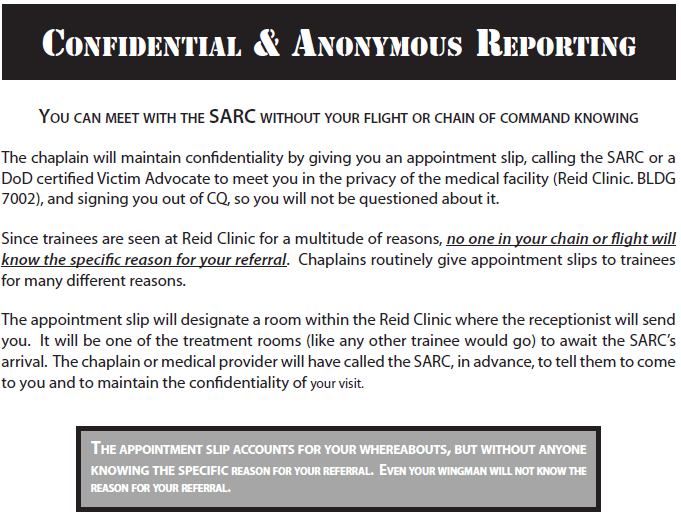
Accessing Sexual Assault Counselors Anonymously
You'll receive training on sexual assault at various points during BMT, and that training can trigger difficult emotions. You always have the option to meet with a Sexual Assault Response Coordinator (SARC) anonymously - without your MTI, anyone in your flight, your wingman, or anyone in the chain of command knowing the specific reason.
The chaplain-routed referral works like this:
- The chaplain maintains confidentiality by giving you an appointment slip, calling the SARC or a DoD-certified Victim Advocate to meet you in the privacy of the Reid Clinic (BLDG 7002), and signing you out of CQ - so you won't be questioned about it.
- No one knows the specific reason for your referral. Trainees visit Reid Clinic for many reasons, and chaplains routinely give appointment slips for many different reasons.
- The appointment slip designates a treatment room within Reid Clinic - like any other trainee visit. The chaplain or medical provider will have called the SARC ahead to maintain confidentiality.
- The slip accounts for your whereabouts without revealing the reason. Even your wingman won't know.
You may also use the Trainee Hotline Phones, available 24/7.
Trainee Hotline Phones
Trainee Hotline Phones are located in the RH&T and ATC. You have unrestricted access to these phones without fear of reprisal.
These phones use a direct menu feature with no outside dialing. Menu options:
- SARC Hotline
- Chaplain
Summary
This section covered a lot - Air Force Core Values, the Foundational Competencies, BMT measurements and the Honor Graduate Program, the appointments framework, flag conditions and heat illness, Risk Management, marching procedures and road-guard duties, the Emergency Management Program, the Feedback Form, Student Leader rules of engagement, anonymous SARC access, and the Trainee Hotline. Becoming familiar with this material will help you throughout BMT. Keep this section marked for quick access to building numbers, hours of operation, and important phone numbers.