AF099 · Lesson 10 of 71
MTI's BMT Arrival Briefing
Table of ContentsShow
- Overview
- Instructor Introduction
- Immediate Safety
- Fire Prevention
- Emergency Evacuation Procedures
- General Policies
- Heat-Related Injuries and Strenuous Exercise
- Immediate Security
- Safeguarding Valuables
- Hygiene Cleanliness
- Males
- Females
- Reporting Statements and Verbal Greetings
- Reporting Statements
- Verbal Greetings
- Wingman / Teammate Policy
- Wingman / Teammate Teams
- Core Rules
- Injured Members
- USAF Wingman Online
- SARC - Sexual Assault Response Coordinator
- Confidential and Anonymous Reporting
- Summary
Like every Airman before you, you'll need to build a solid foundation for your new career - that's exactly what BMT is designed to give you. A lot of rules, a lot of accountability, and a heavy emphasis on safety, security, and cleanliness from the moment you arrive. This section collects the rules and procedures your MTI will brief you on within hours of stepping off the bus.
Overview
Objective: Demonstrate and connect with members of the Air Force team through Basic Military Training indoctrination.
Learning Outcomes
- Recognize your Military Training Instructor (MTI) as your supervisor and the person to see when you need help.
- Practice safety, security, and hygiene cleanliness throughout training.
- Recite the Reporting Statement and render verbal greetings when appropriate.
- Understand the importance of the wingman/teammate policy in BMT and beyond.
- Understand the role of the Sexual Assault Response Coordinator (SARC) and how to meet with one anonymously.
Foundational Competencies
- Accountability - Accepts full responsibility for self and team; displays honesty and truthfulness.
- Information Seeking - An underlying curiosity; a desire to know more about things, people, oneself, the mission, or issues; an eager, aggressive learner.
Summary
- Instructor Introduction
- Immediate Safety
- Immediate Security
- Hygiene Cleanliness
- Reporting Statements and Verbal Greetings
- Wingman / Teammate Policy
- Sexual Assault Response Coordinator (SARC)
Instructor Introduction
Your MTI team members are your immediate supervisors during training. They have full disciplinary authority and will give you orders to follow. If you're having personal or training problems, go to your MTI team first - they'll help directly when they can, and refer you to the right agency when they can't.
Immediate Safety
Fire Prevention
Everyone is responsible for fire prevention. If you spot a potential fire hazard, report it to your MTI or the Charge of Quarters (CQ) immediately.
Emergency Evacuation Procedures
When evacuating the dorm:
- Put on hard-sole shoes (not shower shoes).
- If you're undressed, quickly wrap a blanket around yourself.
- Stay silent and evacuate in a single-file line through the nearest exit.
- Use the handrails. Stay on the right side of the stairwell. If two or more flights are evacuating at the same time, use both sides.
- Follow other members evacuating until you receive further instructions.
General Policies
- Do not horseplay or run inside the dormitory.
- Do not damage the dormitory or its contents.
- Report any damage or safety hazards to your MTI immediately.
- Report all accidents, no matter how minor they seem.
If an accident causes a possible head, neck, or back injury:
- Do not move the victim - you can make the injury worse.
- If someone else is available, send them for help.
- If you're injured and alone, call for help.
Heat-Related Injuries and Strenuous Exercise
South Texas heat and humidity make heat injury a real risk. If you have a history of dehydration, heat exhaustion, heat stroke, or any medical condition triggered by prolonged strenuous exercise, inform your MTI immediately. You'll be referred to an Independent Duty Medical Technician (IDMT).
Immediate Security
Safeguarding Valuables
You'll be issued one lock, four keys (two for the lock, two for the cellphone locker), and two chains - one long, one short.
- Put one lock key and one cellphone key on the long chain.
- Put the other lock key and cellphone key on the short chain.
Wear the long chain around your neck, tucked inside your shirt and out of sight unless told otherwise. (Alternate locations: ID card pouch or pocket - no medical waiver needed.)
Attach the short chain to a luggage tag. Use a blue or black pen and print neatly without punctuation:
- First line: NAME (Last, First, MI), plus Jr / Sr / II / III if applicable.
- Second line: SQUADRON and FLIGHT.
Give the luggage tag with short chain and keys to your instructor for secure storage. Those keys are only used to retrieve your valuables / cellphone in an emergency.
Your security drawer must stay locked at all times unless you're right next to it. If anything goes missing, report it to your MTI as soon as possible.
Hygiene Cleanliness
The most effective way to prevent communicable disease is good personal hygiene. Don't restrict the use of sinks, showers, urinals, toilets, or water fountains - that just helps disease spread.
- Wash your hands with soap and water for 20 seconds at least 5 times a day. Hand wipes and sanitizer are not a substitute.
- Wash before every meal, after using the latrine, and any time your hands get soiled.
- During PACER FORGE, use available hand sanitizer and/or hand washing stations before entering dining and debriefing facilities.
- Shower with soap and water at least once per day in winter, twice per day in summer.
- Don't share towels or personal grooming items (hand soaps, toothbrushes, razors, combs, brushes).
- Never share personal medications - including topical ointments, tablets, capsules, and nasal sprays.
- Brush your teeth at least twice a day; floss at least once a day.
- Cover coughs and sneezes with a tissue, or with your elbow / upper uniform sleeve if no tissue is available. Use hand sanitizer immediately after.
- Keep your personal hydration source (water bottle, canteen, hydration pack) clearly labeled and tracked. Mandatory weekly sanitizing.
- Clean, cut, and file fingernails when needed.
- Avoid putting your hands in your mouth or on your face.
- Change undergarments (briefs, underwear, socks) every day.
- Don't wear the same OCP set more than 2 days without washing.
- Don't share hats, caps, or headgear.
Males
Shave mustache and beard daily with a regular or electric razor. Your face and neck must be clean-shaven at all times, unless you have a shaving waiver.
You may experience Pseudofolliculitis Barbae (PFB) - razor bumps - caused by stiff, curved hair re-entering the skin after a few days of growth. Shaving too closely or pressing too hard makes it worse. Report any skin problems or changes to your MTI immediately.
Females
Change tampons / pads regularly - single use should not exceed 8 hours. Hygiene products go in the proper receptacles.
Reporting Statements and Verbal Greetings
Reporting Statements
Use a reporting statement when directed to respond, or when initiating a conversation while in BMT. One reporting statement at the start of the conversation is enough - you don't repeat it. One-word responses ("Yes Ma'am," "No Sir,") and brief politeness do not need a reporting statement.
The format you'll use in BMT is:
"(Full Rank), Trainee (Your Last Name) reports as ordered."
Example: "Sir / Ma'am, Trainee Jones reports as ordered."
Verbal Greetings
Verbal greetings show mutual respect, self-confidence, and pride in your unit. When passing an officer, enlisted member, or civilian on the street or in a hallway, render a verbal greeting:
"Good morning Sir / Ma'am" - or "Good afternoon Sir / Ma'am."
Use judgment: don't interrupt a conversation already in progress, and skip the greeting if it would create a nuisance (e.g., during formation or processing appointments).
Wingman / Teammate Policy
The wingman / teammate policy pairs trainees into teams to teach teamwork and develop responsibility and accountability. It improves safety, health, and wellness during BMT and reduces the likelihood and opportunity for sexual harassment, bullying, hazing, misconduct, and suicidal gestures.
Being a good wingman / teammate means taking care of fellow Airmen and taking action when signs of trouble appear - especially when someone is about to make a poor decision, is in despair, or is showing signs of hurting themselves or others.
Wingman / Teammate Teams
Teams may include (but aren't limited to): trainees attending worship services, processing appointments, members without family attending ceremonial events, escort duties, or watching wingmen on bed rest.
Core Rules
Anytime a member leaves the dormitory, they have a wingman / teammate.
- You will never be alone with an MTI or BMT staff member.
- You will never be alone without a wingman / teammate of the same sex.
- Keep your wingman / teammate always in view.
Exceptions: medical provider or IDMT appointments, first sergeant visits, chaplain visits, SARC / Victim's Advocate visits, sensitive skills / security clearance interviews, 5K and Airman's Run drop-outs, career counseling sessions, and using restroom facilities (except inside dorm latrines).
If you become separated from your team, report it immediately to your MTI, CQ, or supervisory personnel. Personnel notified must inform squadron leadership; if necessary, the squadron will initiate the "Missing Trainee" checklist to locate you.
While in transit, you'll either be in flight formation or in groups of at least two members of the same sex. MTIs are responsible for ensuring everyone has a wingman / teammate.
Injured Members
Injured trainees who can't participate in regular flight activities are never alone - and never alone with an MTI without a wingman / teammate present. This includes when an injured member must stay in the dormitory. With approval from the squadron commander or designee, injured members may ride in a POV with a wingman / teammate when necessary.
The wingman / teammate policy can't cover every training situation - but the intent is that no one is ever alone. Use sound judgment and common sense to comply with the spirit of the policy.
USAF Wingman Online
Wingman Online is a Total Force web tool for Airmen, family members, and friends. It offers fast access to resources and information about Comprehensive Airman Fitness (CAF) and resilience skills development - physical, social, spiritual, and mental domains. Worth bookmarking for yourself and sharing with people in your life.

SARC - Sexual Assault Response Coordinator
You'll receive training on sexual assault at several points during BMT. That training can trigger difficult emotions. You always have the option to meet with a SARC anonymously, without your MTI, flight wingman, or anyone in your chain of command knowing the specific reason.
Confidential and Anonymous Reporting
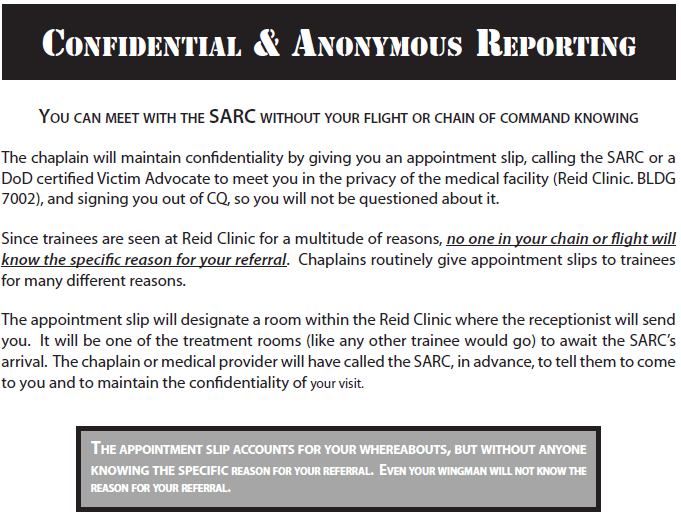
Here's how the chaplain-routed referral works (this is what Fig 01-1 describes):
- The chaplain maintains confidentiality by giving you an appointment slip, calling the SARC or a DoD-certified Victim Advocate to meet you in the privacy of the medical facility (Reid Clinic, Bldg 7002), and signing you out of CQ - so you won't be questioned about it.
- No one knows the specific reason for your referral. Trainees visit Reid Clinic for many reasons, and chaplains routinely give appointment slips for many different reasons.
- The appointment slip designates a treatment room within Reid Clinic, just like any other trainee visit. The chaplain or medical provider will have called the SARC ahead of time to maintain the confidentiality of your visit.
- The slip accounts for your whereabouts without revealing why. Even your wingman won't know the reason for your referral.
If anything happens, this path exists. Use it.
Summary
You've just joined the ranks of countless Airmen who came through BMT before you. There are a lot of rules and not much supervision in between, so accountability matters. Getting through BMT is a team effort - the wingman policy is a highly effective tool for that.
If you encounter any problem during BMT, notify your MTI immediately. You're now on the road to becoming an Airman.