AF099 · Lesson 66 of 71
U.S. Space Force Satellite Systems
Table of ContentsShow
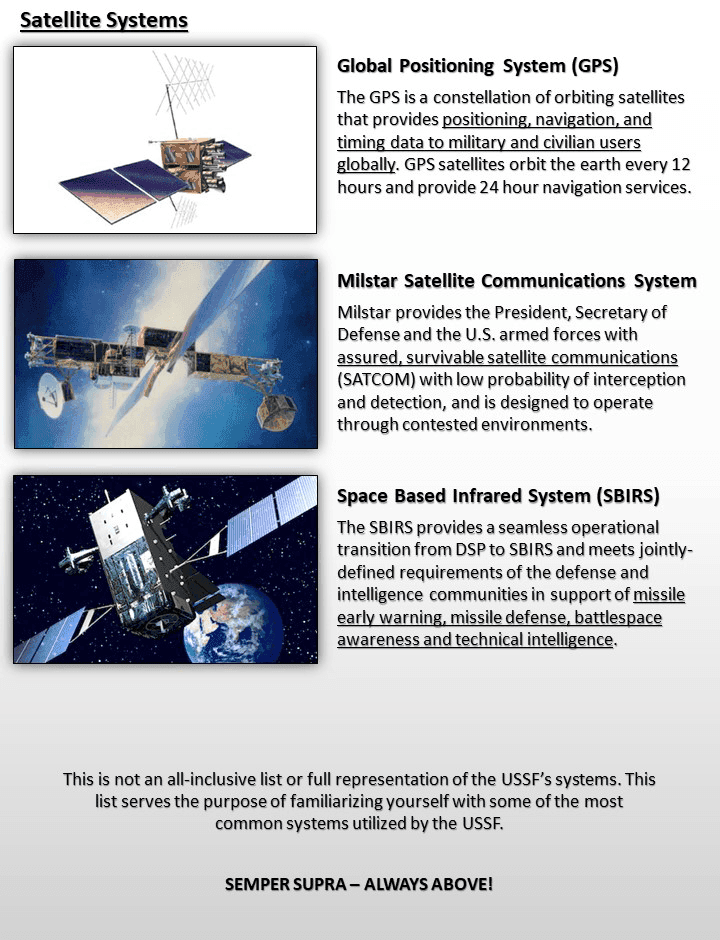
This section covers three satellite "cards" - one per major space system the U.S. Space Force operates or depends on. The cards are entirely visual, with short callouts of mission and orbit.
You'll be expected to recognize the major Space Force satellite constellations and what each one does for the joint force.
Mission categories
Position, Navigation, and Timing (PNT)
- Global Positioning System (GPS) - worldwide PNT for military and civilian users; medium Earth orbit.
Military Satellite Communications (MILSATCOM)
- Advanced Extremely High Frequency (AEHF) - survivable, jam-resistant strategic and tactical comms.
- Wideband Global SATCOM (WGS) - high-capacity wideband communications.
- Mobile User Objective System (MUOS) - narrowband (operated jointly with the Navy).
- Defense Satellite Communications System (DSCS) - legacy wideband (being replaced by WGS).
Missile Warning and Defense
- Space-Based Infrared System (SBIRS) - early warning of ballistic-missile launches from geosynchronous and highly elliptical orbits.
- Defense Support Program (DSP) - legacy missile-warning constellation.
Weather
- Defense Meteorological Satellite Program (DMSP) - military weather observation supporting operations.
Space Domain Awareness
- Geosynchronous Space Situational Awareness Program (GSSAP) - surveillance of the geosynchronous belt.
Satellite cards
These are satellite cards. See the images for the specific photos and callouts.