AF099 · Lesson 27 of 71
Nutrition Principles
Table of ContentsShow
- Overview
- Basics of Proper Nutrition
- Essential Nutrients
- Carbohydrates
- Protein
- Fats
- Water
- Vitamins and minerals
- USDA Dietary Guidelines for Americans
- Maintaining a healthy weight
- MyPlate
- Grains (orange section)
- Vegetables (green section)
- Fruits (red section)
- Dairy (light blue section)
- Protein (purple section)
- Oils
- Readiness Nutrition
- Meals, Ready-to-Eat (MREs)
- Food Allergies / Food Intolerances
- Dietary Supplements and Energy Drinks
- Summary
The BMT PT Program described physical training as a lifestyle, but lifting and running alone won't get you there. Eating right goes hand-in-hand with PT - both are needed to reach your goals and beyond. Eating well comes down to decision-making every time you choose your next meal.
This section covers what your body actually needs (carbs, protein, fat, vitamins, minerals, water), how to use the MyPlate model to build meals at the DFAC, hydration in BMT, food allergies, and the truth about dietary supplements and energy drinks in a military environment.
Overview
Objective: Identify basic facts and general principles about culture fundamentals in the Air Force.
Learning Outcomes
- Understand the basics of proper nutrition.
- Recall basic facts regarding essential nutrients.
- Identify basic facts regarding the USDA dietary guidelines.
- Understand the MyPlate concept and what it includes.
- Discuss the concept of readiness nutrition and the importance of monitoring what you eat.
- Recognize food allergies / food tolerances and the importance of telling a medical provider.
- Understand the effects of supplements and energy drinks along with health concerns.
Foundational Competencies
- Decision Making - Makes well-informed, effective, and timely decisions; uses sound judgment to integrate and weigh situational constraints, risks, and rewards.
- Results Focused - A concern for working well or competing against a standard of excellence.
Summary
- Basics of Proper Nutrition
- Essential Nutrients
- USDA Dietary Guidelines for Americans
- MyPlate
- Readiness Nutrition
- Food Allergies / Food Intolerances
- Dietary Supplements and Energy Drinks
Basics of Proper Nutrition
BMT is mentally and physically demanding in a way you've probably never been pushed before. Proper fuel and hydration are essential to meet that demand. Every Airman is responsible for being mission-ready at all times - that includes being physically fit and properly fueled.
To graduate BMT on time and injury-free, choose the right amount of high-quality nutrients and fluids at the appropriate times. Proper fueling sustains and optimizes your physical and mental well-being throughout training. The right nutrients optimize performance, improve overall health and wellness, and speed healing if you get injured or sick.
You're not on this journey alone. For medical or nutritional needs, you can refer to this section, your Medical Treatment Facility (MTF), Wilford Hall Ambulatory Surgical Center's Outpatient Nutrition Clinic, or the Viper Dieticians.
Essential Nutrients
There are six nutrition components to highlight: carbohydrates, proteins, fats, vitamins, minerals, and water.
The energy-providing nutrients - carbohydrates, proteins, and fats - are called macronutrients. These are essential calorie-containing nutrients that the body needs in relatively large amounts to operate properly.
Micronutrients - vitamins and minerals - don't provide energy, but they help the body efficiently use the energy from the foods you eat. They're needed in relatively small amounts.
Carbohydrates
Carbs are known as the "energy powerhouse" because they're the primary fuel for your brain and muscles. They provide four calories per gram. During digestion, carbs turn into glucose, the body's most basic form of sugar. If you don't eat enough carbs, skeletal muscle will be broken down to provide glucose for the brain.
Carbs come from dairy (milk, yogurt), fruits, grains, vegetables, sweets, and many processed foods. Whole grains, fresh fruits, vegetables, and legumes are also excellent sources of fiber.
Fiber helps prevent constipation, can lower blood glucose, and can reduce cholesterol levels. There are two types:
- Soluble fiber slows digestion and makes you feel fuller. Found in oats, barley, beans, and seeds.
- Insoluble fiber adds bulk to stool and helps prevent constipation. Found in wheat bran, vegetables, and whole grains.
Glycogen is the stored form of carbohydrate in the muscle and liver - your "safety net" when bloodstream glucose runs low.
There are two types of carbohydrates:
- Simple - refined sugars in candy, desserts, fruit juice, and processed grains (white rice).
- Complex - whole grains (quinoa, whole wheat bread, brown rice), whole fruits, and starchy vegetables (sweet potato, squash). The natural fiber content gives the body a prolonged source of energy, keeps blood sugar consistent, and prevents energy crashes mid-training-day.
Most dietitians recommend that at least 50% of your carbs come from complex carbohydrates. If you eat less than 45% of total calories from carbs (or less than 130 g/day), you may feel faint, dizzy, weak, struggle to concentrate, or be unable to participate fully in PT.
Protein
Protein provides four calories per gram. It builds and repairs body tissue, helps maintain fluid and electrolyte balance, supports antibodies for immune health, and is a component of hormones and enzymes. It provides energy but shouldn't be the main source.
Amino acids are the building blocks of proteins. There are 20 dietary amino acids; 9 are essential - your body can't make them, so they have to come from food.
- Animal proteins (beef, poultry, pork, fish, eggs) provide all 9 essential amino acids and are considered complete.
- Plant-based complete proteins: quinoa, soy, rice & beans (combined). Other plant sources (beans, nuts, lentils, edamame, tofu) and low-fat or non-fat dairy are good sources too.
- Grains and vegetables are moderate to low sources of protein.
Protein is needed for muscle development, but excess protein doesn't build bigger muscles. Excess gets burned for energy or converted to carbs/fat and stored. The body doesn't store protein, so portions need to be eaten daily - adjusted to your activity level. Eating too much protein can lead to dehydration, constipation, and increased calorie/fat intake.
Fats
Fat digests slowly and provides energy for moderate-intensity or long-duration activity. It provides nine calories per gram - twice that of carbs and protein.
Fat is essential for hormone production (estrogen, cholesterol, testosterone), for the structure of cell walls, for transporting and storing fat-soluble vitamins, and for insulating and protecting vital organs.
Three types of fat:
- Monounsaturated (MUFA) - healthy. Liquid at room temp (olive oil). Found in olive oil, canola oil, peanut oil, avocados, most nuts, fatty fish (tuna, salmon).
- Polyunsaturated (PUFA) - healthy. Liquid at room temp. Found in similar plant and fish sources. May play a role in cognitive health.
- Saturated - should be eaten in moderation; mostly from animal products. Solid at room temp (butter). Reduce by choosing reduced- fat / low-fat / non-fat dairy and animal options.
There's a fourth type - trans fats - which are commercially produced and should be avoided. Found in commercially baked foods; look on the label for "hydrogenated" or "partially hydrogenated" oils.
Body fat storage varies person to person based on sex and genetics. Women typically store more fat than men for biological reasons. Even a fairly lean individual has stored fat - for example, a 150-pound person at 10% body fat has about 62,000 calories stored as fat. You can live much longer without food than without water.
A diet that is moderately low in fat (20-35% of total calories) supports both physical performance and overall health.
Water
Water has no calories, but it's essential for nutrient transport, digestion, body-temperature regulation, and cognitive function. Training places a major demand on fluid replacement.
Failing to keep up with water requirements doesn't just hurt performance - it can cause heat cramps, heat exhaustion, stroke, and death.
The simplest way to check hydration is the urine test. Drink enough water that your urine is pale yellow / light lemonade color and only weakly scented.
Water is the best beverage for hydration, and it's available in your dorm. Sport drinks (Powerade, Gatorade) help replace electrolytes lost during strenuous exercise exceeding 60 minutes. Other fluid sources: fresh fruit, broth-based soups, juices, milk, fresh vegetables.

Over-hydration is also dangerous, though much less common in a training environment.
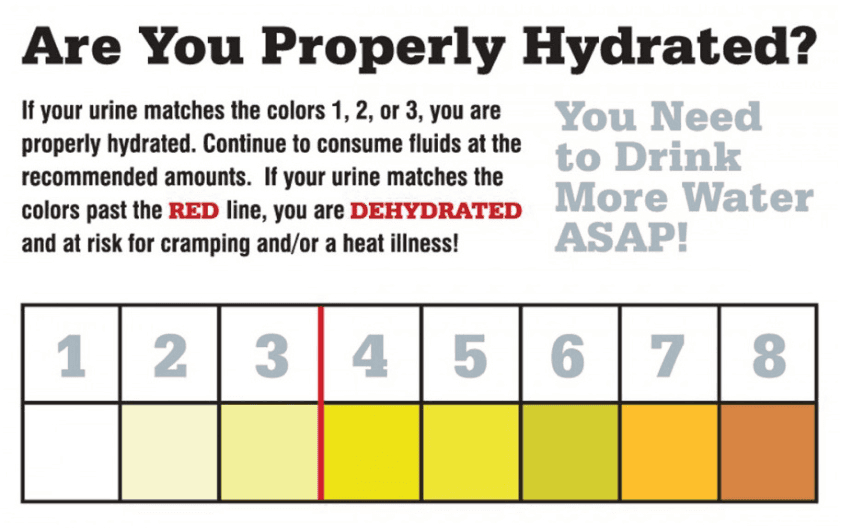
Hydration chart - match your urine color against shades 1-8.
BMT hydration schedule
- Drink ¼ to ½ of your issued hydration source (16-24 oz) every hour during normal activities.
- Do not exceed 10 quarts in any 24-hour period.
- Do not drink more than ¾ of your hydration source in a single hour.
- Over-hydration is a serious - potentially deadly - medical concern. Balance is the key.
Vitamins and minerals
Micronutrients are essential because the body can't make them
- they have to come from food. There are more than 28 essential micronutrients that play key roles in making hemoglobin, maintaining bone health, supporting immune function, and protecting the body from oxidative damage. They also assist in building and repairing muscle tissue during recovery.
Vitamins
Two main groups:
- Fat-soluble (A, D, E, K) - require fat in the diet to be absorbed; stored in fatty tissues. Excessive consumption or supplementation can cause toxicity. Vitamin D is commonly insufficient or deficient in many Americans and is critical for bone health.
- Water-soluble (C and B-complex) - dissolve in water; not stored in the body. Replenish daily.
Minerals
Categorized as major or trace based on the amount the body needs. Minerals especially important during BMT (and in any athletic population):
- Iron - builds red blood cells that transport oxygen so your brain stays sharp and your muscles keep working. Iron needs are higher for women during military training, and can be hard to meet with diet alone - female trainees are issued a daily multivitamin/mineral with iron to help meet needs.
- Calcium - builds strong bones and teeth, supports muscles, and regulates heartbeat.
A balanced, nutrient-dense diet is the best way to get vitamins and minerals. Both men and women in BMT may be prescribed a nutrition or pharmaceutical prescription for anemia based on laboratory results. Vegetarians, vegans, and people with lactose intolerance are at higher risk and should self-monitor adequate nutrient intake.
USDA Dietary Guidelines for Americans
Per the USDA's ChooseMyPlate website, the Dietary Guidelines provide science-based advice on food and physical activity choices for better health.
A healthy diet:
- Emphasizes fruits, vegetables, whole grains, and fat-free or low-fat milk and milk products.
- Includes lean meats, poultry, fish, beans, eggs, and nuts.
- Is low in saturated fats, trans fats, cholesterol, salt (sodium), and added sugars.
MyPlate helps you use the Dietary Guidelines to:
- Make smart choices from every food group.
- Find balance between food and physical activity.
- Get the most nutrition out of calories.
- Stay within daily calorie needs.
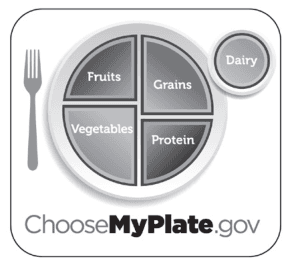
Figure 23-1: MyPlate
Maintaining a healthy weight
Healthy weight is a key to a long, successful career. The Air Force recognizes abdominal circumference (AC) as one of the most specific indicators of disease risk in adults.
Excessive body weight harms physical performance and increases the risk of consequences under military appearance standards. Being overweight or obese contributes to long-term health risks: high blood pressure, high blood cholesterol, heart disease, stroke, diabetes, arthritis, breathing problems, and certain cancers.
Weight loss, when needed, should be gradual - 1-2 pounds per week. Rapid weight loss (more than 2 lbs/week) increases risk of injury and illness. Underweight also hurts performance and raises stress-fracture risk. Healthy energy balance is key. Controlled calorie intake (250-500 calories below requirements) generates healthy and safe weight loss.
- Women should never consume below 1,200 calories per day.
- Men should never consume below 1,500 calories per day.
Small changes add up - start with incremental changes, like eating one more vegetable per day, and commit to them long-term.
Choose the most nutritionally rich foods from each food group every day. Daily recommendations are described in portions measured in ounces, cups, or tablespoons. Measuring cups/containers can be used after BMT - in the meantime, your hand is a great tool for estimating portions.
MyPlate
Grains (orange section)
Excellent source of carbohydrates, vitamins, minerals, and fiber. Two subgroups:
- Whole grains - whole-wheat flour, bulgur (cracked wheat), oatmeal, whole cornmeal, brown rice, quinoa, bran cereals, granola.
- Refined grains - milled for finer texture and longer shelf life, but dietary fiber, iron, and B vitamins are removed. Examples: white flour, white bread, white rice, plain bagels. Some refined grains are enriched by adding B vitamins and iron back in.
The DFAC offers whole-grain products at every meal. Try to make at least half your grains whole.
Daily Recommendation
- Female: 6 oz equivalent
- Male: 7-8 oz equivalent
Ounce equivalent of grains: 1 slice of bread, 1 cup of ready-to-eat cereal, or ½ cup of cooked rice, pasta, or cereal.
Vegetables (green section)
Provides vitamins, minerals, fiber, and fluid. Starchy vegetables (potatoes, peas, corn) are excellent sources of complex carbs - consume more of these to fuel longer-duration performance.
Vegetables can be raw, cooked, fresh, frozen, canned, or dried/dehydrated; whole, cut-up, mashed, or pureed. Nutrient value isn't lost by being frozen or canned. Vegetable juice counts - but it's often devoid of fiber and phytochemicals.
Choose two to three servings of vegetables with lunch and dinner every day. Aim for at least three different colors on your plate per meal - a mix of colors gives a mix of nutrients.
Daily Recommendation
- Female: 2½ cups
- Male: 3 cups
Example of 1 cup of vegetables: 1 cup of raw or cooked vegetables or vegetable juice, or 2 cups of raw leafy greens.
Fruits (red section)
Carbohydrates, vitamins, minerals, fiber, and fluid.
- Fruit juice is a concentrated source of sugar and contains little fiber - consume sparingly. Choose just one serving per meal.
- Canned and dried fruits often have added sugar - read the ingredients. Choose canned fruit packed in light syrup or its own juice. Avoid heavy syrups (canned fruit in the DFAC is not packed in heavy syrup).
Daily Recommendation
- Female: 1.5-2 cups
- Male: 2 cups
Example of a serving: ½ cup of fruit or 100% fruit juice, or 4 oz / ¼ cup of dried fruit.
Dairy (light blue section)
Good source of protein, carbohydrates, vitamins (D and B), minerals (calcium), and fluid.
Foods made from milk that retain calcium are part of this group (yogurt). Foods made from milk with little to no calcium - cream cheese, cream, butter - are not part of the dairy group. Choose low-fat or non-fat dairy at each meal.
Daily Recommendation
- Female: 3 cups
- Male: 3 cups
Example of a cup of dairy: 1 cup milk or yogurt, 1½ oz of natural cheese, or 1 string cheese.
Protein (purple section)
Provides amino acids and B vitamins, plus iron. All meat (poultry, beef, pork), seafood, beans, eggs, soy products, nuts, and seeds are part of this group.
- Go lean - choose plant-based protein, OR low-fat / lean meat and poultry. Plant sources include tofu, beans, nuts, and nut butters.
- Meat grades of "select" and "choice" offer lower fat than "prime." Look for "loin" or "round roast" on the label.
- Turkey and chicken are lower-fat options.
- Seafood - at least 8 oz of cooked seafood per week. Seafood is rich in omega-3 fatty acids. Examples: tuna, salmon, tilapia, haddock, halibut.
- Choose a protein food at each meal.
Daily Recommendation
- Female: 5-5½ oz equivalents
- Male: 6-6½ oz equivalents
Serving size: approximately the palm of your hand (not including fingers).
Oils
Oils are not a food group, but they provide essential fatty acids. Most oils are liquid at room temperature - like the vegetable oils used in cooking.
- Common oils: canola, corn, soybean, olive.
- Foods naturally high in oils: nuts, olives, some fish, avocados.
- Foods that are mainly oil: mayonnaise, certain salad dressings, soft margarine.
- Most oils are high in MUFA or PUFA fats, low in saturated fat. Plant-source oils have no cholesterol.
Coconut oil, palm oil, and palm-kernel oil are high in saturated fat - treat them as solid fats.
Solid fats (butter, milk fat in whole milk, beef/chicken/pork fat, stick margarine, shortening, partially hydrogenated oil) come from animal foods or hydrogenation of vegetable oils. Limit solid fats - they raise cardiovascular disease risk.
All fats and oils are mixtures of saturated and unsaturated fatty acids:
- Solid fats contain more saturated and/or trans fats.
- Oils contain more MUFA and PUFA.
- Saturated fats, trans fats, and cholesterol raise damaging LDL cholesterol, leading to heart disease. Trans fats also lower protective HDL cholesterol and should be avoided.
To lower heart-disease risk, cut back on foods containing saturated fats, trans fats, and cholesterol.
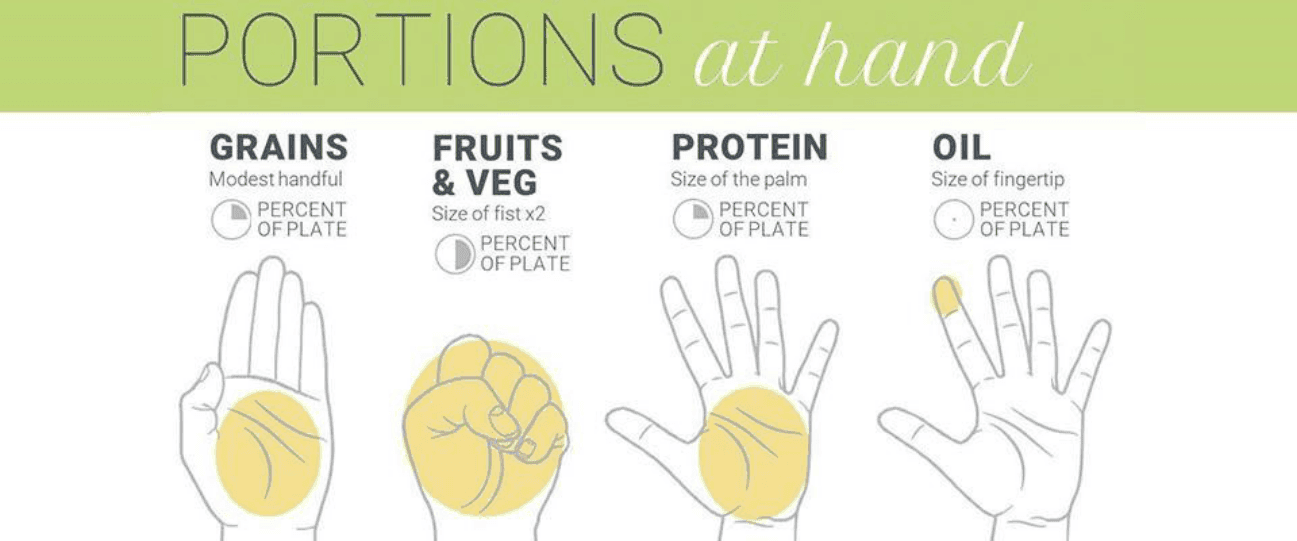
Hand-portion guide for plate-building during BMT.
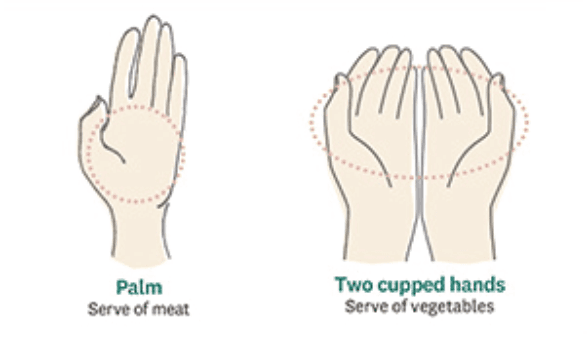
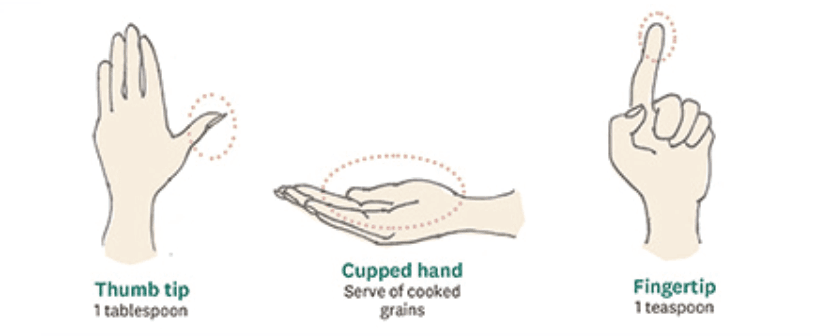
Quick reference: hand-based serving sizes when no measuring tools are available.
Readiness Nutrition
Meals, Ready-to-Eat (MREs)
MREs (similar to TOTMs) are intended for the deployed environment. Each averages about 1,250 calories - three MREs per day = roughly 3,750 calories (13% protein, 36% fat, 51% carbohydrate). It also provides ⅓ of the Military Dietary Reference Intake of macro- and micronutrients per the National Academy of Sciences Institute of Medicine.
Eating three full MREs in one day may give you more calories than you need. Unless you're extremely active, you probably won't need to eat the whole thing at once. Pick the foods that best fuel your mental and physical performance - skip the candies and desserts.
Your deployed environment shapes what and how much you should eat. Cold or hot temperatures, elevation, and other environmental factors all impact which foods will best fuel your body.
Hydration matters downrange too. Environmental factors, activity, and bowel habits (diarrhea vs. constipation) all affect daily water needs. Keep a water bottle or canteen close at home station and in deployed environments.
Food Allergies / Food Intolerances
Eight foods account for 90% of all food-allergic reactions. Allergic reactions are immune responses that come on suddenly, can be life-threatening, and occur with every exposure to a particular food.
If you have a known, medically diagnosed food allergy, tell your medical provider and your MTI.
Most food allergies start in childhood, but they can develop later in life. The top 8 most common food allergens:
- Eggs
- Fish
- Crustacean shellfish
- Milk
- Peanuts
- Soybeans
- Tree nuts
- Wheat
Having an allergy means staying on guard, doing more research, asking more questions, knowing what's in the foods you eat, and possibly carrying medications with you at all times.
Food intolerances come on gradually, are non-life-threatening, and don't trigger an immune response. Symptoms include diarrhea and bloating.
Dietary Supplements and Energy Drinks
You won't be able to use dietary supplements or energy drinks during BMT. That said, supplement use is increasingly popular in the military, so know what you're getting into.

Supplements are intended to supplement a diet, not substitute for it. They may contain vitamins, minerals, herbs, botanicals, amino acids, high doses of caffeine, or other substances. They are not regulated by the FDA - there's no guarantee that what you purchase is what you actually get.
If a healthcare provider recommends a supplement, look for a third-party verification sticker:
- BSCG - Banned Substances Control Group (Certified Drug Free)
- Informed Sport (Informed Choice)
- NSF Certified for Sport
- USP Verified
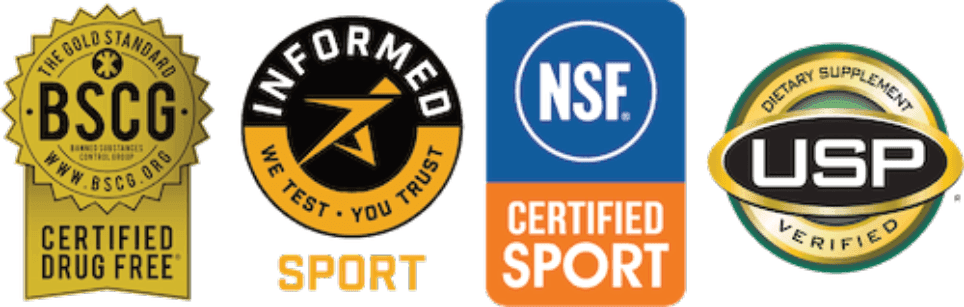
Look for one of these seals before buying a supplement.
Supplements can often do more harm than good. Consult a qualified healthcare professional before taking any supplement.
Energy drinks can lead to sleep disturbances and other, more serious health concerns. Climate and stress can change how your body reacts to supplements and energy drinks - especially in a deployed environment.
Two key resources:
- Human Performance Resource Center (DoD) - HPRC-ONLINE.ORG/OPSS - go-to source for nutrition, performance, and supplements.
- Operation Supplement Safety (OPSS) - OPSS.ORG - up-to-date info on supplements, including a list of banned ingredients for military members.
Airmen on flight status or in the Personnel Reliability Program (PRP) must still consult their primary care physician, flight surgeon, or dietician for clearance on what to take and what not to take.
Summary
Striving to achieve and maintain proper eating habits is a worthy goal. Healthy eating contributes to a healthy lifestyle, helps you maintain proper weight, reduces injury risk, and reduces stress, among other benefits. Plan your nutrition routine with the Core Value of Excellence In All We Do in mind - it'll help you maintain a professional image and physically perform your duties. The rewards are well worth the effort.