AF099 · Lesson 24 of 71
BMT PT Program
Table of ContentsShow
- Overview
- Air Force Physical Training Standards
- Passing requirements
- What happens if you fail
- Weekly PT
- Strength, CIT, and Aerobic Pre-Exercise Warm-Up
- Cardio Interval Training (CIT) Program
- CIT standards
- CIT exercises
- Anaerobic (Muscular Fitness) Training Program
- Muscular Fitness exercise sequence
- Post-Anaerobic, CIT, and Aerobic Cool Down
- Aerobic (Run) Training Regimen
- Fundamental running principles
- Pre-Run Warm-Up
- Aerobic interval run
- Lane assignments
- Brisk walk
- Post-Aerobic Exercise Cool Down
- Supplemental Strength Sessions
- One-by-Three Strength Training
- How it works
- Tuning the load
- Pull-Up Training
- Self-Guided Exercises in BMT
- Rules
- Available exercises
- Summary
Physical Training in the Air Force is aimed at producing fit Airmen ready for the mental and physical demands of their duties. PT is as much a lifestyle as it is an operational necessity. In BMT, you'll work three programs in parallel - Cardio Interval Training (CIT), Anaerobic (Muscular Fitness), and Aerobic (Run) - all wrapped around a fixed warm-up and cool-down framework. To graduate, you must meet or exceed the Air Force PT standards.
This is the longest section in the course because PT is broken into many parts. The structure below walks through each one, plus the support sessions for trainees who need extra work to reach standard.
Overview
Objective: Without reference, achieve physical training standards.
Learning Outcomes
- Demonstrate the ability to meet or exceed Air Force Fitness Standards prior to graduating BMT.
- Understand the importance of the Strength and CIT Pre-Exercise Warm-Up program.
- Demonstrate the exercises and standards of the CIT Program.
- Demonstrate the exercises and standards of the Anaerobic (Muscular Fitness) Training Program.
- Recall the general instructions for Post-Anaerobic and CIT cool down.
- Understand the fundamental principles of an effective Aerobic (Run) Training Regimen.
- Recall the general instructions for Post-Aerobic cool down.
- Recognize the Supplemental Strength Sessions for trainees unable to meet BMT standards.
- Understand the One-by-Three training method as the safest way to increase overall strength.
- Demonstrate daily pull-up training for Battlefield Airmen.
- Recognize Self-Guided Exercises as a method to improve strength and exercise on waivers.
Foundational Competencies
- Initiative - Doing more than is required; finding and creating new opportunities.
- Perseverance - Grit and effort toward difficult long-term goals despite failure or plateaus.
- Results Focused - A concern for working well or for competing against a standard of excellence.
Summary
- BMT Physical Training Standards
- Strength and CIT Pre-Exercise Warm-Up
- Cardio Interval Training (CIT)
- Anaerobic (Muscular Fitness) Training Program
- Post-Anaerobic and CIT Cool Down
- Aerobic (Run) Training Regimen
- Post-Aerobic Exercise Cool Down
- Supplemental Strength Sessions
- One-by-Three Strength Training
- Pull-up Training
- Self-Guided Exercises in BMT
Air Force Physical Training Standards
PT is your chance to prove your commitment to Excellence In All We Do. Give your best effort on the initial appraisal - it provides a realistic snapshot of your current fitness and shows you what to work on. After the initial appraisal, focus on improvement.
Don't ignore injuries. Seek medical attention for anything that keeps hurting more than 48 hours. Untreated injuries get worse and keep you out of training.
Passing requirements
To graduate BMT, you must meet or exceed the Air Force PT standards with a composite score ≥ 75 points AND meet the minimum point values for every component.
The Final PT Evaluation happens in the 5th Week of Training (5 WOT) and covers:
- Cardiorespiratory fitness - 1.5-mile run (60 points possible)
- Muscular fitness - push-ups (20 points possible, 1-minute)
- Muscular fitness - sit-ups (20 points possible, 1-minute)
Composite score categories:
| Score | Category |
|---|---|
| ≥ 90.0 points | Excellent |
| 75.0-89.9 | Satisfactory |
| < 75.0 | Unsatisfactory |
Standards are established by sex and age. Your MTI will brief you on initial accession standards, 3 WOT, and 5 WOT BMT PT standards. Flights get a minimum of two nights' rest from any PT session before the final evaluation.
The detailed scoring tables - run-time-to-points and reps-to-points mappings, plus the minimum value required in each component - are published by the Air Force as age- and sex-specific charts. Rather than reproduce the older BMT study-guide snapshot, this course points you to the current official Air Force scoring charts as the standard to train toward:
Aim for the official Air Force standard. The BMT accession, 3 WOT, and 5 WOT checkpoints your MTI briefs can be more lenient than the career fitness standard in these charts. Train to the official PFRA charts above - clear the real assessment and you'll pass any BMT checkpoint comfortably. Your MTI's brief remains authoritative for the specific BMT graduation minimums.
What happens if you fail
- First failure - Stay with your flight and retest in the failed components.
- Second failure - Counseled by your MTI. Before the third evaluation, you'll be given a choice: keep the same components, or pick one of the DAF-approved alternatives for the failed area. State your decision to your MTI before the evaluation.
- Third failure - Counseled by your MTI and referred for further action under DAFMAN 36-2905.
2025-2026 update. The alternate-component choice described above comes from the BMT study guide, but reporting confirms BMT removed the alternate components in April 2025 (HAMR, hand-release push-ups, cross-leg reverse crunches) to standardize the training pipeline. Trainees who fail now retake the full test in the original components: 1.5-mile run, traditional push-ups, and sit-ups. This is deliberate divergence, not lag - while the operational force moved to the four-component PFRA (2-mile run or HAMR, scored waist-to-height ratio) on July 1, 2026, BMT kept the legacy three-component test. You'll meet the PFRA at your first operational assignment. As always, your MTI's brief is authoritative for what happens in your flight.
Weekly PT
Weekly PT consists of:
- Aerobic (run)
- Cardio Interval Training (CIT)
- Anaerobic (muscular fitness)
- Motivational formation runs (per 737 TRGOI 36-2905 and the weekly activities schedule)
Strength, CIT, and Aerobic Pre-Exercise Warm-Up
This warm-up runs before both anaerobic and CIT programs. The point is to get muscles loose and the heart pumping for sustained exercise. Static stretching is for AFTER, not before - pre-workout stretching doesn't prevent injuries (despite the common belief) and can actually leave muscles tight.
All flights perform this in unison.
- Brisk walk or double time - done while walking to the PT pad.
- Arm rotations (standing) - 20 reps (10 forward, 10 backward), starting with small circles and growing larger.
- Jumping jacks - 20 reps of a four-count movement.
- Windmills - alternating sides, hand-to-opposite-foot reaches.
- Calf raises - 20 reps, two-count.
- Forward lunges - 3 reps each leg, four-count.
- Side hops - 3 reps each side, four-count.
- Squats - 10 reps, four-count.
- Walk outs - 10 reps, two-count (hands walk forward to high plank, then back).
Cardio Interval Training (CIT) Program
CIT starts with the pre-exercise warm-up. Two sequences (A and B) alternate on different days throughout the week.
CIT standards
- Weeks 1-3: work-to-rest ratio of 2:1. Each exercise lasts 20 seconds, repeated 5 times for a total of 6 cycles (~24 minutes total). 30-second rest at the end of each cycle.
- Weeks 4-7: work-to-rest ratio of 3:1. Each exercise lasts 30 seconds, repeated 5 times for a total of 6 cycles (~32 minutes total). 40-second rest at the end of each cycle.
CIT exercises
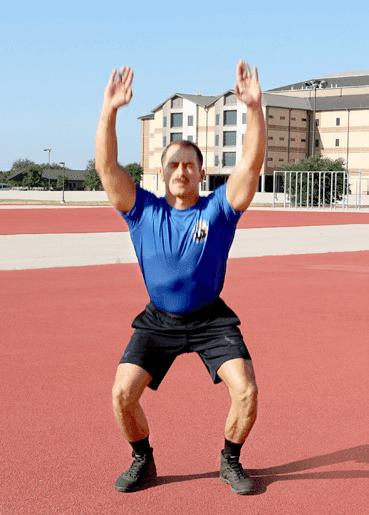
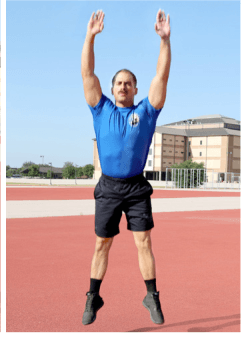
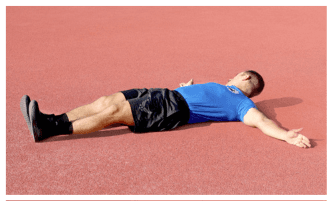
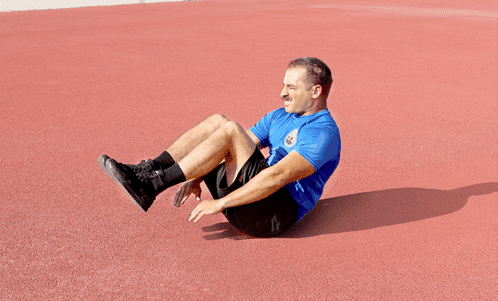
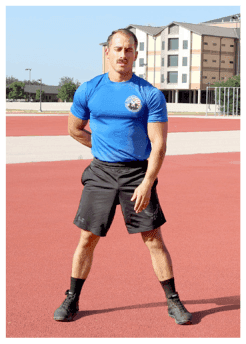
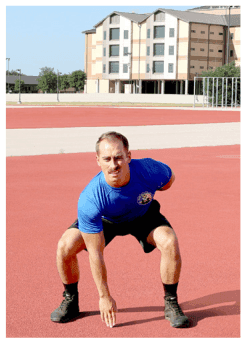
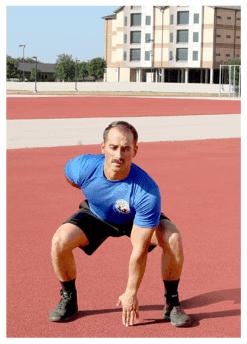
The CIT exercises run in the order shown below. Image rows show the movement sequence for each exercise.
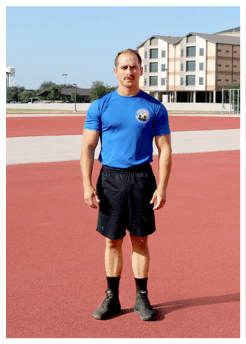
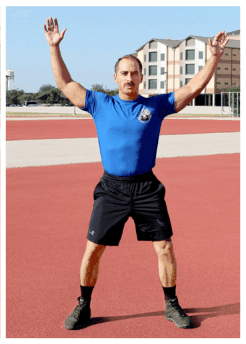
Jumping jacks - start with feet together and hands at sides; push through the balls of the feet, raising hands overhead in an arching motion.
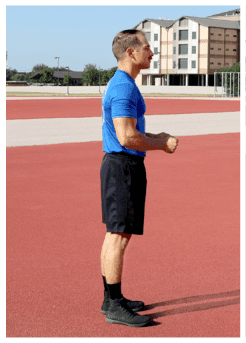
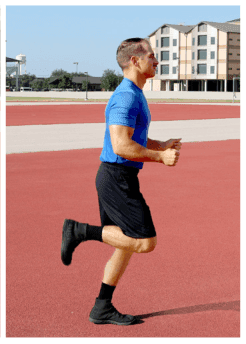
Butt kicks - heel raises toward gluteus, alternating legs in place, arms at 90° as in a jogging position.
American twists - seated 45° back-lean, hands clasped at chest, torso rotates left and right at the shoulders.
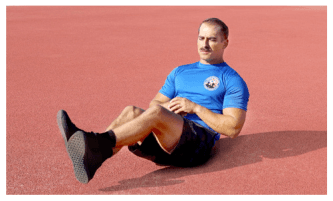
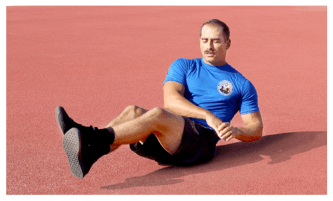
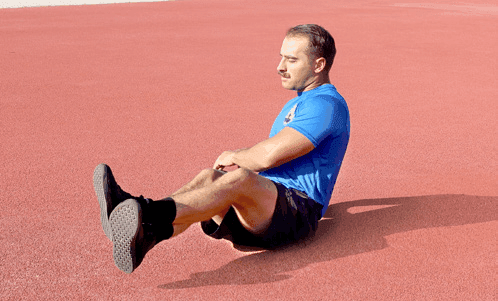
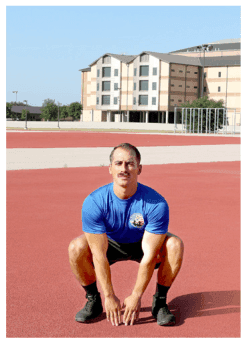
Frog jumps - drop hips back into a deep squat, fingers touch the ground at the bottom, then jump up with arms overhead.
Hiccups - start supine in a "T" shape; bring knees and hands to meet at midline, then return.

Monster walk - knees bent close to 90°, hands interlaced at chest; step forward L, R, then back L, R.
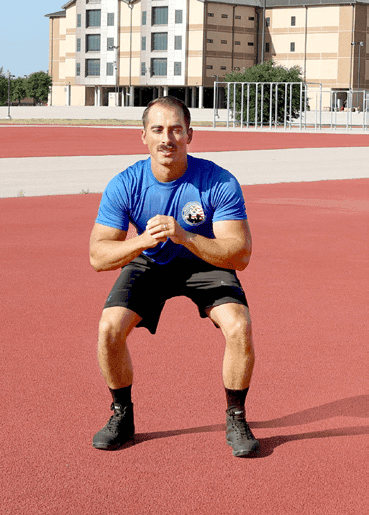
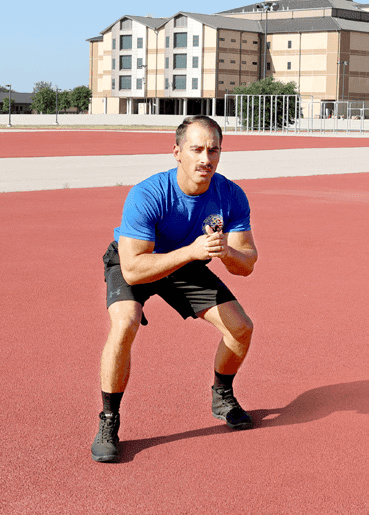
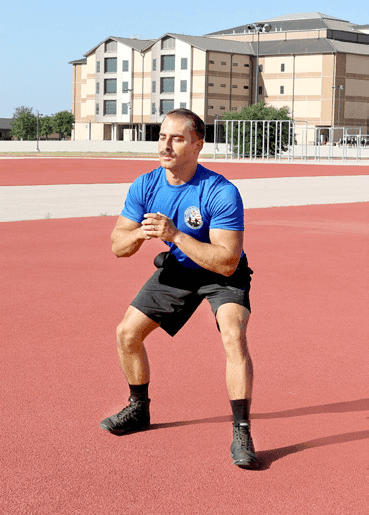
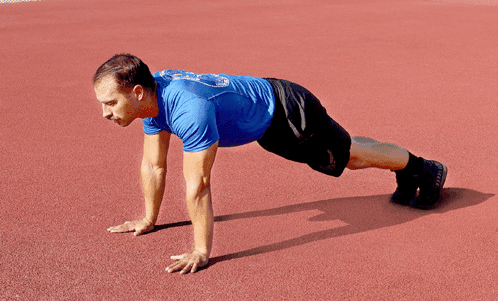
Break dancer - push-up position; raise one leg and swing it out ~45° to the side, alternating legs.
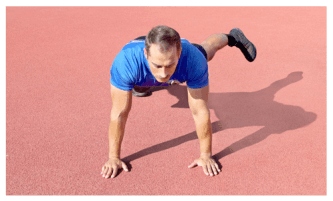
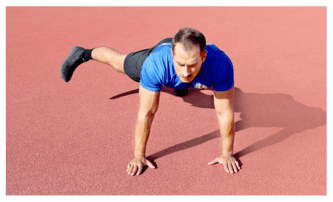
Lateral hops - feet shoulder width, knees slightly bent; hop side to side, both feet landing together.
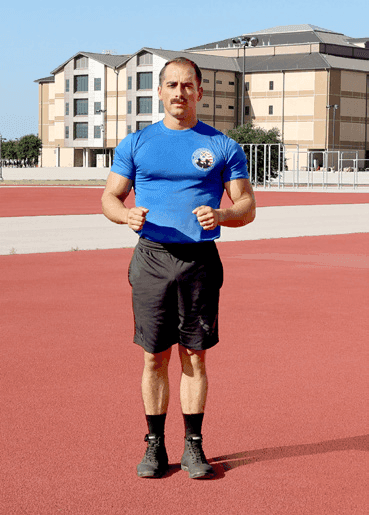
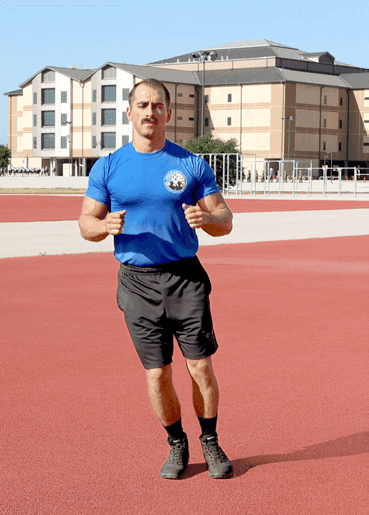
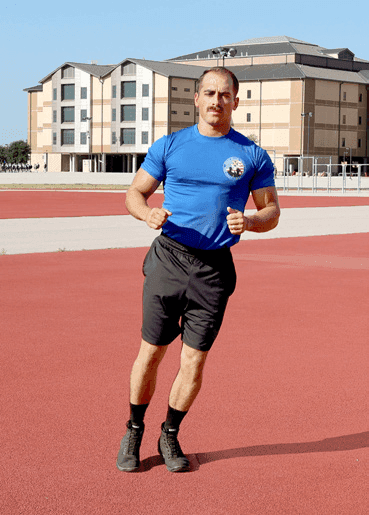
Jump ropes - simulate the rotation of a jump rope, soft landings on each jump.
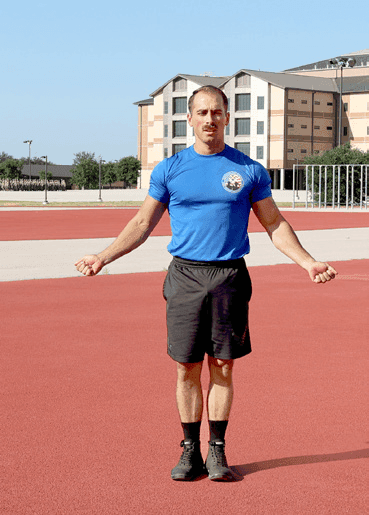
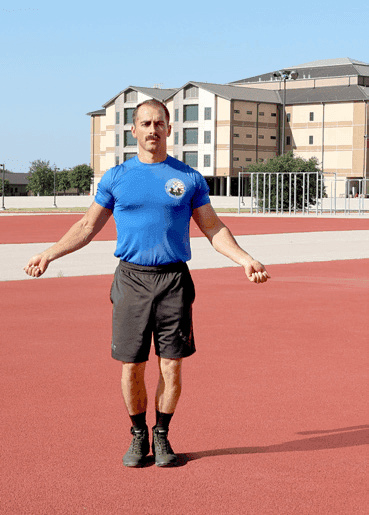
Reverse crunch - supine, hands under hips; bend knees toward chest, then extend legs with heels 6 inches above the ground.
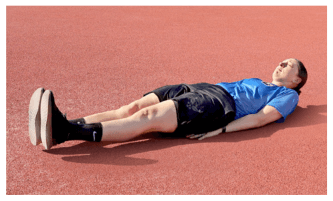

Frog jacks - jump to a wide squat stance, alternating one hand touching the ground each rep.
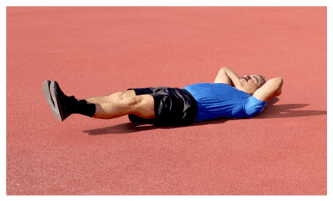
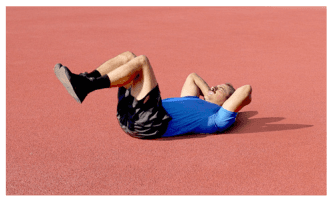
Knees-to-elbows - supine with hands cupped at ears; bring knees to elbows, then extend legs out keeping heels 6 inches above ground.

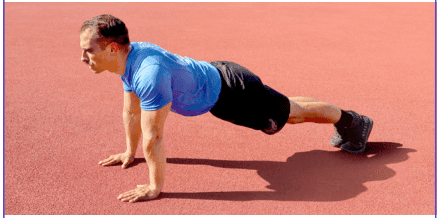
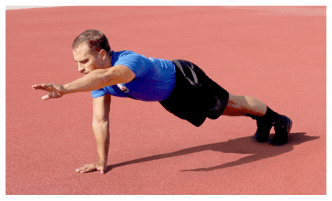
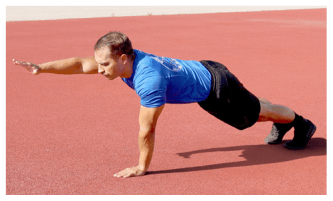
High plank reach-outs - push-up position; extend one arm forward at a time, no hip rotation.
Air squats - feet slightly wider than hip width; hips back, thighs near parallel to ground, chest up, knees tracking the toes.
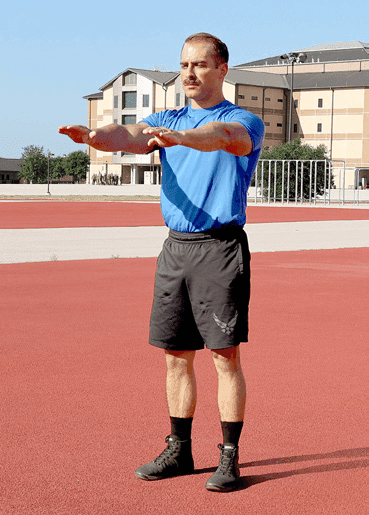
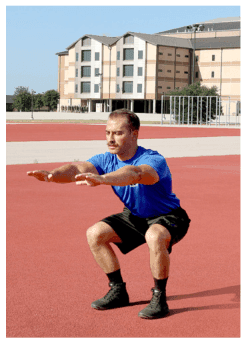
After the round, a 1-minute hydration break, then a controlled run (50-70% effort × 3) - exceeding 70% increases injury risk. Trainees waiting their turn jog in place.
Anaerobic (Muscular Fitness) Training Program
Muscular Fitness sessions also start with the Pre-Exercise Strength Warm-Up. Standards:
- Single (S) - execute alone while counting reps and sets.
- Pairs (P) - two trainees of similar height alternate positions after each set.
- Performer - does the reps and sets.
- Wingman (spotter) - watches the performer, monitors form, corrects, and motivates.
- Sets and reps vary by WOT, emphasizing quality (form) first and quantity second.
Muscular Fitness exercise sequence
| Exercise | Type | Sets | Notes |
|---|---|---|---|
| Pull-ups | S | 3 | Maximum ability; wingmen jog in place behind performer until their turn. |
| Sit-ups | P | 2 | Wingman holds feet; arms cross chest; rest only in the up position during evaluations. |
| Glute bridge | S | 2 | Four-count; reps vary by WOT. |
| In & out | S | 2 | Four-count; reps vary by WOT. |
| Supermans | S | 2 | 20-second hold each set. |
| Leg lift | S | 2 | 20-second hold; feet 6 inches off the ground, low back pressed down. |
| Side plank (L/R) | S | 2 | 20-second hold each side. |
| Heel reaches | S | 2 | Four-count alternating-side crunch reaches. |
| Squat holds | S | 1 | Four-count; reps vary by WOT. |
| Push-up pyramid | S | 1 | Two-count; reps vary by WOT. Performed with overhead press. |
| Overhead press | S | 1 | Two-count; performed with push-up pyramid. |
| American twists | S | 2 | Four-count; reps vary by WOT. |
| Fire hydrants (L/R) | S | 2 | Four-count, one set per side starting left. |
| Reverse crunch | S | 2 | Four-count; reps vary by WOT. |
| High plank/low plank | S | 2 | Four-count, one set per side starting left. |
| Prone row | S | 1 | Two-count; reps vary by WOT. |
| Reverse lunge pyramid | S | 1 | Four-count; performed with squat holds. |
Image rows show the demo sequence for each exercise.
Pull-ups - palms away with thumbs around the bar; pull chin above the bar, lower under control to full extension.
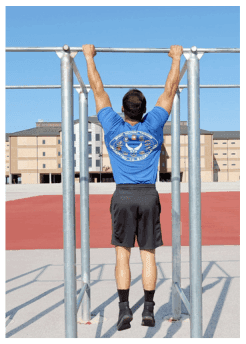
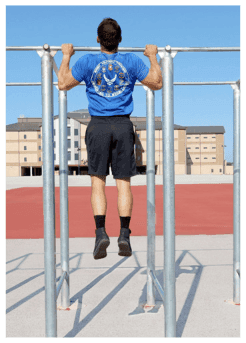
Sit-ups - knees bent 90°, wingman holds feet; arms crossed at chest, elbows touch knees/thigh at the top, shoulder blades touch ground at the bottom.


Glute bridge - supine with knees 90° and feet flat; raise hips to align shoulders, hips, and knees, squeeze glutes, lower under control.
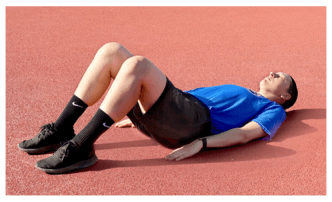
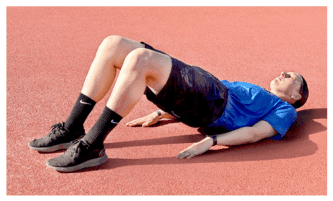
In & out - seated, hands behind hips, fingertips forward; extend legs out leaning back, then bring knees back to 90° (heels off the ground throughout).
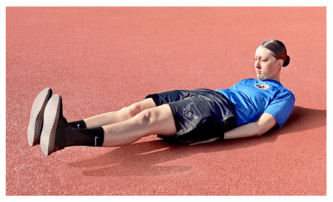
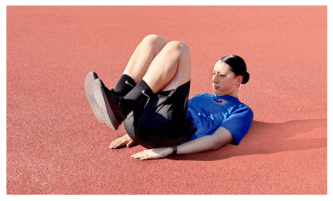
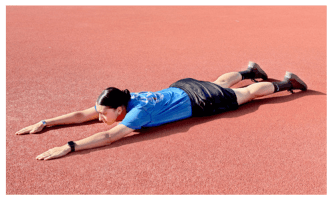
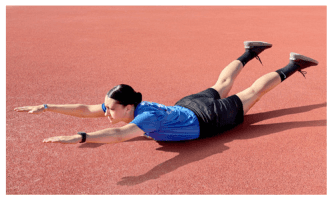
Supermans - face down with arms extended forward, palms down; raise legs and shoulders as high as possible, hold for 20 seconds.
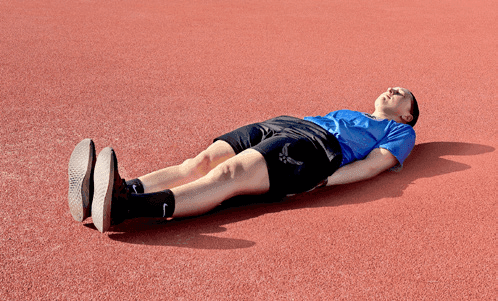
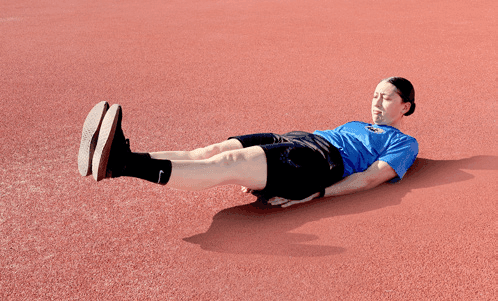
Leg lift - supine with hands under hips; raise feet at least 6 inches off the ground, lower back pressed down, hold 20 seconds.
Side plank (L/R) - on one elbow with legs extended; raise hips into a straight line, hold 20 seconds each side.
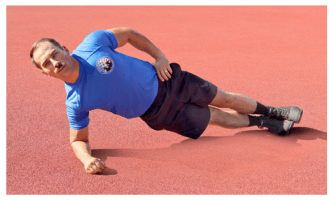
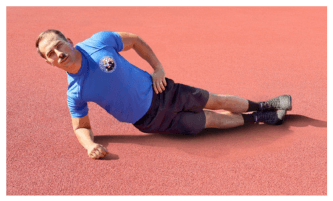
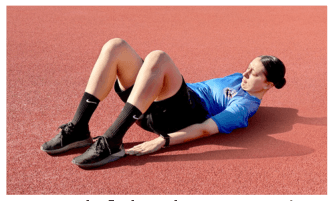
Heel reaches - supine with knees 90°, feet flat, arms by sides; raise shoulders slightly and reach to the same-side heel, alternate sides.

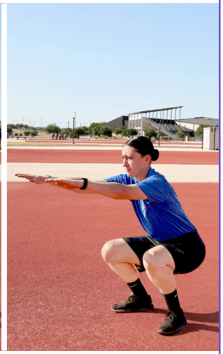
Squat holds - squat down with thighs near parallel, hold for two counts, return to standing.
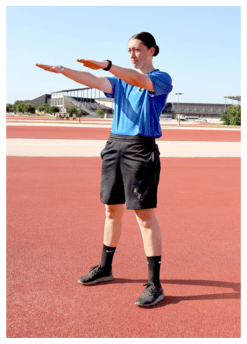
Push-up pyramid - standard push-up form; lower until upper arms are parallel to the ground, return to full arm extension. Performed in conjunction with the overhead press.
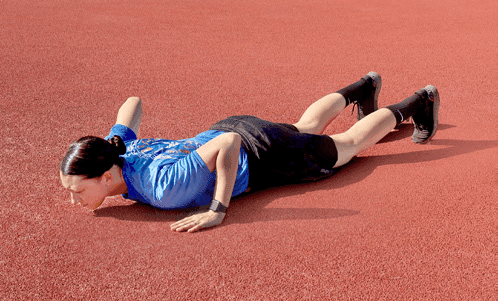
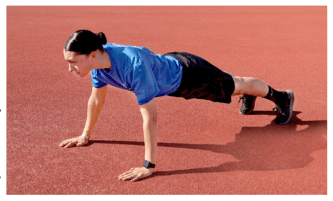
Overhead press - seated with arms above the head; lower elbows to about shoulder height on the down count, press back up on the up count. Performed with the push-up pyramid.
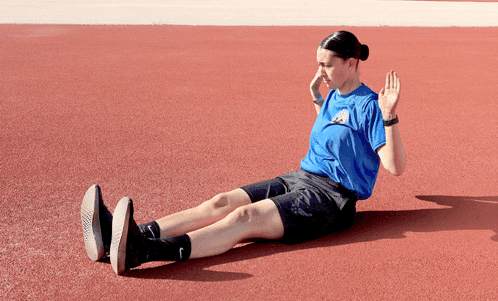
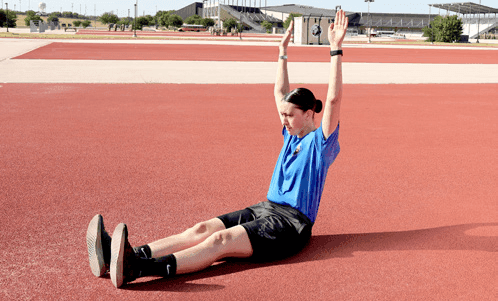
American twists (anaerobic) - seated 45° back-lean with hands clasped at chest; rotate the upper torso left, center, right, center on a four-count.
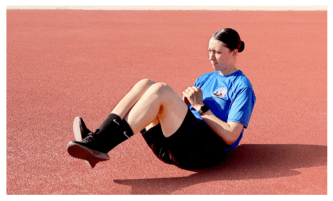
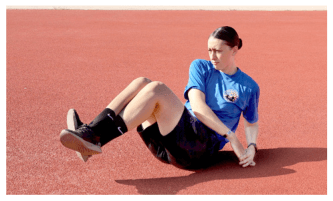
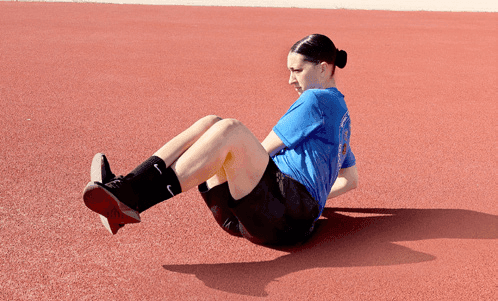
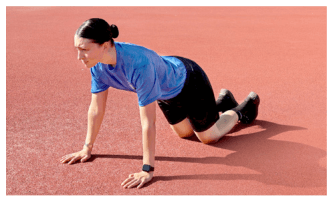
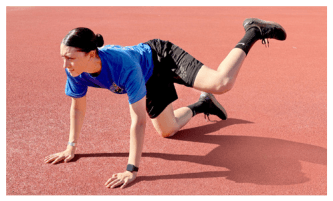
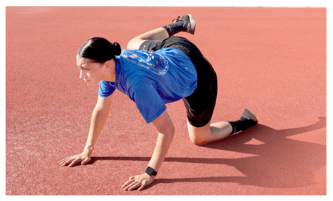
Fire hydrants (L/R) - start on hands and knees; raise the left knee out to 90°, lower; alternate to the right. Hips and shoulders stay stable.
Reverse crunch - same form as the CIT reverse crunch. See the CIT section above for the image sequence.
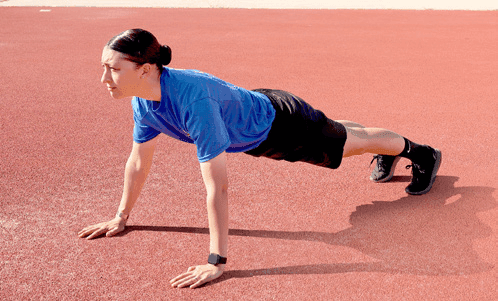
High plank/Low plank - from push-up position, lower onto one forearm at a time, then return up to the high plank one arm at a time. Hips stay square.
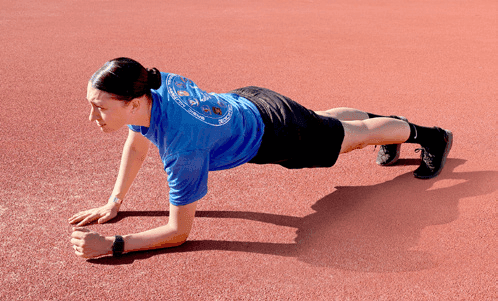
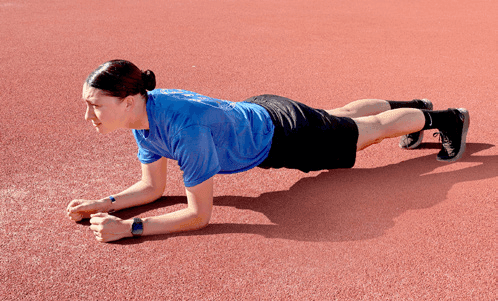
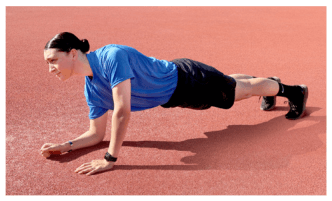
Prone row - face down with arms extended overhead; bend elbows and pull them back along the body while arching the back and lifting the chest, then return.
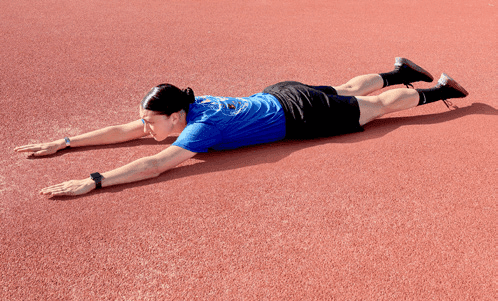
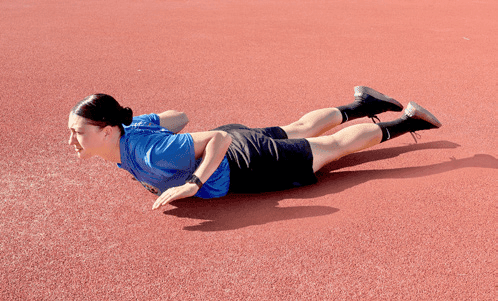
Reverse lunge pyramid - hands on hips; step backward with one foot, drop the back knee toward the ground (front knee stays behind the toes), push back to standing, alternate sides.
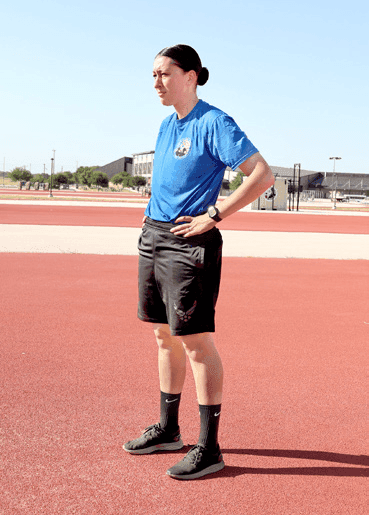
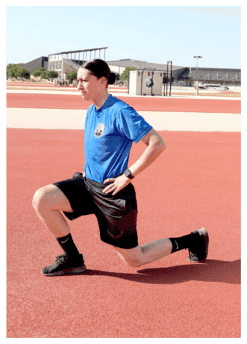
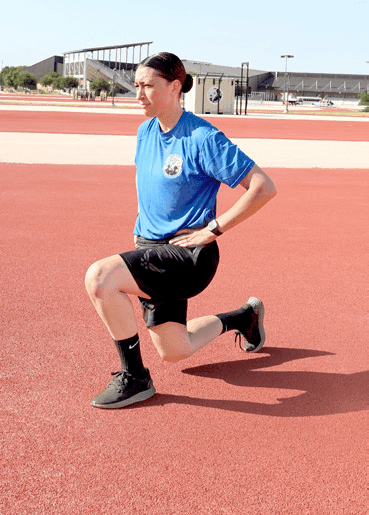
After the muscular fitness exercises end, 1-minute hydration break, then move into the cool-down.
Post-Anaerobic, CIT, and Aerobic Cool Down
This stretch routine runs after all three training programs.
General rules:
- Stretch only after exercising - not before.
- Hold each stretch 15-30 seconds.
- Stretch to gentle tension only - no pain.
- Whole flight performs in unison.
The cool-down stretches:
- Triceps stretch - bent elbow with opposite hand applying mild pressure.
- Quadriceps stretch - pull foot toward gluteus while standing.
- Hip flexor stretch - long forward stance, hips pushed forward.
- Hamstring stretch - hinge at hips, reach toward toes (one side at a time).
- Calf stretch - push-up position with one foot crossed over the other heel.
- Chest stretch - face-down with one arm extended, slight shoulder rotation.
- Figure-4 stretch - supine "figure 4" with knee pulled toward chest.
- 90-90 stretch - seated with both knees at 90°, one in front and one behind, lean toward front knee.
- Groin stretch - soles together, lean forward.
Aerobic (Run) Training Regimen
Your aerobic program begins in the 3rd Week of Training (3 WOT).
Fundamental running principles
- Posture - Spine tall, head up, shoulders back, slight forward lean from the ankles (not bending at the waist).
- Core - Abdominal, side, and hip muscles strong and stable. You can't fire a cannon from a canoe.
- Arms - Carried close to the body, swinging from the shoulders (not the elbows). Elbows bent at 90° or less, mostly forward-back. Hands don't cross midline.
- Feet - Land under your body with a bent knee, not stretched out in front. Avoid landing on a fully extended leg.
- Cadence - Quick and light regardless of pace. Target 180 steps per minute (3 per second).
- Breathing - Slow and comfortable. Don't restrict to nose or mouth alone, and don't pant.
Pre-Run Warm-Up
The aerobic warm-up runs the same idea as the strength/CIT warm-up but tuned for running:
- Brisk walk
- Jumping jacks (20 reps, four-count)
- Forward lunges (3 reps each leg, four-count)
- Squats (10 reps, four-count)
- Calf raises (20 reps, two-count)
- Side hops (20 reps)
- Carioca (2 minutes) - sideways crossover steps.
- High knees / Butt kicks (2 minutes) - alternating drills.
Aerobic interval run
- 24 minutes total interval run.
- 50-70% effort on the curves (run pace), 70-90% effort on the straightaways (push pace).
- Blue and green belts may perform "last-Airman-first" in groups of 5-10.
- Walking breaks under 1 minute are acceptable.
- Bad form significantly increases injury risk. Small changes multiplied by thousands of steps add up - pay attention to it.
Lane assignments
Your post-PT assessment is based on your most recent 1.5-mile appraisal run. Your MTI provides your run time based on your ability group, and you'll be issued a reflective belt for that group. Initial and mid-assessment belt changes are posted in the dayroom.
| Ability Group | Time Range | Runner's Pace | Run Time | Location |
|---|---|---|---|---|
| A | < 11:39 | 2:15 | 26 min | PT Track |
| B | 11:39-12:53 | 2:15 | 26 min | PT Track |
| C | 12:54-14:25 | 2:15 | 26 min | PT Track |
| D | 14:26-17:35 | 2:15 | 26 min | PT Track |
Walking breaks under 1 minute are acceptable.
Brisk walk
A 1-minute brisk walk runs before interval runs and after the self-paced run, in your assigned ability group lane.
Post-Aerobic Exercise Cool Down
Same set of stretches as the post-anaerobic / CIT cool-down - the aerobic program reuses the routine. Hold each stretch 15-30 seconds, gentle tension only, performed in unison with the flight.
Supplemental Strength Sessions
Trainees who fail to meet BMT standards at the initial, 3 WOT, or 5 WOT appraisals must attend supplemental strength training 2-3 times a week. The primary goal is core strength.
- Each exercise: 45 seconds with a 15-second rest interval.
- Next exercise starts every minute on the minute.
- The PT NCO picks one exercise from each grouping below - five total per cycle.
- Repeat twice for three total cycles (~15 minutes).
- Selection should maximize variation between sessions.
| Group | Pick one of |
|---|---|
| Core Strength 1 | V-up · American twists · Reverse crunches · Dead bug |
| Hip Strength / Mobility | Single-leg glute bridge · Single-leg quarter squats · Fire hydrants · Single-leg toe touch |
| Shoulder Stabilization | Cat-camel · Prone stroke · Prone plane |
| Core Strength 2 | Break dancer · Shoulder taps / Knee taps · Crunches · Heel touches |
| Thoracic Extension | Prone row · Alternate Supermans |
Each cycle ends with a cool-down flexibility set (30 seconds each, repeat once for 2 cycles ~2 minutes):
- Inch-worm
- Prone extension hold
Additional stretching is allowed as needed.
One-by-Three Strength Training
The One-by-Three method is the fastest and safest way to increase overall strength when done correctly. It's mandatory for trainees not meeting BMT initial, 3 WOT, or 5 WOT strength standards, and highly encouraged for borderline trainees. One-by-threes are done in addition to regular PT, not as a substitute. Don't accomplish more than three sets in a day.
How it works
Take your most recent eBMT push-up or sit-up count, divide by 3. That's your per-set target. Hit it three times across three one-minute sets.
Worked example - A trainee who can do 15 push-ups in one minute:
- 15 ÷ 3 = 5 push-ups per set.
- Set 1: 5 push-ups in 1 minute. Rest until the next minute.
- Set 2: 5 push-ups in 1 minute. Rest until the next minute.
- Set 3: 5 push-ups in 1 minute. Rest.
Tuning the load
Once you can finish the third set without struggling to complete the last few reps, increase the count. The divide-by-3 number is just your starting benchmark.
If your one-minute maximum is less than 10, modify the exercise to do more reps:
- Push-ups from your knees
- Pull-ups from a lower bar with one foot on the ground
As you gain strength, transition to unmodified form.
Pull-Up Training
All trainees may perform up to three 10-second pull-up sessions per day. Each session = 10 seconds doing as many correct pull-ups as possible.
For trainees who are struggling, alternative forms include:
- Hanging from the bar
- Hanging knee raises
- Feet on the ground at an angle, pulling up to the bar (keeping feet planted)
Same-sex spotters may assist with mounting the bar and conducting the pull-ups.
Self-Guided Exercises in BMT
In addition to the PT program, supplemental PT, and one-by-threes, trainees may perform self-guided strengthening exercises at their own discretion. This includes trainees on waivers, as long as the chosen exercises don't violate the waiver.
Use self-guided exercises to improve physical strength. They may be done during the training day, in the evenings before lights out, or on the weekend, as time permits.
Rules
- If it hurts, don't do it. Try a different exercise.
- Proper form prevents injury. Never sacrifice form for quantity.
- Increase repetitions / time gradually.
Available exercises
This section provides a chart of self-guided exercises with form notes, target muscle groups, recommended reps or holds, and difficulty level (Beginner / Intermediate). Examples include:
- Core: High plank · Side plank (and modified) · Wall sit · Superman hold · Flutter kicks · Bicycle crunches · Crunches
- Hips / Legs: Side leg lift
- Legs / Glutes: Air squats · Front lunge


Summary
PT is as much a lifestyle as it is an operational necessity. A fit Airman is healthier, handles stress better, and is ready for whatever the job throws at them. The BMT PT program builds your physical foundation quickly - but it's on you to take it from there and make it part of your life beyond BMT.