1Z3X1 · Operations
Tactical Air Control Party (TACP)
Also known as: JTAC, Joint Terminal Air Controller, 1C4X1
Last updated
At a glance
- ASVAB minimums
- G 49
- Security clearance
- SecretTop Secret for some positions
- Tech school
- Fairchild, Washington · JBSA Lackland, Texas · Fort Benning, Georgia
- Career field size
- 1,357 Airmen
- Possible bases
- 19 stateside · 12 overseas
- Civilian equivalent pay
- $29k–$116k
- Special warfare / operational
- U.S. citizenship required
Table of ContentsShow
What does the Tactical Air Control Party (TACP) career field do?
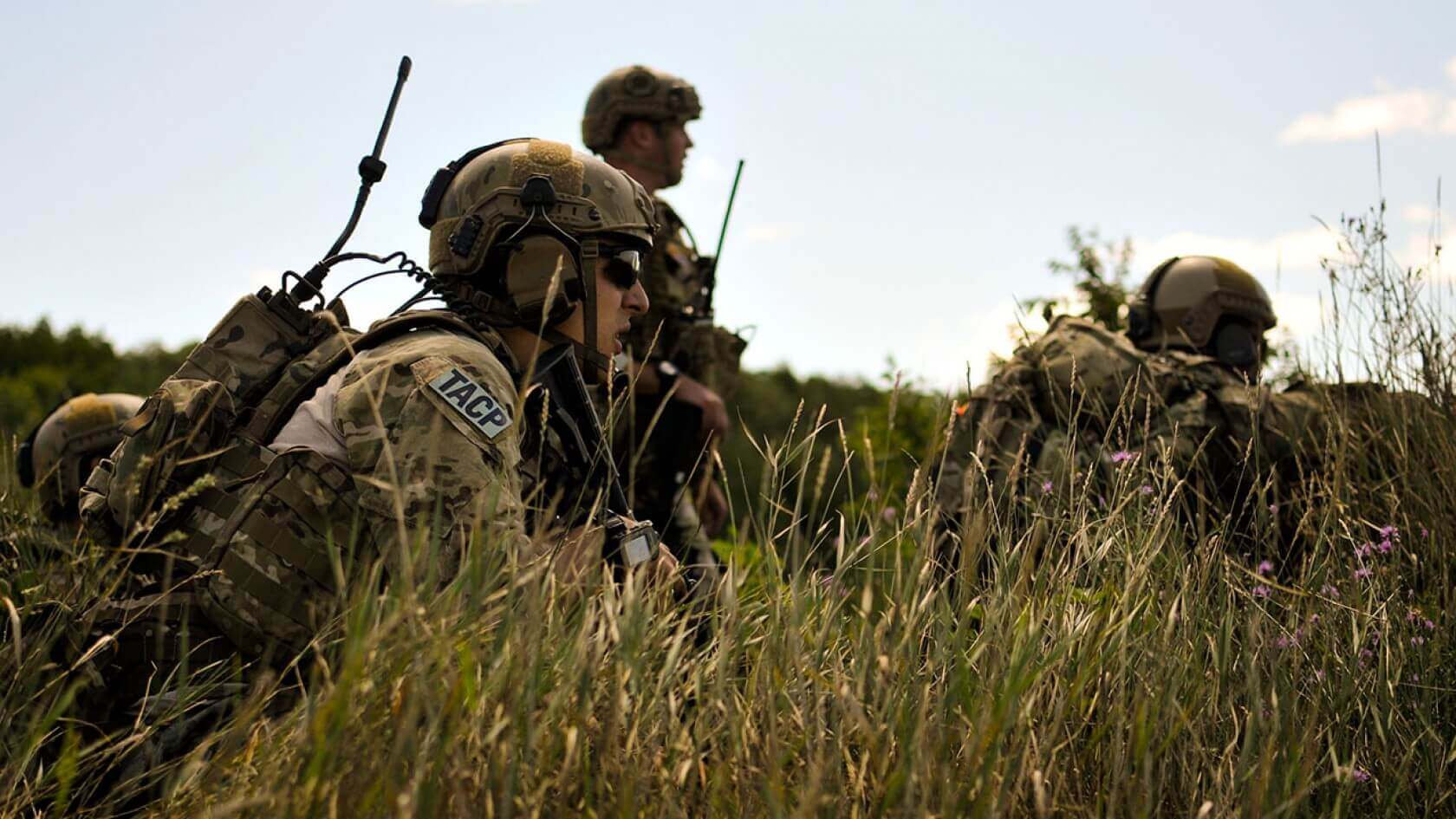
Tactical Air Control Party (TACP) Airmen are Air Force Special Warfare’s premier experts in precision strike, joint fires integration, and distributed command, control, and communications (DC3). They are also expertly trained in surface warfare and enhanced reconnaissance and surveillance for operations at the tactical edge in contested and degraded environments. All TACP Airmen are qualified as a Joint Terminal Attack Controller (JTAC) to maximize their ability to integrate joint fire support on and off the battlefield. They are the critical link to the find, fix, track, target, engage, and assess (F2T2EA) “kill chain” process. TACP Airmen operate in direct ground combat, either alongside Joint, interagency, allied, or coalition forces, or unattached as an independent but integrated element. TACP is aligned with both conventional combat maneuver units and special operations forces. They plan, coordinate, and direct the employment of lethal and non-lethal effects from air and land-based systems. TACP utilizes advanced C3 technologies, networks, and state of the art systems to present effects across the battlespace. They are members of the Special Warfare Airman career field, in accordance with AFPD 10-35, Air Force Special Warfare, and are related to DoD Occupational Subgroup 125000.
Duties and responsibilities
- Planning and Integration. Plans, coordinates, conducts, and manages airpower integration, enabling precision strikes through comprehensive mission planning, airspace management, risk mitigation, and problem-solving. Ensures seamless integration of air and surface fires within the ground scheme of maneuver to maximize combat effectiveness and mitigate risks.
- Joint Terminal Attack Control (JTAC) and Joint Fires. Plans, coordinates, conducts, and manages JTAC and joint fires missions, enabling precision lethality through both air and surface delivered effects. Understands target identification, comprehensive fires employment, terminal attack control, weaponeering, and target marking, ensuring accurate engagements and maximizing joint fires effectiveness.
- Distributed Command, Control, and Communications (DC3). Plans, coordinates, conducts, and manages distributed command, control, and communication (C3), maintaining resilient command and control in highly contested environments. Develops and maintains advanced communication networks to provide interoperability of systems, air-ground operations and network redundancy to improve success of secure precision strike and optimize Airpower application in complex, degraded, and dangerous environments.
- Surface Warfare. Experts in surface warfare capabilities to achieve superior mobility and effectiveness of joint combat operations while conducting insertion and extractions, overland and waterborne movements, and survivability movements in highly contested and degraded environments. Experts in small unit tactics and team movement in areas presenting unique challenges which require specialized tactics, equipment and training to overcome rugged terrain, extreme weather, significant elevation differences, and littoral regions. Masters of small team combat leadership, battlefield situational awareness, land navigation, small arms weapons employment, and mounted or man-portable, multi-role weapons systems, to decisively influence joint combat operations.
- Enhanced Reconnaissance and Surveillance. Plans, coordinates, conducts, and manages enhanced reconnaissance and surveillance, expanding situational awareness and enabling precision targeting. Understands proactive intelligence collection, small unmanned aerial systems (sUAS) employment, Electromagnetic Environment Awareness (EMEA), sensor integration, information dissemination, and reconnaissance mission planning and execution to facilitate decisive air and surface fires effects.
Specialty qualifications
Knowledge. This specialty requires the successful completion of the 1Z3X1 Technical Training pipeline, access to classified information systems; knowledge of Air Force Special Warfare doctrine and implementation; knowledge of theater air, space and cyber operations to include friendly and adversary weapons systems and munitions characteristics and capabilities; aircraft employment; intelligence, surveillance, and reconnaissance capabilities; targeting systems; Special Warfare, JTAC, TACP C2 and CAS tactics, techniques and procedures; airspace control; joint targeting; Military Decision Making Process; Joint Operations Planning Process for Air; and integration of joint precision strike assets; group 1 and 2 Small Unmanned Aerial System piloting and employment; Drop Zone (DZ) and Landing Zone (LZ) control and marking.
- Small unit tactics and field skills include individual and crew-served weapons employment; global positioning equipment; map and navigation techniques; military symbology; tactical communications and computer procedures and equipment; data links; antenna theory; close-quarters combat; waterborne operations; signaling and marking; battlefield lifesaving procedures; casualty collection; and chemical, biological, radiological, and nuclear (CBRN) warfare defense equipment.
- Applies knowledge of: occupational risk management; Joint, Air Force and Army manuals, instructions, technical orders, and regulations; maintains physical readiness; Multi-Domain Command and Control System; TACP C2 and TACP vehicle and support equipment operations/management, and operator maintenance; Air Force and Army supply and mobility procedures; Air Force and Army command and unit staff functions and taskings.
Education. Not used
Training. For award of AFSC 1Z3X1, completion of the following formal courses are mandatory:
- Special Warfare Assessment and Selection (SWAS).
- Special Warfare Zulu Course
- Tactical Air Control Party Apprentice Course.
- SERE S-V97-A Advanced Survival Skills Training and S-V98-A Long Term Survival Skills Training
- USAF Underwater Egress Training (UET) Course
- US Army Airborne Parachutist Course
- 1Z351. Completion of TACP Formal Training Unit
- 1Z371. Completion of Tactical Air Control Party Craftsman Course and 7-level CFETP tasks.
Experience. The following experience is mandatory for award of the AFSC indicated:
- 1Z3XX. Should gain at least one year of experience in strike operations prior to being assigned to the 7FVQC (TACP C2) UTC.
- 1Z351. Qualification in and possession of AFSC 1Z331. Certification as a JTAC as specified in AFMAN 10-3505V1 and AFMAN 10-3505V2 and award of SEI 914.
- 1Z371. Qualification in and possession of AFSC 1Z351 and 12 months in upgrade training (6 months for retrainees).
- 1Z391. Qualification in and possession of AFSC 1Z371. Also, experience in leading and managing Special Warfare operations and teams involving-but not limited to-Precision Strike, Joint Fires Integration, and Military Decision-Making Process.
Other. The following are mandatory as indicated:
- For entry into this specialty:
- Completion of formal assessment and selection as approved by the TACP CFM.
- See attachment 4 for additional entry requirements.
- The following are mandatory for Active Duty retraining and prior service candidates:
- Successful completion of the AFSPECWAR Initial Fitness Test (IFT) within 60 days of EAD.
- Grade E-5 or below with less than 10 years Total Active Federal Military Service who has not been eliminated from an AFSPECWAR training pipeline within the last 24 months.
- The following are mandatory for Air National Guard candidates:
- Successful completion of the Air National Guard TACP 1-Level Program for selection consideration.
- Prior service entries and retraining is limited to E-5 and below.
- For entry, award, and retention of these AFSCs:
- Meet qualification standards to bear firearms IAW DAFI31-117, Arming and Use of Force, by Air Force Personnel, DAFI31-131, Combat Arms Training and Maintenance Program, and DAFMAN 33-131V2 Small Arms and Light Weapons Qualification Programs.
- Meet physical qualification for Special Warfare as outlined in DAFMAN 48-123, Medical Examinations and Standards, and the accompanying Medical Standards Directory (MSD), Special Warfare column. Applicants must also meet physical qualifications for entry into sister service schools such as US Army Airborne Parachutist Course.
- Must possess a valid state driver's license to operate government motor vehicles (GMV) in accordance with AFI 24-301, Vehicle Operations.
- Must maintain eligibility to deploy and mobilize worldwide. Personnel with an Assignment Limitation Code of C-1 or C-2 may retain AFSC 1Z3X1 as long as they are capable of successfully completing all core tasks in the 1Z3X1 Career Field Education and Training Plan.
- Physical qualification and maintenance of human performance standards as defined by Career Field Manager.
- Be a volunteer for jump and ground operations to include TACP and JTAC duties.
- For award and retention of AFSC 1Z331/51/71/91/00:
- Certification as a JTAC in accordance with AFMAN 10-3505V1, Volume 1, Joint Terminal Attack Controller (JTAC) Training Program, and AFMAN 10-3505V2 Joint Terminal Attack Controller Standardization and Evaluation Program.
- Must not be permanently decertified as a JTAC IAW AFMAN 10-3505V2.
- Maintain qualifications for award of SEI 914, JTAC, is required prior to attendance of the 7-level awarding course.
- A passing score on of the AFSPECWAR Operator Fitness Test (OFT).
- For award and retention of these AFSCs:
- Must maintain local network access IAW AFI 17-130, Cybersecurity Program Management and AFMAN 17-1301, Computer Security.
- Specialty requires routine access to Tier 3 (T3) information, systems, or similar classified environment.
- Completion of a current T3 Investigation required IAW DoDM 5200.02, AFMAN 16-1405, Air Force Personnel Security Program, is mandatory.
- 1Z351, 1Z371, 1Z391, and 1Z300 personnel assigned to the 7FVUK/M, 7FVEC/S, 7FVVD/E/F/J/K/L/M, and 7FVQC UTCs, or assigned to staffs, training units, and test and evaluation units require routine access to Tier 5 (T5) material or similar environment. NOTE: Award of the entry level without a completed T3 Investigation is authorized provided an interim Secret security clearance has been granted according to DoDM 5200.02, AFMAN 16-1405
Civilian career paths
Comparable civilian careers for this field pay roughly $28,940 to $116,350 per year (median salaries; varies by role and location):
- Air Traffic Controllers: $130,420
- Athletes and Sports Competitor: $50,850
- Bailiffs: $48,000
- Broadcast Technicians: $43,570
- Career/Technical Education Teachers, Postsecondary: $55,620
- Coaches and Scouts: $36,330
- Computer and Information Systems Managers: $151,150
- Computer Network Support Specialists: $65,450
- Computer Systems Analysts: $93,730
- Correctional Officers and Jailers: $47,410
- Dispatchers: $40,980
- Firefighters: $52,500
- First-Line Supervisors of Correctional Officers: $60,910
- First-Line Supervisors of Firefighting and Prevention Workers: $78,870
- First-Line Supervisors of Mechanics, Installers, and Repairers: $70,240
- First-Line Supervisors of Police and Detectives: $92,970
- Fish and Game Wardens: $58,040
- Fitness and Wellness Coordinators: $116,350
- General and Operations Managers: $103,650
- Light Truck Driver: $37,050
- Network and Computer Systems Administrators: $84,810
- Parking Enforcement Workers: $42,070
- Police and Sheriff's Patrol Officers: $65,540
- Public Safety Telecommunicators: $43,290
- Quality Control Systems Managers: $108,790
- Radio, Cellular, and Tower Equipment Installers and Repairers: $57,720
- Range Managers: $64,020
- Security Guards: $31,050
- Surveying and Mapping Technician: $46,200
- Telecommunications Equipment Installers and Repairers: $61,470
- Telephone Operators: $37,710
- Transit and Railroad Police: $72,580
- Transportation Security Screeners: $44,300
- Umpires, Referees, and Other Sports Officials: $28,940
ASVAB requirements
To qualify for 1Z3X1, you need:
Enter your scores in the AFSC explorer and this section will check each requirement for you.
Entry requirements
Medical profile (PULHES)ShowHide
PULHES scale: lower numbers mean a stricter medical standard. Tap a letter for what it measures.
Vision requirementsShowHide
Medical disqualifiersShowHide
These screened conditions disqualify a candidate for this AFSC:
Physical requirementsShowHide
Education prerequisitesShowHide
Security & backgroundShowHide
Where you could be stationed
Stateside (19)
- Fort Bliss, Texas
- Fort Campbell, Kentucky
- Fort Carson, Colorado
- Fort Drum, New York
- Fort Hood, Texas
- Fort Polk, Louisiana
- Fort Riley, Kansas
- Fort Sill, Oklahoma
- Fort Stewart, Georgia
- Hanscom, Massachusetts
- Hurlburt Field, Florida
- JBSA Camp Bullis, Texas
- JBSA Lackland, Texas
- Joint Base Lewis-McChord, Washington
- Moody, Georgia
- Nellis, Nevada
- Pope, North Carolina
- Shaw, South Carolina
- Will Rogers World, Oklahoma
Overseas (12)
- Al Dhafra, United Arab Emirates
- Camp Ederle, Italy
- Camp Humphreys, South Korea
- Eielson, Alaska
- Fort Wainwright, Alaska
- Hohenfels, Germany
- Istanbul, Turkey
- JB Elmendorf-Rich, Alaska
- Lucius D Clay Kas, Germany
- Osan AB, South Korea
- Vilseck, Germany
- Wheeler, Hawaii
Badges & identifiers
Duty badges
The occupational badges worn by Airmen in this career field.
- Army Ranger Tab
- Army Special Forces Tab
- Command and Control Badge
- Parachutist Badge
- SCUBA Badge
- TACP Beret
Duty identifiers
Special duty patches and identifiers associated with this AFSC.
- TACP Duty Identifier
Degrees & training plan
While serving in 1Z3X1 you can earn associate degrees through the Community College of the Air Force:
- Information Systems Technology
- Strategic Operations Management
- Career Field Education & Training Plan (CFETP)View CFETP (PDF, opens in a new tab)
The CFETP is the official Air Force document describing this career field's full training pipeline, from tech school through advanced skill levels.
Videos, Reddit & resources
1Z3X1 videos(12)
These do not reflect official U.S. Air Force views and may contain inaccuracies — negative opinions are often overrepresented online.
Air Force TACP - 1Z3X1
Airman Vision · 7/23/2025
1 of 12 videos
Reddit discussions(8)
These do not reflect official U.S. Air Force views and may contain inaccuracies — negative opinions are often overrepresented online.
Official links & resources(6)
Researching other jobs too? Every career field's videos and discussions are collected the same way — browse all AFSCs.
Frequently asked questions
- What ASVAB score do you need for Tactical Air Control Party (TACP) (1Z3X1)?
- You need General 49+ on the ASVAB to qualify for 1Z3X1.
- Where can Tactical Air Control Party (TACP) Airmen get stationed?
- 1Z3X1 Airmen serve at 31 bases: 19 stateside and 12 overseas, including Al Dhafra, United Arab Emirates, Camp Ederle, Italy, Camp Humphreys, South Korea.
- Does 1Z3X1 require a security clearance?
- Yes — Tactical Air Control Party (TACP) requires a Secret clearance.
Where this data comes from
Most of the data on this page comes from the Air Force Enlisted Classification Directory (AFECD) and recruiter TTMS readouts, which are no longer released publicly. Pulling it together and keeping it accurate takes real time, so I update these pages as often as I can.
Requirements do change between updates. Before you make any decisions, confirm the details with your recruiter. They always have the latest word.