1A1X3 · Operations
Special Mission Aviator
Also known as: Aerial Gunner
Last updated
At a glance
- ASVAB minimums
- M 60
- Security clearance
- Secret
- Tech school
- JBSA Lackland, Texas · 27 days
- Career field size
- 918 Airmen
- Possible bases
- 10 stateside · 1 overseas
- Civilian equivalent pay
- $44k–$161k
- Aircrew
- Special warfare / operational
- U.S. citizenship required
Table of ContentsShow
What does a Special Mission Aviator do?
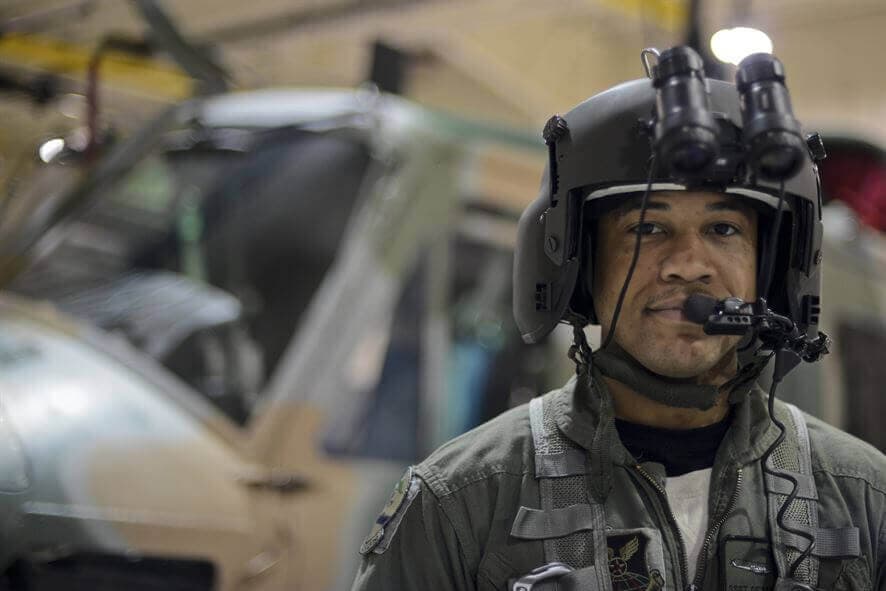
Specialty Summary. The Lead-MAJCOM for aircraft and mission set determines the performance tasks of the Special Mission Aviator (SMA), as outlined in the Master Training Tasks/Task Training Lists for Mission Design Series crew positions. Mission types may include combat rescue, special operations, personnel recovery, mobility operations, nuclear security, domestic security, distinguished visitor transportation, firefighting, and geospatial intelligence collection. The SMA, operating rotary-wing, tiltrotor, or fixedwing aircraft, performs a variety of legacy CEA duties, such as Flight Engineer, Loadmaster, Aerial Gunner, Sensor Operator, Combat Systems Officer, and other specialized roles. The SMA is responsible for receiving cargo and passenger load briefings, verifying the placement of cargo and passengers according to aircraft limitations and restrictions, and ensuring the accuracy of cargo documentation. Additionally, the SMA services the aircraft with fuel, water, and hydraulics, and computes take-off and landing data, including weight and balance calculations. The SMA also demonstrates proficiency in aircrew flight equipment, performs aircrew functions, and manages mission-specific tasks such as personnel and equipment/cargo airdrop. The SMA performs in-flight refueling functions, monitors, and operates complex aircraft instrumentation systems during flight, including engine controls, aircraft systems panels, and indicators. The SMA uses airborne sensors to actively or passively acquire, track, and monitor airborne, maritime, and ground targets, while also overseeing various weapons systems. Some missions require atypical aircraft configurations to penetrate hostile or denied areas undetected, using night vision devices and terrain-following procedures. These missions may also involve operations on unprepared surfaces and runways. To successfully operate in diverse mission and training environments, a SMA must possess professionalism, discipline, attention to detail, knowledge, communication skills, and the ability to manage stress.
Duties and responsibilities
- The SMA performs pre-flight, thru-flight, post-flight, and operational checks/inspection of aircraft systems, including electrical, propulsion, hydraulic, pneumatic, environmental, emergency and flight control systems, according to applicable flight manuals. The SMA also computes and certifies aircraft performance, weight and balance data for takeoff, in-flight, cruise, and landing, ensuring mission execution. The SMA configures the aircraft based on mission requirements and coordinates logistical support. The SMA operates and monitors aircraft systems, including engine starts, flight operations, and engine shutdowns. The SMA observes aircraft systems, instruments, and warning indicators for malfunctions, analyzes issues, and determines the aircraft’s status and mission impact, applying decisive actions as outlined in the flight manuals to mitigate risks and restore systems to operational status. The SMA maintains aircraft flight records, maintenance status forms and performs non-scheduled maintenance, inspections, and servicing of aircraft systems such as fuel, oil, and hydraulic fluids. Additionally, the SMA operates in-flight refueling systems, performs flight testing, and conducts functional check flights following aircraft maintenance and system upgrades.
- The SMA operates mission planning systems and software, collaborating with crewmembers to generate mission plans. This includes determining fuel loads, mission requirements, plotting flight routes, considering factors such as airspeed, distance, navigation methods, altitudes, weather conditions, threats, and terrain. The SMA manages the mission and advises the crew on mission status, aircraft capabilities, time-on-target calculations, changes to flight plans, and corrections to deviations. The SMA monitors aircraft performance during all phases of flight, including altitude, air speed, fuel consumption, weather/terrain-following radio detection and ranging (RADAR), and weapon/defensive systems. The SMA also transmits and receives air traffic clearances, adheres to arrival and departure procedures, and implements joint force command and control mission directives. The SMA performs inspections and operational checks of aircraft defensive systems, identifies and counters air defense systems such as radar, infrared, and optically guided surface-to-air missiles, and executes evasive maneuvers to defeat potential threats.
- The SMA inspects and operates airborne communications systems, RADAR, computers, Electronic Protection, and Electronic Warfare systems. The SMA determines optimal settings for airborne equipment based on console situation displays and tabular data. The SMA troubleshoots, operates, and loads classified operating parameters for RADAR frequency countermeasure systems, infrared countermeasure systems, and other threat detection and communication systems.
- The SMA performs pre-flight inspections and operational checks of aircraft cargo/airdrop systems, in accordance with flight manuals. The SMA develops cargo loading plans, ensuring the correct distribution of weight, verifying the proper placement of cargo, personnel, and equipment. The SMA is also responsible for conducting air and ground infiltration and exfiltration operations, including aerial delivery of personnel and equipment, and cargo sling operations. The SMA calculates the optimal aircraft positioning for cargo or personnel airdrops, based on conditions at the drop zone and parachute aerodynamics. The SMA supervises cargo and personnel airdrops, attaches extraction parachutes to cargo platforms, inspects cargo and platforms, and ensures the correct setup of tie-downs, parachutes, and extraction systems. The SMA ensures all necessary documentation, including flight logs and clearance forms, is completed, and acts as the liaison for interfacing with passengers and military support agencies.
- The SMA performs pre-flight inspections and operational checks of aircraft weapons systems and carries out in-flight maintenance as necessary. The SMA applies decisive actions to restore malfunctioning systems, loads, operates, and positions crew-served weapons, and ensures the proper operation of armament and pyrotechnic systems.
- The SMA performs inspections and operational checks of alternate insertion/extraction, hoist, cargo sling, and firefighting systems, ensuring they meet the requirements outlined in flight manuals and technical orders. The SMA advises the crew of threats and obstacles during approach, landing, and hovering, and assists in maneuvering the aircraft to ensure safe landing/insertion/extraction. The SMA also operates alternate insertion/extraction equipment, including fast rope, rope ladder, and rescue hoist systems, while acting as a safety observer during personnel deployment and recovery operations.
Specialty qualifications
Knowledge. In-depth knowledge of the assigned and supporting mission set(s) is required: combat rescue, special operations, personnel recovery, mobility operations, nuclear security, domestic security, distinguished visitor transportation, firefighting, and or geospatial intelligence collection. Proficiency must also extend to various aircraft systems, including electrical, communication, navigation, mechanical, hydraulic, flight control, pneumatic, fire suppression, environmental, and cabin pressurization systems. A strong understanding of diagram and schematic interpretation, flight theory, fixed- and rotary-wing aerodynamics, in-flight maintenance, aircrew flight equipment, oxygen systems, and aircraft emergency procedures is essential. Familiarity with aircraft performance charts, loading charts, technical publications, operational flight instructions, directives, and procedures is also required. Personnel must understand transport aircraft types, capacities, configurations, as well as secure communication systems. Additional areas of required expertise include cargo restraint techniques, full-motion video systems, ammunition and weapons system care and employment, ballistic principles, weapon malfunction analysis and repair, and explosives safety. Competence in air navigation and air traffic procedures, airway and oceanic routes, navigational aids, weather and atmospheric conditions, terrain-following and weather RADAR, night vision devices, parachute and airdrop operations, hot and aerial refueling, active and passive collection sensors, forward-looking infrared systems (FLIR), advanced countermeasures and threat detection systems are also critical to mission success.
Education. For entry into this specialty, completion of high school or general educational development equivalency with course(s) in mechanics, mathematics, physics, computer principles, speech, and English is desired.
Training. Completion of the following training is mandatory for award of the AFSC indicated:
- 1A113. Completion of Enlisted Undergraduate Flying Training.
- Students without prior rotary-wing aviation service entering shreds B, C, F, and G should complete Career Enlisted Aviator Rotary-Wing Fundamentals Course (CEARF).
- 1A133. Completion of Initial Qualification Training for the assigned aircraft/crew-position and Initial Qualification Course and accompanying Certificate of Aircrew Qualification AF Form 8 in Mission Design Series.
Experience. The following experience is mandatory for award of the AFSC indicated:
- 1A153. Qualification in and possession of AFSC 1A133 is required for AFSC 1A153. Candidates must have experience in key functions such as aircraft performance weight and balance computations, aircraft records tracking, and aircraft systems maintenance and inspections. Additional required competencies include cargo restraint techniques, effective communication practices, familiarity with current flying directives, ability to interpret diagrams, loading charts, and applicable technical publications. Knowledge of border agency clearance requirements and related publications is essential, along with experience in operating cargo loading equipment and conducting cargo/personnel airdrop procedures using appropriate techniques and equipment. Proficiency in inspecting, operating, and troubleshooting aircraft and airborne sensor detection systems, as well as weapons systems, is also mandatory. Responsibilities include performing scanning duties, using night vision goggles (NVGs), managing emergency equipment, and executing in-flight emergency procedures. Members must be able to certify and maintain Mission Ready (MR) and/or Combat Mission Ready (CMR) status. Experience and understanding of aviation organizational functions and support shops - such as Training, Tactics, Standards and Evaluations, and Scheduling - are also required.
- 1A173. Qualification in and possession of AFSC 1A153 is required for AFSC 1A173. In addition, candidates must have experience performing or supervising functions related to Special Missions Aviation activities. This includes knowledge of transport aircraft types, capacities and configurations, airdrop techniques, weight and balance factors, and arithmetic computations relevant to flight operations. Proficiency is also required in the use of emergency equipment and execution of in-flight emergency procedures, personal equipment and oxygen systems, secure communications, and adherence to current flying directives. Candidates must be capable of interpreting diagrams, loading charts, and applicable technical publications, as well as understanding border agency clearance requirements and related documentation. Experience in cargo restraint techniques and in inspecting, operating, and troubleshooting airborne weapons systems is essential. Additional duties include performing scanner tasks, applying NVG procedures, ensuring safe and effective weapons employment, conducting aircrew training and evaluations, and completing all required reports and forms. The ability to supervise aviation organizational functions and support shops - such as Training, Tactics, Standards and Evaluations, and Scheduling - are also required.
- 1A193. Qualification in and possession of AFSC 1A173 and experience managing and directing Special Missions Aviation functions and activities.
Other. The following are mandatory as indicated:
- For entry into this specialty:
- See attachment 4 for entry requirements.
- For entry, award, and retention of these AFSCs:
- Physical qualification for aircrew duty according to DAFMAN 48-123, Medical Examinations and Standard, Class III medical standards.
- Normal depth perception as defined in DAFMAN 48-123.
- Qualification for aviation service according to AFI 11-402, Aviation and Parachutist Service, Aeronautical Ratings and Aviation Badges.
- Must maintain eligibility to deploy and mobilize worldwide.
- Height in accordance with DAFMAN 48-123 and as directed in the current Medical Standards Directory Section T.
- For award and retention of these AFSCs:
- Specialty requires routine access to Tier 3 (T3) information, systems, or similar classified environments.
- Completion of a current T3 Investigation IAW DoDM 5200.02, AFMAN 16-1405, Department of the Air Force Personnel Security Program.
- Must maintain local network access IAW AFMAN 17-1201, User Responsibilities and Guidance for Information Systems and AFMAN 17-1301, Computer Security.
- Must not be downgraded to Non-Mission Ready/Non-Combat Mission Ready (NMR/NCMR), or Unqualified (UQ) Status for more than four periods in a Ready Aircrew Program cycle due to events under the aircrew member’s control. NOTE: Award of the entry level without a completed T3 Investigation is authorized provided an interim Secret security clearance has been granted according to DoDM 5200.02, AFMAN 16-1405.
Civilian career paths
Comparable civilian careers for this field pay roughly $43,570 to $160,970 per year (median salaries; varies by role and location):
- Aircraft Cargo Handling Supervisors: $53,610
- Aircraft Mechanics and Service Technicians: $66,440
- Airline Pilots, Copilots, and Flight Engineers: $160,970
- Aviation Inspectors: $78,400
- Avionics Technicians: $67,840
- Broadcast Technicians: $43,570
- Electrical and Electronics Installers and Repairers, Transportation Equipment: $70,200
- First-Line Supervisors of Mechanics, Installers, and Repairers: $70,240
- Flight Attendants: $59,050
- Intelligence Analysts: $86,940
- Remote Sensing Scientists and Technologists: $107,210
- Remote Sensing Technicians: $52,460
- Transportation Inspectors: $78,400
ASVAB requirements
To qualify for 1A1X3, you need:
Enter your scores in the AFSC explorer and this section will check each requirement for you.
Entry requirements
Medical profile (PULHES)ShowHide
PULHES scale: lower numbers mean a stricter medical standard. Tap a letter for what it measures.
Vision requirementsShowHide
Medical disqualifiersShowHide
These screened conditions disqualify a candidate for this AFSC:
Security & backgroundShowHide
Where you could be stationed
Stateside (10)
- Cannon, New Mexico
- Duke Field, Florida
- Eglin, Florida
- Fairchild, Washington
- Fort Rucker, Alabama
- Hurlburt Field, Florida
- JB Andrews, Maryland
- JBSA Lackland, Texas
- Kirtland, New Mexico
- Moody, Georgia
Overseas (1)
- Mildenhall, United Kingdom
Badges & identifiers
Duty badges
The occupational badge worn by Airmen in this career field.
- Enlisted Aircrew Badge
Duty identifiers
Special duty patches and identifiers associated with this AFSC.
- CEA Duty Identifier
Degrees & training plan
- Career Field Education & Training Plan (CFETP)View CFETP (PDF, opens in a new tab)
The CFETP is the official Air Force document describing this career field's full training pipeline, from tech school through advanced skill levels.
1A1X3 specialties (shred-outs)
This career field splits into 8 specialties — you may be assigned to one of these:
- 1A1X3AAC-130J Gunner
- 1A1X3BCV-22B Flight Engineer
- 1A1X3CUH-1N/TH-1H Flight Engineer
- 1A1X3DHC-130J Loadmaster
- 1A1X3EMC-130J Loadmaster
- 1A1X3FHH-60W Flight Engineer
- 1A1X3GMH-139A Flight Engineer
- 1A1X3HC-146A Loadmaster
Shred-outs share the 1A1X3 career path; where a specialty sets its own minimums or screens, they're noted above.
Videos, Reddit & resources
1A1X3 videos(9)
These do not reflect official U.S. Air Force views and may contain inaccuracies — negative opinions are often overrepresented online.
Duties of a Special Missions Aviator
Military Excursions · 6/5/2025
1 of 9 videos
Reddit discussions(5)
These do not reflect official U.S. Air Force views and may contain inaccuracies — negative opinions are often overrepresented online.
Official links & resources(3)
Researching other jobs too? Every career field's videos and discussions are collected the same way — browse all AFSCs.
Frequently asked questions
- What ASVAB score do you need for Special Mission Aviator (1A1X3)?
- You need Mechanical 60+ on the ASVAB to qualify for 1A1X3.
- Where can Special Mission Aviator Airmen get stationed?
- 1A1X3 Airmen serve at 11 bases: 10 stateside and 1 overseas, including Mildenhall, United Kingdom.
- Does 1A1X3 require a security clearance?
- Yes — Special Mission Aviator requires a Secret clearance.
- How long is tech school for Special Mission Aviator?
- Tech school for 1A1X3 runs about 27 days at JBSA Lackland, Texas.
Where this data comes from
Most of the data on this page comes from the Air Force Enlisted Classification Directory (AFECD) and recruiter TTMS readouts, which are no longer released publicly. Pulling it together and keeping it accurate takes real time, so I update these pages as often as I can.
Requirements do change between updates. Before you make any decisions, confirm the details with your recruiter. They always have the latest word.