1A1X8 · Operations
Executive Mission Aviator
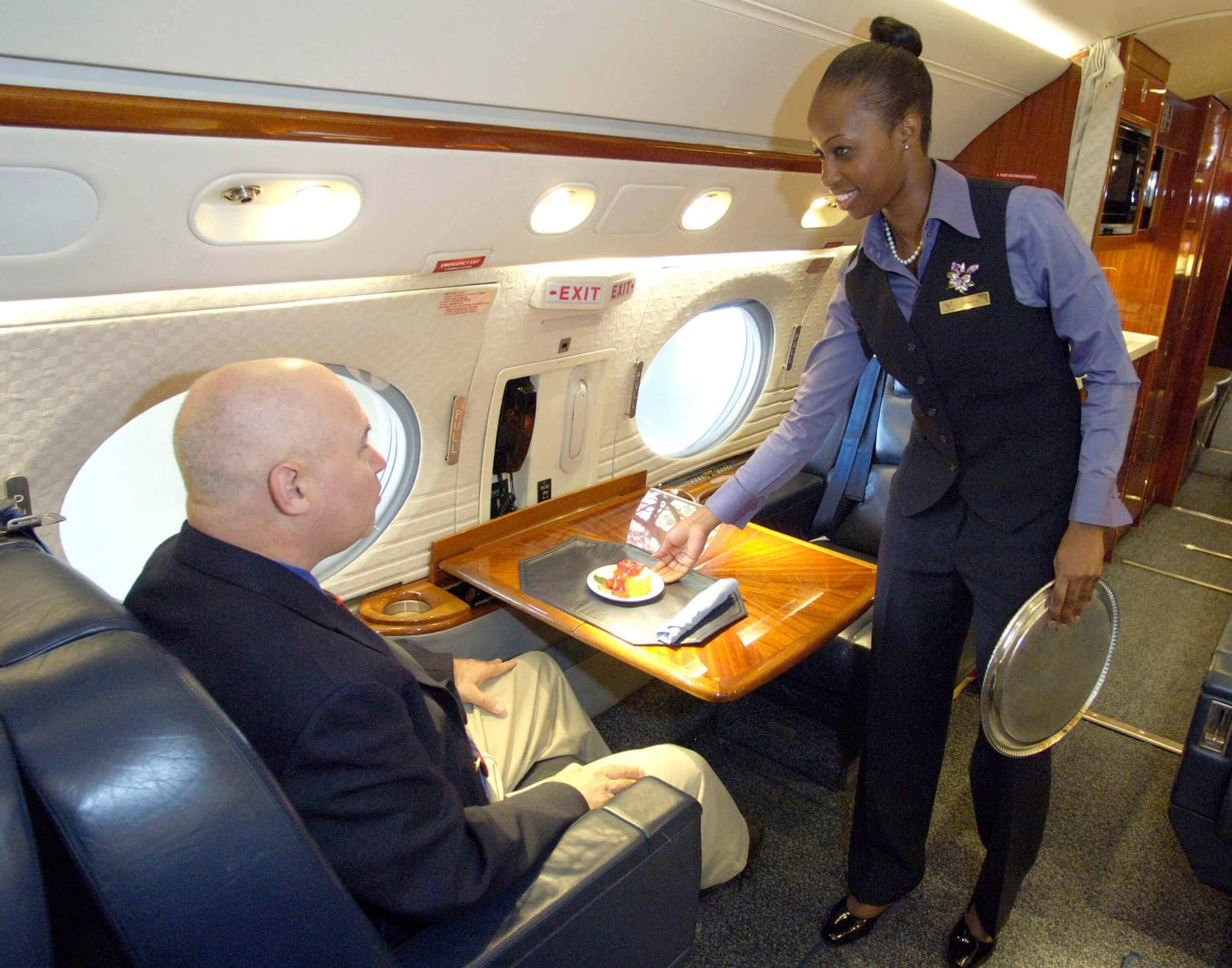
Also known as: Flight Attendant
Last updated
At a glance
- ASVAB minimums
- M 60+A 50
- Security clearance
- Top Secret
- Tech school
- JBSA Lackland, Texas · 37 days
- Career field size
- 215 Airmen
- Possible bases
- 3 stateside · 0 overseas
- Civilian equivalent pay
- $25k–$59k
- Aircrew
- Prior service only
- U.S. citizenship required
Table of ContentsShow
What does an Executive Mission Aviator do?
The Lead-MAJCOM for aircraft and mission set will determine the Executive Mission Aviator (EMA) performance tasks as outlined in Master Training Tasks/Task Training Lists associated with the Mission Design Series (MDS) crew position. Performs aircrew functions aboard various Executive Airlift platforms. Performs aircraft visual inspections, in-flight duties, employs aircraft equipment and information systems in direct support of the National Command Authority and Senior Advisors. Computes aircraft take-off and landing data/weight and balance. Some missions require non-standard configurations and operations into geopolitical contentious environments and are responsible for handling and safety of mission customers. Supervises and instructs personnel in operation, repair, and alternate procedures. Establishes, manages, and supervises airborne mission systems operation and directs aircrew Training. The critical nature of the mission and associated training environments demands high degrees of attention, focus, professionalism, knowledge, skill, discipline, coordination, and stress management to successfully and safely carry out. Related DoD Occupational Subgroup: 120100, 155300, 195000.
Duties and responsibilities
- Responsible for passenger safety and care during aircraft operations. Demonstrates and maintains proficiency in emergency equipment use, emergency procedures, and egress. Briefs passengers on normal and non-normal use of aircraft systems/equipment and provides emergency medical assistance.
- Performs as the direct contact between the USAF and the passenger. Plans and coordinates all passenger needs for normal and non-normal use of aircraft systems and equipment requirements. Passengers include but are not limited to US and foreign senior military and governmental leaders.
- Performs loading and off-loading of aircraft. Coordinates with military and civilian airfield agencies to acquire supplies and transportation. Validates passenger manifest. Performs passenger and baggage inspections. Applies restraint devices such as straps and nets to prevent shifting during flight. Ensures access to escape exits. Directs safety, security, and fire prevention procedures.
- Computes takeoff, climb, cruise, and landing data. Determines engine fuel consumption using airspeed, atmospheric data, charts, computer, or electronic calculator. Records actual aircraft performance data in flight engineer's log.
- Operates, monitors, and repairs airborne voice and data communication systems. Plans, organizes, and coordinates mission activities and materials. Determines aircraft status and coordinates link establishment and network connectivity information. Interprets computer-generated displays, data, and alarms, and takes appropriate switch actions. Performs preflight, in-flight, and post flight inspections. Performs initial power-on and testing of airborne communications, computers, and electronic systems. Establishes and maintains voice and data communications circuits/links. Repairs and maintains airborne communications, computers, and electronic systems. Operates aircraft emergency systems and equipment.
- Operates and monitors engine and aircraft systems controls and indicators. Assists pilot or performs engine starts, and monitors run-up, flight operations, and engine shutdown. Operates engine controls to provide desired efficiency and economy. Monitors engine instruments throughout period of operation. Controls, monitors, and regulates aircraft systems such as electric, communication, navigation, hydraulic, fuel, air conditioning, and pressurization; ventilation; auxiliary power unit; and lubrication systems. Observes warning indicators and light for fire, overheat, depressurization, and system failure. Reports abnormal conditions to pilot and recommends corrective action. Visually monitors aircraft clearances (interior and exterior), identifies proximal threats to the aircraft and initiates corrective actions (aircraft scanning).
- Establishes, supervises, and directs aircrew Training. Develops and directs instruction in equipment operation and Executive Mission Aviator activities. Ensures standardized procedures are taught and used to teach in-flight equipment operation, baggage handling, customer service, form documentation, emergency procedures, and egress. Determines need for specific instruction and establishes training programs on Executive Mission Aviator activities.
- Evaluates Executive Mission Aviator activities. Evaluates compliance with technical manuals, regulations, and work standards. Serves on or directs Executive Mission Aviator inspection teams to evaluate in-flight duties and operational programs. Interprets inspection reports and prescribes corrective actions.
Specialty qualifications
Knowledge. Mandatory knowledge of: normal and emergency aircraft procedures, emergency equipment location and use, basic first aid; aircraft systems to include electrical, communication systems, navigation, mechanical, hydraulic, aircraft refueling, flight control, pneumatic, fire suppression, environmental, and cabin pressurization; flight theory; minor in-flight maintenance; using and interpreting diagrams, schematics, aircraft performance charts, arithmetic, weight and balance factors, and loading charts; secure communications use (UHF, VHF, SATCOM, IFF); Interpreting and adhering to Technical Orders/publications, flying instructions/directives/procedures, Air Force Instructions, border agency clearance requirements, and aircraft forms; types, capacities, and configuration of transport aircraft; dispensing and preserving food aboard aircraft; Personnel must maintain competency in customer service/relations, and interpersonal communications.
Training. Completion of the following training is mandatory for award of the AFSC indicated:
- 1A118. Completion of Enlisted Undergraduate Flying Training.
- 1A138. Completion of Initial Qualification Training for the assigned aircraft/crew-position and Initial Qualification Course and accompanying Certificate of Aircrew Qualification AF Form 8 in Mission Design Series.
Experience. The following experience is mandatory for award of the AFSC indicated:
- 1A158. Possession of AFSC 1A138 and completion of Mission Qualification Training. Experience in operating and maintaining airborne equipment and/or information systems; certify and maintain Mission Ready (MR) and/or Combat Mission Ready (CMR) status; experience and understanding in aviation organizational functions and shops.
- 1A178. Qualification in and possession of AFSC 1A158. Experience and qualification in advanced operations and employment of aircraft mission systems. Ability to supervise aviation organizational functions and shops to include Training, Tactics, Scheduling, and Evaluations.
- 1A198. Qualification in and possession of AFSC 1A178 and experience managing and directing Special Missions Aviation functions and activities.
For entry into this specialty:
- Lead MAJCOMs will establish MDS assignment/hiring criteria
- See attachment 4 for entry requirements.
- No record of substance abuse, domestic violence, or child abuse.
- Never been convicted by a general, special, or summary courts-martial.
- Never been convicted by a civilian court of Category 1, 2, or 3 offenses, nor exceeded the accepted number of Category 4 offenses. Category 3 and 4 traffic offenses alone are not disqualifying.
- Completion of a current T5 Investigation required IAW DoDM 5200.02, AFMAN 16-1405, Air Force Personnel Security Program.
For award and retention of these AFSCs:
- Physical qualification for aircrew duty according to DAFMAN 48-123, Medical Examinations and Standards, Class III medical standards.
- Normal depth perception as defined in DAFMAN 48-123.
- Qualification for aviation service according to AFI 11-402, Aviation and Parachutist Service, Aeronautical Ratings and Aviation Badges.
- Must maintain eligibility to deploy and mobilize worldwide.
- Height in accordance with DAFMAN 48-123 and as directed in the current Medical Standards Directory Section T.
- Ability to speak clearly and distinctively.
- Must maintain local network access IAW AFI 17-130, Cybersecurity Program Management and AFMAN 17-1301, Computer Security.
- Specialty requires routine access to Tier 5 (T5) information systems or similar classified environments.
- Must not be downgraded to Non-Mission Ready/Non-Combat Mission Ready (NMR/NCMR), or Unqualified (UQ) Status more than four periods in a Ready Aircrew Program cycle due to events under the aircrew member’s control. NOTE: Award of the entry level without a completed T5 Investigation is authorized provided an interim Top-Secret security clearance has been granted according to DoDM 5200.02, AFMAN 16-1405.
Civilian career paths
Comparable civilian careers for this field pay roughly $25,110 to $59,050 per year (median salaries; varies by role and location):
- Career/Technical Education Teachers, Post secondary: $55,620
- First-Line Supervisors of Passenger Attendants: $54,870
- First-Line Supervisors of Personal Service Workers: $42,000
- Flight Attendants: $59,050
- Food Service Managers: $56,590
- Locker Room, Coatroom, and Dressing Room Attendants: $26,700
- Passenger Attendants: $28,770
- Reservation and Transportation Ticket Agents and Travel Clerks: $39,430
- School Bus Monitors: $31,960
- Tour Guides and Escorts: $29,460
- Transportation Security Screeners: $44,300
- Travel Guides: $29,460
- Ushers, Lobby Attendants, and Ticket Takers: $25,110
ASVAB requirements
To qualify for 1A1X8, you need:
Enter your scores in the AFSC explorer and this section will check each requirement for you.
Entry requirements
Medical disqualifiersShowHide
These screened conditions disqualify a candidate for this AFSC:
Security & backgroundShowHide
Where you could be stationed
Stateside (3)
- JBSA Lackland, Texas
- Joint Base McGuire-Dix-Lakehurst, New Jersey
- Scott, Illinois
Badges & identifiers
Duty badges
The occupational badge worn by Airmen in this career field.
- Enlisted Aircrew Badge
Duty identifiers
Special duty patches and identifiers associated with this AFSC.
- CEA Duty Identifier
Degrees & training plan
- Career Field Education & Training Plan (CFETP)View CFETP (PDF, opens in a new tab)
The CFETP is the official Air Force document describing this career field's full training pipeline, from tech school through advanced skill levels.
1A1X8 specialties (shred-outs)
This career field splits into 11 specialties — you may be assigned to one of these:
- 1A1X8AC-32/C-40B/C Flight Attendant
- 1A1X8BC-32/C-40B/C Communications Systems Operator
- 1A1X8CC-37A/B Flight Attendant
- 1A1X8DC-37A/B Flight Engineer
- 1A1X8FC-37A/B Communications Systems Operator
- 1A1X8GE-4B Flight Engineer
- 1A1X8HE-4B Flight Attendant
- 1A1X8IE-4B Communications Systems Operator/Technician/Controller
- 1A1X8JPresidential Airlift Group, Flight Engineer
- 1A1X8KPresidential Airlift Group, Flight Attendant
- 1A1X8LPresidential Airlift Group, Communication System Operator
Shred-outs share the 1A1X8 career path; where a specialty sets its own minimums or screens, they're noted above.
Videos, Reddit & resources
1A1X8 videos(8)
These do not reflect official U.S. Air Force views and may contain inaccuracies — negative opinions are often overrepresented online.
Air Force Executive Mission Aviator (Flight Attendant) 1A1X8
Airman Vision · 9/21/2025
1 of 8 videos
Reddit discussions(1)
These do not reflect official U.S. Air Force views and may contain inaccuracies — negative opinions are often overrepresented online.
Official links & resources(1)
Researching other jobs too? Every career field's videos and discussions are collected the same way — browse all AFSCs.
Frequently asked questions
- What ASVAB score do you need for Executive Mission Aviator (1A1X8)?
- You need Mechanical 60+ and Administrative 50+ on the ASVAB to qualify for 1A1X8.
- Where can Executive Mission Aviator Airmen get stationed?
- 1A1X8 Airmen serve at 3 bases: 3 stateside and 0 overseas.
- Does 1A1X8 require a security clearance?
- Yes — Executive Mission Aviator requires a Top Secret clearance.
- How long is tech school for Executive Mission Aviator?
- Tech school for 1A1X8 runs about 37 days at JBSA Lackland, Texas.
Where this data comes from
Most of the data on this page comes from the Air Force Enlisted Classification Directory (AFECD) and recruiter TTMS readouts, which are no longer released publicly. Pulling it together and keeping it accurate takes real time, so I update these pages as often as I can.
Requirements do change between updates. Before you make any decisions, confirm the details with your recruiter. They always have the latest word.