1Z2X1 · Operations
Combat Control
Also known as: CCT, 1C2X1
Last updated
At a glance
- ASVAB minimums
- G 49
- Security clearance
- SecretTop Secret for some positions
- Tech school
- Fairchild, Washington · JBSA Lackland, Texas · Keesler, Mississippi · Pope, North Carolina · Fort Benning, Georgia · 179 days
- Career field size
- 646 Airmen
- Possible bases
- 8 stateside · 0 overseas
- Civilian equivalent pay
- $43k–$130k
- Special warfare / operational
- U.S. citizenship required
Table of ContentsShow
What does the Combat Control career field do?
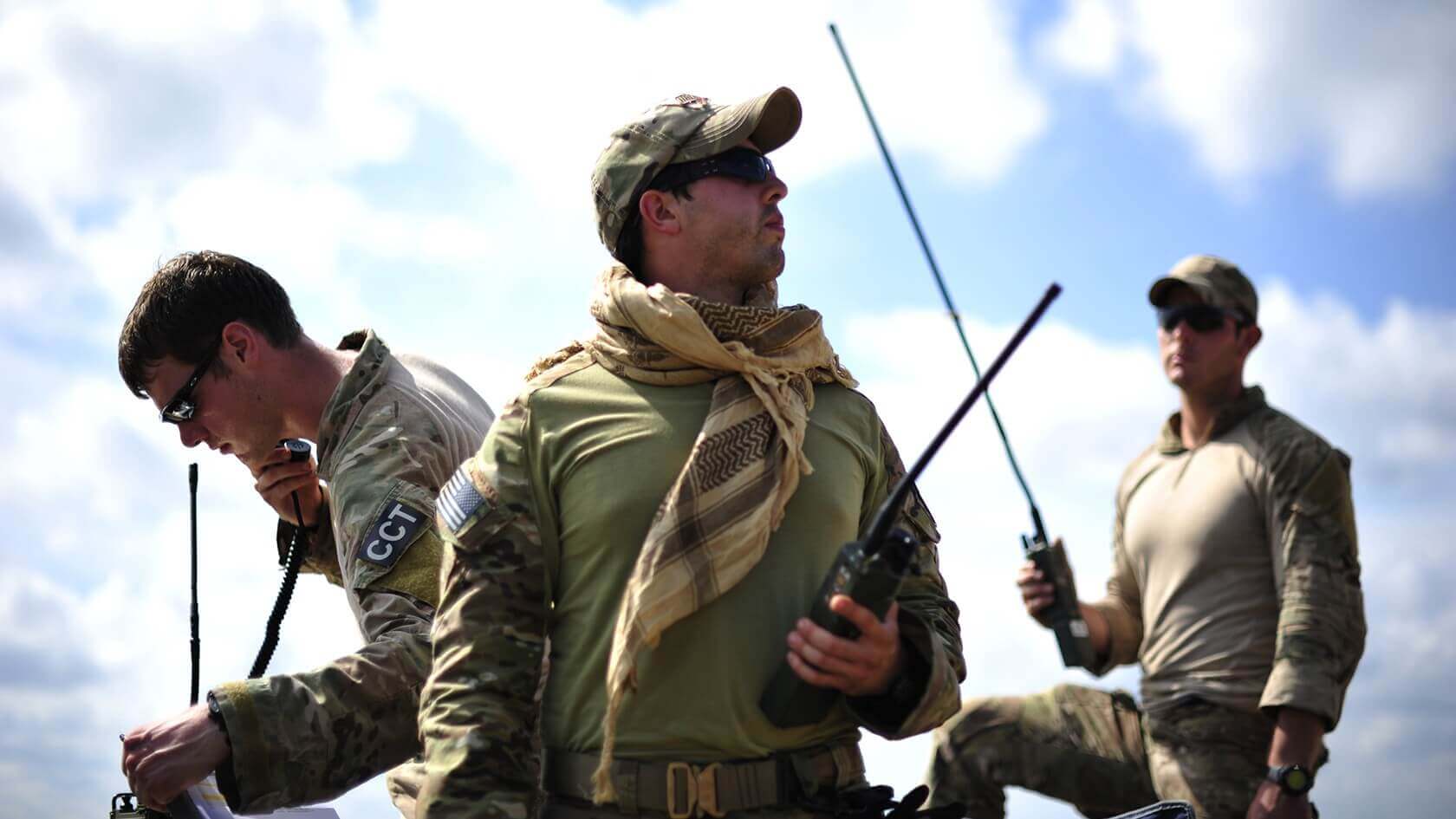
Provides command, control, communications, intelligence, surveillance, and reconnaissance (C3ISR) to assist, control and enable the application of manned and unmanned, lethal, and non-lethal airpower in all geographic and environmental conditions across the full spectrum of military operations. Includes terminal control (air traffic control [ATC]) and targeting, and control of air strikes (including joint terminal attack control [JTAC]) (ground, air, and space deconfliction) and use of visual and electronic aids to control airheads and enable precision navigation. Provides long-range voice and data command and control and communications. Performs tactical level surveillance and reconnaissance functions, fusing organic and remote-controlled technologies and manned platforms to build the common operating picture (COP). Related DoD Occupational Subgroup: 125000.
Duties and responsibilities
- Plans, organizes, supervises, and establishes ATC in the target area. Initiates, coordinates, and issues ATC clearances, holding instructions, and advisories to maintain aircraft separation and promote safe, orderly, and expeditious flow of traffic under visual and conventional approach control flight rules. Operates and monitors portable and mobile communications equipment and terminal and tactical navigational aids required to control and support air traffic in forward areas. Evaluates and relays status of airfields and assault zones to inbound aircraft and higher headquarters. Provides limited weather observations, including surface and altitude wind data, temperature, and cloud heights. Prepares and issues advisories to pilots, ATC and other agencies concerning weather, notice-to-airmen information, air traffic flow control measures, and wake turbulence. Provides flight assistance and emergency service to air traffic. Records weather and ATC data. Controls vehicular traffic on the airport movement area.
- Plans, coordinates, and conducts reconnaissance and surveillance of potential assault zones, targets, and areas of interest. Operates advanced technologies, including ground-based sensors and unmanned aerial systems (UAS) to support reconnaissance and target identification. Surveys runways, assault zones (drop zones, landing zones, vertical lift / helicopter landing zones, forward area refueling points [FARP]) and other areas critical to aviation and records data for inclusion in mission plans. Reports current battlefield information.
- Identifies, assesses, and marks assault zones with visual and electronic navigational aids for day and night air-land and airdrop operations. Coordinates clearances, instructions, advisories, and air traffic movement with forward and rear area commanders. Uses ground-to-air communications equipment in conjunction with visual and electronic systems to control and expedite the movement of en route, arriving, and departing air traffic. Directs actions to handle aircraft emergencies or mishaps. Coordinates casualty and patient evacuation between aviation and medical personnel. Provides airlift operations support that cannot be provided by combat communications groups or other agencies. Operates global positioning systems (GPS) equipment for targeting, navigation, and for the location, assessment, and establishment of assault zones. Coordinates airfield ground support (crash/fire/rescue, sweep).
- Targets and controls fires. Plans, coordinates, and conducts fires to accomplish supported commander objectives. Includes JTAC and supporting arms for surface elements and C3ISR in support of combined forces air component commander (CFACC) assets and/or combined forces Special Operations component commander (CFSOCC). Employs visual and electronic navigation and marking equipment to direct aviation assets to target. Issues weapons release clearance.
- Deploys into semi- and non-permissive forward areas and forward operating locations by land (mounted, special purpose vehicle or dismounted), sea (surface or subsurface naval vessel, small watercraft, self-contained underwater breathing apparatus [SCUBA], closed circuit, or surface swim) or air (parachute, airmobile, air-land) to participate in the full spectrum of military operations to include air expeditionary force (AEF), force projection, direct action (DA), counterterrorism (CT), counter-proliferation (CP), foreign internal defense (FID), humanitarian assistance (HA), special reconnaissance (SR), personnel recovery (PR), noncombatant evacuation operations (NEO), integrated survey program (ISP), counter narcotic (CN), operational preparation of the environment (OPE), advanced force operations (AFO) and fire support operations. Uses demolitions to remove obstacles. Maintains qualification on primary assigned weapons.
Specialty qualifications
Knowledge. Knowledge is mandatory of: ATC, reconnaissance and air power control principles and procedures; aircraft flight characteristics; encompassing tactical airlift and weapons delivery; air and surface firepower systems and effects; International Civil Aviation Organization (ICAO), Federal Aviation Administration (FAA), and military air regulations; map, aeronautical chart, and publication use; characteristics and use of tactical and ATC communications systems and equipment, air navigation aids, night vision equipment; GPS and other operational equipment; meteorology principles; deployment procedures; joint service operation; infiltration techniques; movement and route selection; alternate insertion and extraction (AIE) methods; parachute procedures and equipment; jump master training; small unit tactics; amphibious and SCUBA operations; small arms and crew served weaponry; and destructive demolition applications.
Education. Not used.
Training. Completion of the following courses is mandatory for award of AFSC 1Z231:
- Special Warfare Candidate Course (SWCC).
- Special Warfare Assessment and Selection Course.
- Special Warfare Air Traffic Control (SWATC).
- Level C SERE Combat Survival Training.
- US Army Airborne Parachutist (Static-line Parachutist).
- Military Freefall Parachutist.
- Combat Control Apprentice Course.
Experience. The following experience is mandatory for award of the AFSC indicated:
- 1Z251. Qualification in and possession of AFSC 1Z231. Also, experience in performing Combat Control duties.
- 1Z271. Qualification in and possession of AFSC 1Z251. Also, experience performing and supervising Combat Control duties.
- 1Z291. Qualification in and possession of AFSC 1Z271. Also, experience performing and managing Combat Control functions as a flight leader.
Other. The following are mandatory as indicated:
- For entry into this specialty:
- Successful completion of the AFSPECWAR Candidate Fitness Test (CFT).
- Air National Guard (ANG) CCT candidates must complete the ANG 1Z2/CCT ONE-LEVEL Program for selection consideration.
- See attachment 4 for additional entry requirements.
- The following are additionally mandatory for Active-Duty retraining candidates:
- Successful completion of the AFSPECWAR Initial Fitness Test (IFT).
- Grade of E-5 or below with less than 10 years Total Active Federal Military Service (Total Federal Military Service for Reserve of the Air Force personnel).
- Current commander’s written recommendation.
- Completion of, and selection into, the Combat Control Retraining Assessment Process (AD Only, AFPC will provide requirements upon retraining approval, includes passing an IFT within 60 days of SWCC start date).
- For entry, award, and retention of AFSC:
- Meet qualification standards to bear firearms IAW AFI 31-177, Arming and Use of Force by Air Force Personnel, AFI 36-2654, Combat Arms Program, and AFMAN 36-2655, USAF Small Arms and Light Weapons Qualification Programs.
- Meet physical qualification Special Warfare IAW AFI 48-123, Medical Examinations and Standards, and the accompanying Medical Standards Directory (MSD), Special Warfare column. Applicants must also meet physical qualifications for entry into sister service schools such as Army Airborne, Freefall, and Navy Dive, as applicable.
- Must possess a valid state-issued driver’s license to operate government motor vehicles (GMV) in accordance with AFI 24-301, Vehicle Operations.
- Ability to speak English clearly and distinctly as demonstrated by Reading Aloud Test (RAT).
- For entry, award, and retention of AFSCs 1Z211/31/51/71/91/00:
- Maintain qualification as a static line and military freefall parachutist IAW AFMAN 10-3500V2, Air Force Special Warfare Standardization and Evaluations.
- Passing completion of the AFSPECWAR Operator Fitness Test (OFT).
- For the award and retention of AFSCs 1Z2XX:
- Must maintain local network access IAW AFI 17-130, Cybersecurity Program Management and AFMAN 17-1301, Computer Security.
- Specialty requires routine access to Tier 3 (T3) information, systems, or similar classified environments.
- Completion of a current T3 Investigation required IAW DoDM 5200.02, AFMAN 16-1405, Air Force Personnel Security Program, is mandatory. NOTE: Award of the entry level without a completed T3 Investigation is authorized provided an interim Secret security clearance has been granted according to DoDM 5200.02, AFMAN 16-1405.
- 1Z251 personnel filling positions within C2 and Operational UTC’s, require routine access to Tier 5 (T5) information, systems, or similar classified environments.
Civilian career paths
Comparable civilian careers for this field pay roughly $43,290 to $130,420 per year (median salaries; varies by role and location):
- Air Traffic Controllers: $130,420
- Broadcast Technicians: $43,570
- Career/Technical Education Teachers, Postsecondary: $55,620
- Emergency Management Directors: $76,250
- Geographic Information Systems Technologists and Technicians: $92,870
- Intelligence Analyst: $86,940
- Public Safety Telecommunicators: $43,290
ASVAB requirements
To qualify for 1Z2X1, you need:
Enter your scores in the AFSC explorer and this section will check each requirement for you.
Entry requirements
Medical profile (PULHES)ShowHide
PULHES scale: lower numbers mean a stricter medical standard. Tap a letter for what it measures.
Vision requirementsShowHide
Medical disqualifiersShowHide
These screened conditions disqualify a candidate for this AFSC:
Physical requirementsShowHide
Security & backgroundShowHide
Where you could be stationed
Stateside (8)
- Burlington, Vermont
- Cannon, New Mexico
- Hurlburt Field, Florida
- JBSA Lackland, Texas
- Joint Base Lewis-McChord, Washington
- Nellis, Nevada
- Pope, North Carolina
- Walter Reed Natl, Maryland
Badges & identifiers
Duty badges
The occupational badges worn by Airmen in this career field.
- Air Traffic Control Badge
- Combat Control Beret
- Military Freefall Parachute (HALO) Badge
- Parachutist Badge
- SCUBA Badge
Duty identifiers
Special duty patches and identifiers associated with this AFSC.
- CCT Duty Identifier
Degrees & training plan
While serving in 1Z2X1 you can earn associate degrees through the Community College of the Air Force:
- Air Traffic Operations and Management
- Strategic Operations Management
- Career Field Education & Training Plan (CFETP)View CFETP (PDF, opens in a new tab)
The CFETP is the official Air Force document describing this career field's full training pipeline, from tech school through advanced skill levels.
Videos, Reddit & resources
1Z2X1 videos(12)
These do not reflect official U.S. Air Force views and may contain inaccuracies — negative opinions are often overrepresented online.
A perfect duo, CCT and Pararescue Jumpers, two amazing figures of Easy&Simple 1/6. #actionfigure
figurinesdecollection · 10/29/2024
1 of 12 videos
Reddit discussions(5)
These do not reflect official U.S. Air Force views and may contain inaccuracies — negative opinions are often overrepresented online.
Official links & resources(7)
Researching other jobs too? Every career field's videos and discussions are collected the same way — browse all AFSCs.
Frequently asked questions
- What ASVAB score do you need for Combat Control (1Z2X1)?
- You need General 49+ on the ASVAB to qualify for 1Z2X1.
- Where can Combat Control Airmen get stationed?
- 1Z2X1 Airmen serve at 8 bases: 8 stateside and 0 overseas.
- Does 1Z2X1 require a security clearance?
- Yes — Combat Control requires a Secret clearance.
- How long is tech school for Combat Control?
- Tech school for 1Z2X1 runs about 179 days at Fairchild, Washington · JBSA Lackland, Texas · Keesler, Mississippi · Pope, North Carolina · Fort Benning, Georgia.
Where this data comes from
Most of the data on this page comes from the Air Force Enlisted Classification Directory (AFECD) and recruiter TTMS readouts, which are no longer released publicly. Pulling it together and keeping it accurate takes real time, so I update these pages as often as I can.
Requirements do change between updates. Before you make any decisions, confirm the details with your recruiter. They always have the latest word.