1W0X1 · Operations
Weather
Also known as: Special Operations Weather (now Special Reconnaissance)
Last updated
At a glance
- ASVAB minimums
- G 66+E 50
- Security clearance
- SecretTop Secret for some positions
- Tech school
- Keesler, Mississippi · 146 days
- Career field size
- 2,570 Airmen
- Possible bases
- 62 stateside · 29 overseas
- Civilian equivalent pay
- $37k–$138k
- U.S. citizenship required
Table of ContentsShow
What does the Weather career field do?
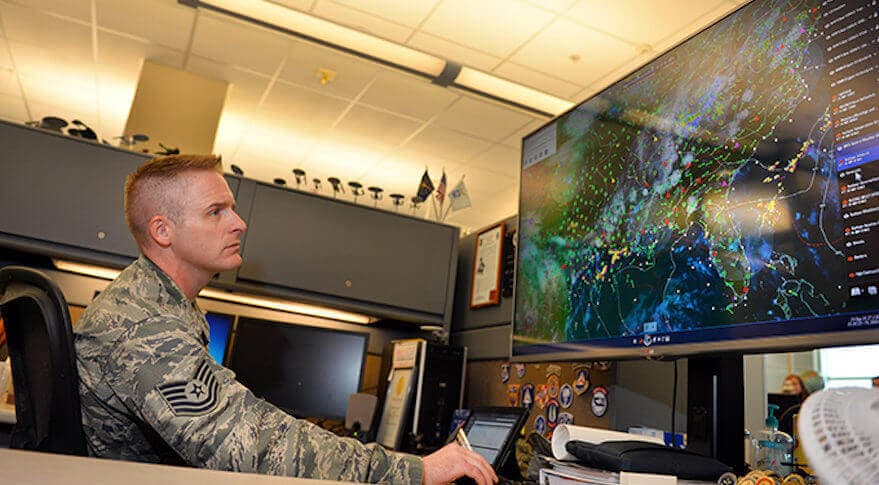
Performs and manages the collection, analysis, and forecast of atmospheric weather and space environmental, including sea state, conditions to enable decision superiority and application of land, air, space, and cyberspace power across the full spectrum of military operations. Integrates current and forecasted atmospheric and space weather conditions into all phases of operations and operational planning, while performing weather and environmental operations for Air Force, Army, and Space Force support organizations and activities. Possesses understanding of joint planning processes to effectively integrate weather considerations into joint operations. Related DoD Occupational Subgroup: 142000.
Duties and responsibilities
- Collect, analyze, and integrate atmospheric and space environmental information, including sea state, into military decision-making processes and operational planning, at all levels (strategic, operational, tactical).
- Operate atmospheric and space-sensing instruments and computer systems to interrogate data from weather radars, meteorological satellites, and products provided by military, national, and international weather agencies.
- Issue advisories, watches, and warnings to alert users of dangerous, inclement, or operationally significant terrestrial, space weather, and sea state events.
- Understand war fighter tactics, techniques, and procedures to maximize air, space, cyberspace combat power. Integrate weather tactics, techniques, and procedures to into the decision-making at all levels to mitigate and exploit weather impact on operations.
- Integrate weather and environmental considerations into joint operation planning in coordination with Army and Space Force partners.
- Provide tailored weather support to Air Force, Army, and Space Force units, including specific forecasts and impact assessments relevant to their respective missions.
Specialty qualifications
Knowledge. Knowledge of the following is mandatory: characteristics and principles of atmospheric weather and space environment; observation, analysis, prediction, and integration of weather and space environment information; operation and operator maintenance of fixed and deployable meteorological and space weather instruments and systems; operation and operator maintenance of communications and computer systems; use of weather products from operational and strategic centers; military weapons systems and decision-making processes; and combat field skills (ability to survive and operate on the battlefield and use of tactical equipment).
Education. For entry into this specialty, a high school diploma or equivalent is required. Courses in physics, chemistry, earth sciences, geography, computer sciences, and mathematics are desirable.
Training. The following training is mandatory for skill level upgrade.
- 1W031. Completion of the Meterological and Oceanographic (METOC) Operations Course (Weather Initial Skills Course) E8ARB1W031 0A1F.
- 1W051. Completion of 5-level Weather Journeyman Course (WJC) E6ANW1W051 00AA and all applicable UTC tasks as outlined in the CFETP. NOTE for ARC only: All ARC (ANG and AFRC) 1W031 personnel must complete ANGWRTC 010 Weather Applications Course immediately following METOC Operations Course for qualification and upgrade training before awarding of the 5-skill level.
- 1W071. Completion of 7-level Weather Craftsman Course (WCC) E6ANW1W071 00AA and all applicable UTC tasks as outlined in the CFETP.
Experience. The following experience is for award of the AFSC indicated:
- 1W051. Qualification in and possession of AFSC 1W031. Also, experience in collecting and analyzing atmospheric data, performing meteorological watch, preparing forecast products, and issuing weather watches, warnings, and advisories.
- 1W071. Qualification in and possession of AFSC 1W051. Also, experience in managing weather integration into operations, determining observation criteria, preparing special support requests, scheduling personnel, providing technical leadership, and directing training and orientation of new personnel.
- 1W091. Qualification in and possession of AFSC 1W071. Also, experience in tailoring unit capabilities, managing weather resources to meet mission requirements, coordinating with MAJCOM and Air Staff, and exploiting the enterprise level capabilities of the Weather career field to advance operational and strategic goals of the AF.
- 1W000. Qualification in and possession of AFSC 1W091 and must be a CMSgt or CMSgt select.
Other. The following are mandatory as indicated:
- For entry into 1W0X1:
- Ability to speak distinctly.
- Visual acuity correctible to 20/20.
- See attachment 4 for additional mandatory requirements for AFSC entry.
- For award and retention of these AFSCs:
- Specialty requires routine access to Tier 3 (T3) information, systems, or similar classified environment. Award and retention of AFSCs requires completion of a current T3 Investigation IAW DoDM 5200.02, AFMAN 16-1405, Air Force Personnel Security Program.
- Some assignments require routine access to Top Secret material or similar environment. For those assignments and position certification of AFSCs 1W0X1, completion of a current T5 Investigation formerly a Single Scope Background Investigation (SSBI) according to DAFMAN 16-1405, Air Force Personnel Security Program, is mandatory.
- For award and retention of these AFSCs, must maintain local network access IAW AFI 17-130, Cybersecurity Program Management and DAFMAN 17-1301, Computer Security. NOTE 1: Award of the entry level without a completed T3 Investigation is authorized provided an interim Secret security clearance has been granted according to AFI 31-501, Personnel Security Program. NOTE 2: Army Weather Support Course (E5OSA15W3 0A1A) is mandatory for weather operations in support of Army missions. NOTE 3: Evasion and Conduct After Capture (ECAC) (S-V88-AL) is mandatory for weather operations in support of Army missions. NOTE 4: Advanced Weather Management Course Part 1-3 (E6AAW1W071 0A1A, E6AAL1W071 0A2A, E3AAR1W071 0A3A) is mandatory for TSgts and MSgts assigned to and/or projected to assume Flight Chief, Detachment Senior Enlisted Leader, or Section Chief leadership positions. NOTE 5: Exception to policy for “experience” and award of AFSC will differ by unit. Approval/award of AFSC will lie directly with unit commander (paragraph 3.5).
Civilian career paths
Comparable civilian careers for this field pay roughly $37,050 to $137,940 per year (median salaries; varies by role and location):
- Atmospheric and Space Scientists: $99,740
- Heavy and Tractor-Trailer Truck Drivers: $47,130
- Light Truck Drivers: $37,050
- Natural Sciences Managers: $137,940
- Remote Sensing Scientists and Technologists: $107,210
- Remote Sensing Technicians: $52,460
ASVAB requirements
To qualify for 1W0X1, you need:
Enter your scores in the AFSC explorer and this section will check each requirement for you.
Entry requirements
Medical profile (PULHES)ShowHide
PULHES scale: lower numbers mean a stricter medical standard. Tap a letter for what it measures.
Vision requirementsShowHide
Medical disqualifiersShowHide
These screened conditions disqualify a candidate for this AFSC:
Education prerequisitesShowHide
Security & backgroundShowHide
Where you could be stationed
Stateside (62)
- Altus, Oklahoma
- Asheville, North Carolina
- Barksdale, Louisiana
- Beale, California
- Cannon, New Mexico
- Columbus, Mississippi
- Creech, Nevada
- Davis-Monthan, Arizona
- Dover, Delaware
- Dyess, Texas
- Eglin, Florida
- Ellsworth, South Dakota
- F E Warren, Wyoming
- Fairchild, Washington
- Fort Bliss, Texas
- Fort Bragg, North Carolina
- Fort Campbell, Kentucky
- Fort Carson, Colorado
- Fort Drum, New York
- Fort Eustis, Virginia
- Fort Hood, Texas
- Fort Polk, Louisiana
- Fort Riley, Kansas
- Fort Sam Houston, Texas
- Fort Stewart, Georgia
- Grand Forks, North Dakota
- Hamilton, Massachusetts
- Hanscom, Massachusetts
- Hill, Utah
- Holloman, New Mexico
- Hunter, Georgia
- Hurlburt Field, Florida
- JB Andrews, Maryland
- JB Charleston, South Carolina
- JB Langley-Eustis, Virginia
- JBSA Randolph, Texas
- Joint Base Lewis-McChord, Washington
- Joint Base McGuire-Dix-Lakehurst, New Jersey
- Keesler, Mississippi
- Kirtland, New Mexico
- Laughlin, Texas
- Little Rock, Arkansas
- Luke, Arizona
- MacDill, Florida
- Malmstrom, Montana
- McConnell, Kansas
- Minot, North Dakota
- Moody, Georgia
- Mountain Home, Idaho
- Nellis, Nevada
- Offutt, Nebraska
- Pope, North Carolina
- Robins, Georgia
- Scott, Illinois
- Seymour Johnson, North Carolina
- Shaw, South Carolina
- Sheppard, Texas
- Tinker, Oklahoma
- Travis, California
- Tyndall, Florida
- Vance, Oklahoma
- Whiteman, Missouri
Overseas (29)
- Andersen, Guam
- Aviano, Italy
- Camp Humphreys, South Korea
- Camp Zama, Japan
- Coronel Enrique S, Honduras
- Eielson, Alaska
- Fort Shafter, Hawaii
- Fort Wainwright, Alaska
- Grafenwohr, Germany
- Incirlik AB, Turkey
- JB Elmendorf-Rich, Alaska
- JB Prl Hbr-Hickam, Hawaii
- Kadena, Japan
- Kaena Point, Hawaii
- Kapaun, Germany
- Katterbach, Germany
- Kunsan, South Korea
- Lakenheath, United Kingdom
- Learmonth, Australia
- Lucius D Clay Kas, Germany
- Mildenhall, United Kingdom
- Misawa, Japan
- Osan AB, South Korea
- Ramstein, Germany
- Seoul AB, South Korea
- Spangdahlem AB, Germany
- Vicenza, Italy
- Wheeler, Hawaii
- Yokota, Japan
Badges & identifiers
Duty badges
The occupational badge worn by Airmen in this career field.
- Meteorologist Badge
Duty identifiers
Special duty patches and identifiers associated with this AFSC.
- WX Duty Identifier
Degrees & training plan
While serving in 1W0X1 you can earn an associate degree through the Community College of the Air Force:
- Meteorology
- Career Field Education & Training Plan (CFETP)View CFETP (PDF, opens in a new tab)
The CFETP is the official Air Force document describing this career field's full training pipeline, from tech school through advanced skill levels.
Videos, Reddit & resources
1W0X1 videos(12)
These do not reflect official U.S. Air Force views and may contain inaccuracies — negative opinions are often overrepresented online.
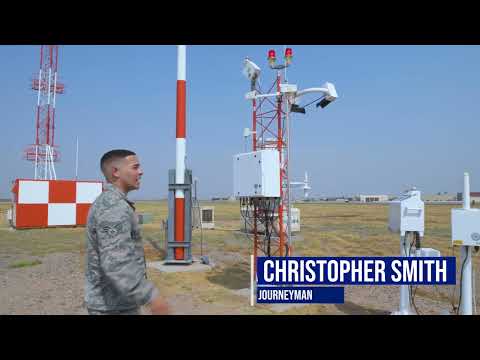
1W0X1 - Weather (Air Force Jobs)
Airman Vision · 4/26/2025
1 of 12 videos
Reddit discussions(10)
These do not reflect official U.S. Air Force views and may contain inaccuracies — negative opinions are often overrepresented online.
Official links & resources(3)
Researching other jobs too? Every career field's videos and discussions are collected the same way — browse all AFSCs.
Frequently asked questions
- What ASVAB score do you need for Weather (1W0X1)?
- You need General 66+ and Electrical 50+ on the ASVAB to qualify for 1W0X1.
- Where can Weather Airmen get stationed?
- 1W0X1 Airmen serve at 91 bases: 62 stateside and 29 overseas, including Andersen, Guam, Aviano, Italy, Camp Humphreys, South Korea.
- Does 1W0X1 require a security clearance?
- Yes — Weather requires a Secret clearance.
- How long is tech school for Weather?
- Tech school for 1W0X1 runs about 146 days at Keesler, Mississippi.
Where this data comes from
Most of the data on this page comes from the Air Force Enlisted Classification Directory (AFECD) and recruiter TTMS readouts, which are no longer released publicly. Pulling it together and keeping it accurate takes real time, so I update these pages as often as I can.
Requirements do change between updates. Before you make any decisions, confirm the details with your recruiter. They always have the latest word.