1P0X1 · Operations
Aircrew Flight Equipment
Also known as: AFE
Last updated
At a glance
- ASVAB minimums
- M 40
- Security clearance
- Secret
- Tech school
- Sheppard, Texas · 56 days
- Career field size
- 2,159 Airmen
- Possible bases
- 50 stateside · 15 overseas
- Civilian equivalent pay
- $25k–$116k
- U.S. citizenship required
Table of ContentsShow
- What does the Aircrew Flight Equipment career field do?
- Duties and responsibilities
- Specialty qualifications
- Civilian career paths
- ASVAB requirements
- Entry requirements
- Where you could be stationed
- Badges & identifiers
- Degrees & training plan
- Specialties (shred-outs)
- Videos, Reddit & resources
- Frequently asked questions
What does the Aircrew Flight Equipment career field do?
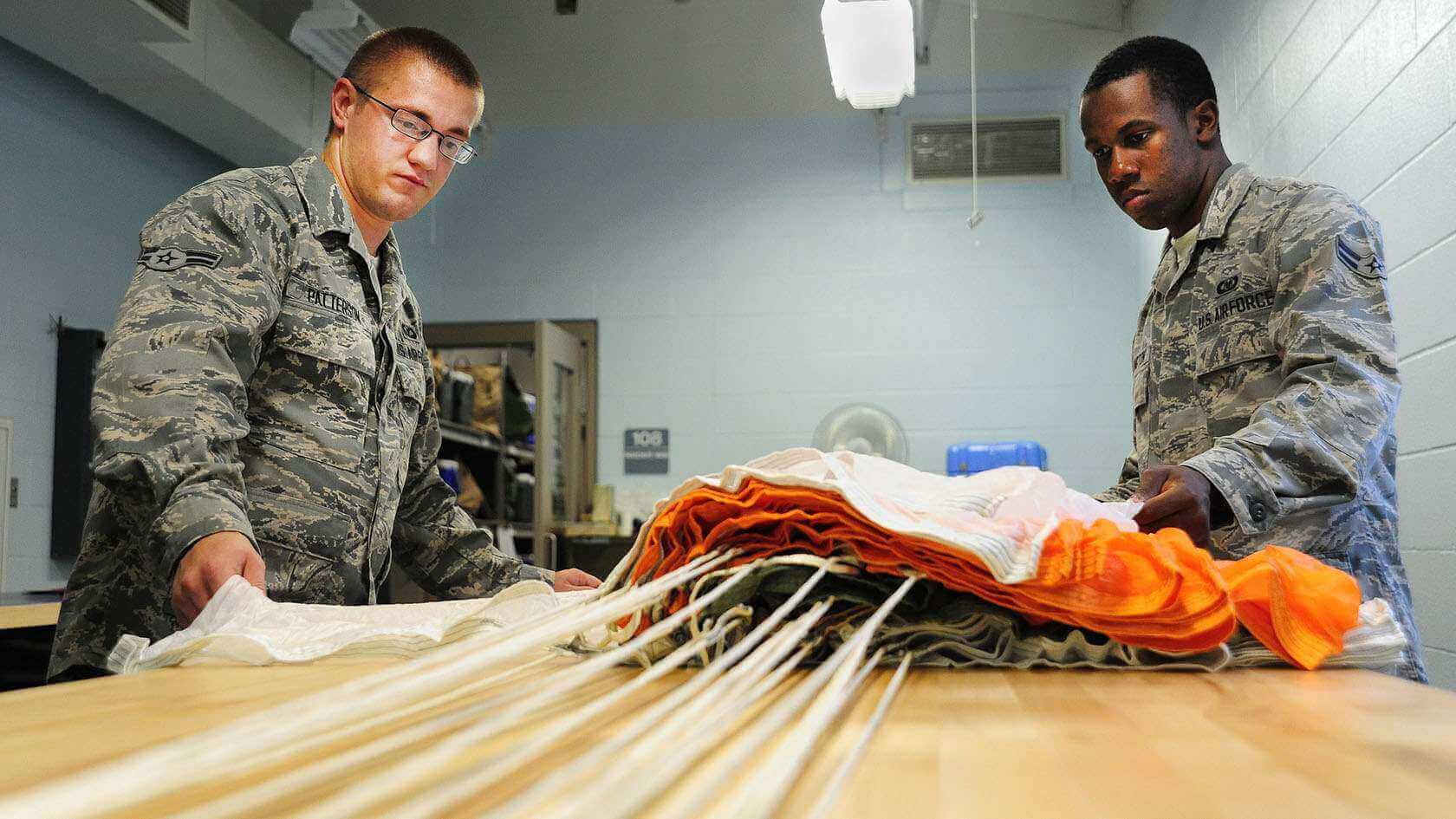
Directly supports aircraft generation, sortie production, and enables aircrew and special warfare operator performance through aircrew flight equipment and life-sustaining assets. Manages, performs, and schedules inspections, maintenance, fitting, and adjustments of assigned Aircrew Flight Equipment (AFE), Aircrew Chemical Biological Radiological Nuclear (ACBRN) equipment and associated components. Prepares, maintains, and monitors AFE operations IAW with applicable publications and directives. Prepares for response to chemical, biological, radiological, and nuclear weapons contamination and supervises and conducts Aircrew Contamination Control Area (ACCA) processing. Disassembles, assembles, inspects, fabricates, cleans, repairs, and packs aerospace weapon system and Air Force Special Warfare (AFSPECWAR) components such as floatation equipment, emergency evacuation systems, and parachutes. Schedules, supervises, and conducts ACBRN and aircrew continuation training. Related DoD Occupational Subgroup: 186000.
Duties and responsibilities
- Inspects, maintains, packs, and adjusts AFE such as flight helmets, oxygen masks, parachutes, flotation devices, survival kits, helmet mounted devices, aircrew night vision and other ocular systems, anti-G garments, protective equipment, chemical biological protective ensembles, and other types of AFE and ACBRN systems. Repairs thermal radiation barriers, flotation equipment, and various parachutes. Evaluates problems and determines feasibility of repair or replacement related to inspecting rubber equipment and parachutes. Evaluates work orders for fabrication and repair of AFE.
- Installs and removes aircraft-installed AFE, effectively accounting for all assets and serviceability status, to include inspection records and manufacturing details. Operates, maintains, and inspects machinery, test equipment, and tools. Performs operator maintenance and service inspections on shop equipment. Stores, handles, uses, and disposes of hazardous waste and materials based on environmental standards.
- Requisitions, stores, forecasts, handles, and transports ammunition, aircrew survival pyrotechnic devices, and other explosives such as actuated cartridges.
- Conducts aircrew continuation training; instructs aircrews on equipment use, operation, and capabilities. Conducts ACBRN training; instructs aircrew on ACBRN donning, doffing, and ACAA contamination mitigation procedures.
- Plans, directs, organizes, and evaluates operational aspects such as equipment accountability, personnel reliability, mobility readiness, and other activities necessary to meet operational readiness. Maintains associated databases to ensure equipment accountability. Establishes performance standards, improves work methods, and advises on inspection, repair, and repack of aircrew flight equipment. Ensures serviceability based on required specifications and technical publications.
- Prepares checklists and complies with operating instructions. Develops lesson plans for aircrew training, safety, and other required programs. Assigns, trains, and prepares AFE personnel for deployment. Procures, maintains, stores, and prepares equipment for deployment. Determines facilities, funding, and mobility of AFE assets to support operational taskings. Develops and submits budget requirements. Requisitions equipment and supplies. Maintains custodial files for accounts such as supply and equipment, munitions, and test, measurement, and diagnostic equipment. Obtains assistance from other agencies to support AFE programs.
- Manages unit and staff agency AFE programs. Provides unit and staff agency assistance to subordinate units to ensure AFE planning, and training have been accomplished, and adherence to. Analyzes training and deficiencies to preventing wartime task degradation. Conducts quality assurance inspections to ensure compliance with policies and directives. Identifies and documents equipment and personnel training discrepancies and recommends corrective actions. Evaluates and critiques instructors' effectiveness, and ensures presentations are accurate and current. Advises and assists agencies whose functions affect AFE activities. Evaluates data involving equipment development and sustainment to resolve problems. Conducts aircraft mishap safety investigations and analysis where operator, aircrew-issued and aircraft-installed life-sustaining equipment is involved. Conducts assessments and provides operational risk analysis in matters affecting the AFE enterprise.
- Establishes, coordinates, and distributes exposure and contamination mitigation procedures. Monitors associated requirements and procedures. Ensures assigned personnel take safety precautions. Prepares wartime and contingency response plans. Coordinates actions to ensure prompt response to enable and sustain operations in a chemical, biological, radiological, nuclear environment with minimal degradation of combat capability. Coordinates actions to continue and/or restore vital functions and operations. Prepares guidance annexes, appendices, supplements, and other supporting documents to support operations plans. Advises leadership on mission impact and recovery activities following an attack; coordinates ACCA requirements. Supervises contamination control operations teams.
Specialty qualifications
Knowledge. Knowledge is mandatory of: Inspection and maintenance procedures; parachute construction; temperature and humidity effects on parachutes and other fabrics; characteristics of rubberized items; solvent, heat, and pressure effects on rubber; proper handling, use, and disposal of hazardous waste, materials, and pyrotechnics; aircrew flight and ACBRN equipment inspections, fitting, and maintenance procedures; supply procedures; principles of contamination control; related technical information, policies, procedures, techniques, and equipment; contingency planning, training, operations, equipment supply procedures, directives and policy; and conducting aircrew continuation and ACBRN Training.
Education. For entry into this specialty, completion of high school with courses in speech, general science, shop mechanics, and basic computer applications are desirable.
Training. For award of AFSC 1P0X1A/B, completion of a basic, suffix specific, aircrew flight equipment course is mandatory.
Experience. The following experience is mandatory for award of the AFSC indicated:
- 1P051A/B. Qualification in and possession of AFSC 1P031A/B as well as experience in equipment inspections, instructing aircrew in continuation training and ACBRN procedures.
- 1P071A/B. Qualification in and possession of AFSC 1P051A/B. Also, experience supervising and performing functions such as inspections, quality assurance, specialist training programs, and aircrew instruction.
- 1P091. Qualification in and possession of AFSC 1P071A/B. Also, experience managing and directing AFE operations and training functions as well as evaluating, planning, and organizing AFE readiness activities.
Other. The following qualifications are mandatory as indicated.
- For entry into this specialty:
- Must possess a valid state driver’s license to operate government motor vehicles (GMV) in accordance with AFI 24-301, Ground Transportation.
- See all items listed in Attachment 4 for entry requirements.
- Passing color vision, as defined by correctly identifying at least 10 or 14 Ishihara Plates.
- For entry, award, and retention of this specialty:
- Ability to speak clearly and distinctly.
- Distance and near visual acuity correctable to 20/20 in at least one eye.
- No record of claustrophobia or claustrophobic tendencies.
- For award and retention of these AFSCs, maintain local network access IAW AFI 17-130, Cybersecurity Program Management and AFMAN 17-1301, Computer Security.
- Specialty requires routine access to Secret material or similar environment. For award and retention of AFSCs 1P0XX, completion of a current National Agency Check, Local Agency Checks and Credit (NACLC) according to DoDMAN5200.02_AFMAN 16-1405, Air Force Personnel Security Program. NOTE: Award of the 3-skill level without completed NACLC is authorized provided an interim Secret security clearance has been granted according to DoDMAN5200.02_AFMAN 16-1405.
- Cross Shredding must be approved by the AFSC 1P0X1 Career Field Manager (RegAF Only).
Civilian career paths
Comparable civilian careers for this field pay roughly $25,020 to $115,640 per year (median salaries; varies by role and location):
- Accountants and Auditors: $73,560
- Administrative Services Managers: $98,890
- Aircraft Mechanics and Service Technicians: $66,440
- Aviation Inspector: $78,400
- Budget Analysts: $78,970
- Career/Technical Education Teachers, Postsecondary: $55,620
- Compliance Managers: $116,350
- Emergency Management Directors: $76,250
- Executive Secretaries and Executive Administrative Assistants: $63,110
- File Clerks: $34,090
- Financial Risk Specialists: $83,660
- First-Line Supervisors of Mechanics, Installers, and Repairer: $70,240
- First-Line Supervisors of Office and Administrative Support Workers: $58,450
- First-Line Supervisors of Production and Operating Workers: $62,850
- General and Operations Managers: $103,650
- Geothermal Technicians: $42,480
- Hazardous Materials Removal Workers: $45,270
- Human Factors Engineers and Ergonomists: $88,950
- Human Resources Specialist: $63,490
- Inspectors, Testers, Sorters, Samplers, and Weighers: $40,460
- Instructional Coordinators: $66,970
- Lifeguards, Ski Patrol, and Other Recreational Protective Service Workers: $25,020
- Maintenance and Repair Workers, General: $40,850
- Meeting, Convention, and Event Planners: $51,560
- Quality Control Analysts: $52,460
- Quality Control Systems Managers: $108,790
- Riggers: $50,850
- Sewers, Hand: $30,000
- Sewing Machine Operators: $28,230
- Stockers and Order Fillers: $29,190
- Supply Chain Managers: $96,390
- Textile Cutting Machine Setters, Operators, and Tenders: $29,910
- Training and Development Managers: $115,640
- Training and Development Specialists: $62,700
ASVAB requirements
To qualify for 1P0X1, you need:
Enter your scores in the AFSC explorer and this section will check each requirement for you.
Entry requirements
Medical profile (PULHES)ShowHide
PULHES scale: lower numbers mean a stricter medical standard. Tap a letter for what it measures.
Vision requirementsShowHide
Medical disqualifiersShowHide
These screened conditions disqualify a candidate for this AFSC:
Physical requirementsShowHide
Security & backgroundShowHide
Where you could be stationed
Stateside (50)
- Altus, Oklahoma
- Barksdale, Louisiana
- Beale, California
- Birmingham, Alabama
- Buckley, Colorado
- Cannon, New Mexico
- Columbus, Mississippi
- Davis-Monthan, Arizona
- Dover, Delaware
- Duke Field, Florida
- Dyess, Texas
- Edwards, California
- Eglin, Florida
- Ellsworth, South Dakota
- Fairchild, Washington
- Fort Rucker, Alabama
- Hill, Utah
- Holloman, New Mexico
- Hurlburt Field, Florida
- JB Andrews, Maryland
- JB Charleston, South Carolina
- JB Langley-Eustis, Virginia
- JBSA Lackland, Texas
- JBSA Randolph, Texas
- Joint Base Lewis-McChord, Washington
- Joint Base McGuire-Dix-Lakehurst, New Jersey
- Kirtland, New Mexico
- Laughlin, Texas
- Little Rock, Arkansas
- Luke, Arizona
- MacDill, Florida
- March, California
- McConnell, Kansas
- Minot, North Dakota
- Moody, Georgia
- Mountain Home, Idaho
- Nellis, Nevada
- Offutt, Nebraska
- Pensacola NAS Che, Florida
- Robins, Georgia
- Scott, Illinois
- Seymour Johnson, North Carolina
- Shaw, South Carolina
- Sheppard, Texas
- Tinker, Oklahoma
- Travis, California
- Tyndall, Florida
- USAF Academy, Colorado
- Whiteman, Missouri
- Wright Patterson, Ohio
Overseas (15)
- Andersen, Guam
- Aviano, Italy
- Eielson, Alaska
- Geilenkirchen, Germany
- JB Elmendorf-Rich, Alaska
- JB Prl Hbr-Hickam, Hawaii
- Kadena, Japan
- Kunsan, South Korea
- Lakenheath, United Kingdom
- Mildenhall, United Kingdom
- Misawa, Japan
- Osan AB, South Korea
- Ramstein, Germany
- Spangdahlem AB, Germany
- Yokota, Japan
Badges & identifiers
Duty badges
The occupational badge worn by Airmen in this career field.
- Operations Support Badge
Duty identifiers
Special duty patches and identifiers associated with this AFSC.
- AFE Duty Identifier
Degrees & training plan
While serving in 1P0X1 you can earn an associate degree through the Community College of the Air Force:
- Aircrew Safety Systems Technology
- Career Field Education & Training Plan (CFETP)View CFETP (PDF, opens in a new tab)
The CFETP is the official Air Force document describing this career field's full training pipeline, from tech school through advanced skill levels.
1P0X1 specialties (shred-outs)
This career field splits into 2 specialties — you may be assigned to one of these:
- 1P0X1AEjection Seat AircraftHas its own entry requirements
- 1P0X1BNon-Ejection Seat AircraftHas its own entry requirements
Shred-outs share the 1P0X1 career path; where a specialty sets its own minimums or screens, they're noted above.
Videos, Reddit & resources
1P0X1 videos(12)
These do not reflect official U.S. Air Force views and may contain inaccuracies — negative opinions are often overrepresented online.
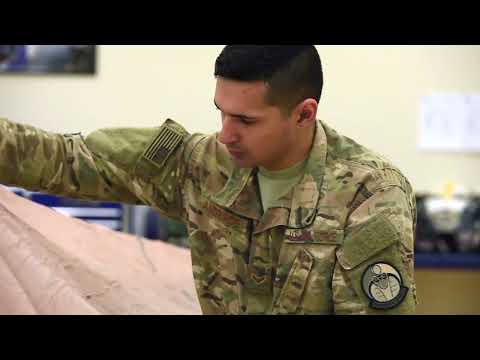
Aircrew Flight Equipment - Parachute Process (1POX1)
Airman Vision · 6/25/2025
1 of 12 videos
Reddit discussions(10)
These do not reflect official U.S. Air Force views and may contain inaccuracies — negative opinions are often overrepresented online.
Official links & resources(4)
Researching other jobs too? Every career field's videos and discussions are collected the same way — browse all AFSCs.
Frequently asked questions
- What ASVAB score do you need for Aircrew Flight Equipment (1P0X1)?
- You need Mechanical 40+ on the ASVAB to qualify for 1P0X1.
- Where can Aircrew Flight Equipment Airmen get stationed?
- 1P0X1 Airmen serve at 65 bases: 50 stateside and 15 overseas, including Andersen, Guam, Aviano, Italy, Eielson, Alaska.
- Does 1P0X1 require a security clearance?
- Yes — Aircrew Flight Equipment requires a Secret clearance.
- How long is tech school for Aircrew Flight Equipment?
- Tech school for 1P0X1 runs about 56 days at Sheppard, Texas.
Where this data comes from
Most of the data on this page comes from the Air Force Enlisted Classification Directory (AFECD) and recruiter TTMS readouts, which are no longer released publicly. Pulling it together and keeping it accurate takes real time, so I update these pages as often as I can.
Requirements do change between updates. Before you make any decisions, confirm the details with your recruiter. They always have the latest word.