1D7X1 · Operations
Information Technology (IT) Systems
Also known as: 3D0X1, 3D0X2, 3D0X3, 3D0X4, 3D1X1, 3D1X2, 3D1X3, Cyber Defense Operations, Combat Crew Communications (8S200)
Last updated
At a glance
- ASVAB (any one path)
- E 60(Option 1)
- orE 55+CYB 60(Option 2)
- Security clearance
- Top Secret
- Possible bases
- 60 stateside · 23 overseas
- Civilian equivalent pay
- $85k–$117k
Table of ContentsShow
- What does the Information Technology (IT) Systems career field do?
- Duties and responsibilities
- Specialty qualifications
- Civilian career paths
- ASVAB requirements
- Entry requirements
- Where you could be stationed
- Badges & identifiers
- Degrees & training plan
- Specialties (shred-outs)
- Videos, Reddit & resources
- Frequently asked questions
What does the Information Technology (IT) Systems career field do?
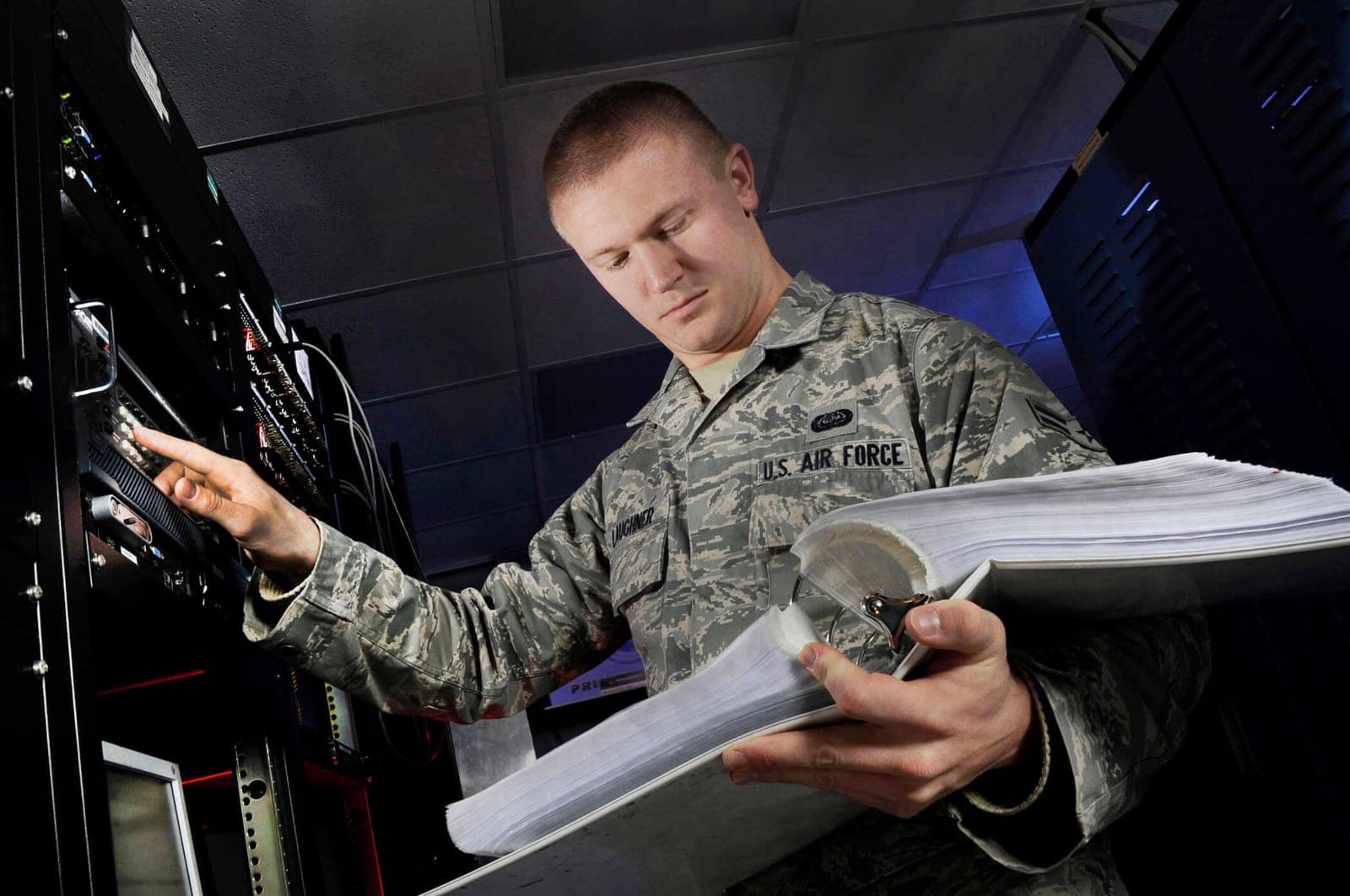
IT Systems personnel can perform three primary work roles: Technical Support, Systems Administrator, and Network Operations. IT systems technicians qualified as Technical Support manage and maintain client devices and accounts as well as routine tasks on network devices and infrastructure to troubleshoot and resolve network connectivity issues. At the intermediate and advanced proficiency levels, Systems Administrators manage and maintain server operating systems and software applications. Network Operations personnel install, support, and maintain network infrastructure devices and systems. Each role requires a unique set of skills and competencies, and IT systems personnel may specialize in one or more of these work roles depending on their expertise, interests, and the position requirements. IT systems manage and perform Warfighter Communications in all environments in support of the overall requirements to survey, secure, protect, defend, preserve, design, build, operate, and extend data, networks, net-centric capabilities, and other designated systems. This Air Force Specialty Code incorporates the use of DCWF codes to tie this specialty to the framework. The DCWF was developed by the National Institute of Standards and Technology (NIST) and the DoD to establish a common lexicon and model for all cyber work. The DCWF will universalize training and education between academia, industry, and military. It will also enable talent management by ensuring the right Airmen, for the right assignment, at the right time. DCWF work roles associated with this specialty will be listed in the Career Field Education and Training Plan (CFETP).
Duties and responsibilities
- The available duties and responsibilities can encompass:
- Technical Support. IT systems personnel qualified as Technical Support design, build, provision, maintain, and sustain information systems, including warfighter communications, within the Department of the Air Force (DAF). This role is responsible for deploying, sustaining, troubleshooting, and repairing standard voice, data, video network, and cryptographic client devices in fixed and deployed environments. The individual will manage client user accounts and organizational client device accounts and perform, coordinate, integrate, and supervise network design, configuration, operation, defense, restoration, and improvements.
- System Administrator. IT systems personnel qualified as a System Administrator design, build, provision, maintain, and sustain information systems, including warfighter communications, within the Department of the Air Force (DAF)... The individual will install, support, and maintain server operating systems or other computer systems and the software applications pertinent to its operation, while also ensuring current defensive mechanisms are in place. They will also respond to service outages and interruptions to network operations and administer server-based networked systems, distributed applications, network storage, messaging, and application monitoring required to provision, sustain, operate, and integrate cyber networked systems and applications in garrison and at deployed locations
- Network Operations. IT systems personnel qualified as Network Operations, design, build, provision, maintain, and sustain information systems, including warfighter communications, within the Department of the Air Force (DAF This role is responsible for deploying, sustaining, troubleshooting, and repairing standard voice, data, and video network infrastructure systems, IP detection systems, and cryptographic equipment. The individual is also responsible for fabricating, terminating, and interconnecting wiring and associated network infrastructure devices. They will also respond to service outages and interruptions to network operations.
- Expeditionary Communications delivers cyber capabilities in austere and mobile environments. Expeditionary Communications includes all applicable statutes, but specifically datalinks, the building, operating, maintaining, securing, and sustaining of tactical and communications networks when needed to support warfighter requirements, systems employed in austere, mobile, and/or expeditionary environments, to provide command and control in support of Air and Space Force missions.
Specialty qualifications
Knowledge. This specialty requires knowledge principles, technologies, capabilities, limitations, and cyber threat vectors of servers, clients, operating systems, databases, networks and related hardware and software. Cybersecurity principles include national and international laws, policies, and ethics related to operational cybersecurity; operational risk management processes; and specific operational impacts of lapses in cybersecurity. The installation and maintenance management functions include wire transmission principles; electrical and light wave communications; wireless fundamentals, and cable testing procedures.
Education. For entry into this specialty, completion of high school or general educational development equivalency is mandatory. Additional courses in Science, Technology, Engineering, and Mathematics (STEM) are desirable. Associate degree or higher in related fields and/or Information Technology (IT) certification is desirable.
Training. For award of the 1D731X, completion of the suffix-specific initial skills training course is mandatory.
Experience. The following experience is mandatory for award of the AFSC indicated:
- There are no specific upgrade requirements for the slick AFSC 1D7X1 not already defined in the training AFI.
- For award of the 1D751, qualification in and possession of 1D731X, and experience in suffix specific functions.
- For award of the 1D771, qualification in and possession of 1D751 and experience in suffix specific functions.
- For award of the 1D791, qualification in and possession of 1D77 and experience managing and directing cyber activities.
Other. The following are mandatory as indicated:
- For entry into this specialty:
- See attachment 4 for additional entry requirements.
- Personnel with prior qualification of attaining and maintaining DoD Cyber Workforce qualifications based on approved cyberspace requirements IAW DAFMAN 17-1305, DAF Cyberspace Workforce Management Program for retraining can request an Exception to Policy (ETP) to waive minimum ASVAB requirements on a case-by-case basis.
- For award and retention of these AFSCs:
- Must obtain or meet DoD Cyber Workforce qualifications based on approved cyberspace requirements applicable for cyberspace tasks required for any position held IAW DoDM 8140.03, Cyberspace Workforce Qualification and Management Program, and DAFMAN 17-1305, DAF Cyberspace Workforce Management Program.
- Must maintain local network access IAW AFI 17-130, Cybersecurity Program Management and AFMAN 17-1301, Computer Security.
- Specialty requires routine access to classified information, systems, missions, and environments to include but not limited to Sensitive Compartmented Information Facilities (SCIF), Airborne platforms, Nuclear Command Control & Communications (NC3), and a multitude of emerging mission requirements in a highly contested domain IAW DoDM 5200.01-DAFMAN 16-1405.
- Must be eligible for Top Secret (Tier 5) and maintain security clearance or based on current position requirements.
- Completion of a background investigation according to DoDM 5200.01 - DAFMAN 16-1405, Personnel Security Program Management, is mandatory. NOTE: Award of the 3-skill level without a completed investigation is authorized provided minimum of interim Tier 5 (Top-Secret) clearance has been granted according to DoDM 5200.01 - AFMAN 16-1405.
Civilian career paths
Comparable civilian careers for this field pay roughly $84,810 to $116,780 per year (median salaries; varies by role and location):
- Computer Network Architects: $116,780
- Computer Programmers; $89,190
- Computer Systems Analysts: $93,730
- Computer Systems Engineers/Architects: $92,870
- Data Warehousing Specialists: $98,860
- Information Security Analysts: $103,590
- Network and Computer Systems Administrators: $84,810
- Software Developers: $110,140
ASVAB requirements
1D7X1 has 2 qualification paths — you only need to meet one:
Option 1
Option 2
Enter your scores in the AFSC explorer and this section will check each requirement for you.
Entry requirements
Medical profile (PULHES)ShowHide
PULHES scale: lower numbers mean a stricter medical standard. Tap a letter for what it measures.
Medical disqualifiersShowHide
These screened conditions disqualify a candidate for this AFSC:
Security & backgroundShowHide
Where you could be stationed
Stateside (60)
- Altus, Oklahoma
- Barksdale, Louisiana
- Beale, California
- Bolling, District Of Columbia
- Cannon, New Mexico
- Columbus, Mississippi
- Creech, Nevada
- Davis-Monthan, Arizona
- Dover, Delaware
- Dyess, Texas
- Edwards, California
- Eglin, Florida
- Ellsworth, South Dakota
- Fairchild, Washington
- Fort George Meade, Maryland
- Fort Gordon, Georgia
- Goodfellow AFB, Texas
- Grand Forks, North Dakota
- Hanscom, Massachusetts
- Hill, Utah
- Holloman, New Mexico
- Hurlburt Field, Florida
- JB Andrews, Maryland
- JB Charleston, South Carolina
- JB Langley-Eustis, Virginia
- JBSA Camp Bullis, Texas
- JBSA Lackland, Texas
- JBSA Randolph, Texas
- Joint Base Lewis-McChord, Washington
- Joint Base McGuire-Dix-Lakehurst, New Jersey
- Keesler, Mississippi
- Kirtland, New Mexico
- Laughlin, Texas
- Linthicum, Maryland
- Little Rock, Arkansas
- Luke, Arizona
- MacDill, Florida
- Malmstrom, Montana
- Maxwell Gunter, Alabama
- McConnell, Kansas
- Minot, North Dakota
- Moody, Georgia
- Mountain Home, Idaho
- Nellis, Nevada
- New Cumberland Defense Depot, Pennsylvania
- Offutt, Nebraska
- Patrick, Florida
- Pentagon, Virginia
- Pope, North Carolina
- Robins, Georgia
- Scott, Illinois
- Seymour Johnson, North Carolina
- Shaw, South Carolina
- Sheppard, Texas
- Travis, California
- Tyndall, Florida
- Vance, Oklahoma
- Washington, District Of Columbia
- Whiteman, Missouri
- Wright Patterson, Ohio
Overseas (23)
- Alconbury, United Kingdom
- Andersen, Guam
- Aviano, Italy
- Croughton, United Kingdom
- Darmstadt, Germany
- Eielson, Alaska
- Einsiedlerhof, Germany
- Incirlik AB, Turkey
- JB Elmendorf-Rich, Alaska
- JB Prl Hbr-Hickam, Hawaii
- Kadena, Japan
- Kunsan, South Korea
- Lakenheath, United Kingdom
- Lucius D Clay Kas, Germany
- Mainz Kastel, Germany
- Mildenhall, United Kingdom
- Misawa, Japan
- Osan AB, South Korea
- Ramstein, Germany
- Spangdahlem AB, Germany
- Spangdahlem, Germany
- Stavanger, Norway
- Yokota, Japan
Badges & identifiers
Duty badges
The occupational badge worn by Airmen in this career field.
- Cyberspace Support Badge
Duty identifiers
Special duty patches and identifiers associated with this AFSC.
- CYBER Duty Identifier
- XCOMM Duty Identifier
Degrees & training plan
- Career Field Education & Training Plan (CFETP)View CFETP (PDF, opens in a new tab)
The CFETP is the official Air Force document describing this career field's full training pipeline, from tech school through advanced skill levels.
1D7X1 specialties (shred-outs)
This career field splits into 3 specialties — you may be assigned to one of these:
- 1D7X1ANetwork OperationsHas its own entry requirements
- 1D7X1BSystems AdministrationHas its own entry requirements
- 1D7X1WExpeditionary Communications
Shred-outs share the 1D7X1 career path; where a specialty sets its own minimums or screens, they're noted above.
Videos, Reddit & resources
1D7X1 videos(12)
These do not reflect official U.S. Air Force views and may contain inaccuracies — negative opinions are often overrepresented online.

Cyber Defense Operations - 1D7X1A Network Systems Operations (previously 3D1X2)
Airman Vision · 4/8/2025
1 of 12 videos
Reddit discussions(10)
These do not reflect official U.S. Air Force views and may contain inaccuracies — negative opinions are often overrepresented online.
Official links & resources(9)
Researching other jobs too? Every career field's videos and discussions are collected the same way — browse all AFSCs.
Frequently asked questions
- What ASVAB score do you need for Information Technology (IT) Systems (1D7X1)?
- 1D7X1 has 2 qualification paths — you only need to meet one: Electrical 60+; or Electrical 55+ and Cyber 60+.
- Where can Information Technology (IT) Systems Airmen get stationed?
- 1D7X1 Airmen serve at 83 bases: 60 stateside and 23 overseas, including Alconbury, United Kingdom, Andersen, Guam, Aviano, Italy.
- Does 1D7X1 require a security clearance?
- Yes — Information Technology (IT) Systems requires a Top Secret clearance.
Where this data comes from
Most of the data on this page comes from the Air Force Enlisted Classification Directory (AFECD) and recruiter TTMS readouts, which are no longer released publicly. Pulling it together and keeping it accurate takes real time, so I update these pages as often as I can.
Requirements do change between updates. Before you make any decisions, confirm the details with your recruiter. They always have the latest word.