1C6X1 · Operations
Space Systems Operations
Last updated
At a glance
- ASVAB minimums
- E 60
- Security clearance
- Top Secret
- Tech school
- Vandenberg, California · 51 days
- Career field size
- 1,076 Airmen
- Possible bases
- 4 stateside · 3 overseas
- Civilian equivalent pay
- $42k–$119k
- U.S. citizenship required
Table of ContentsShow
What does the Space Systems Operations career field do?
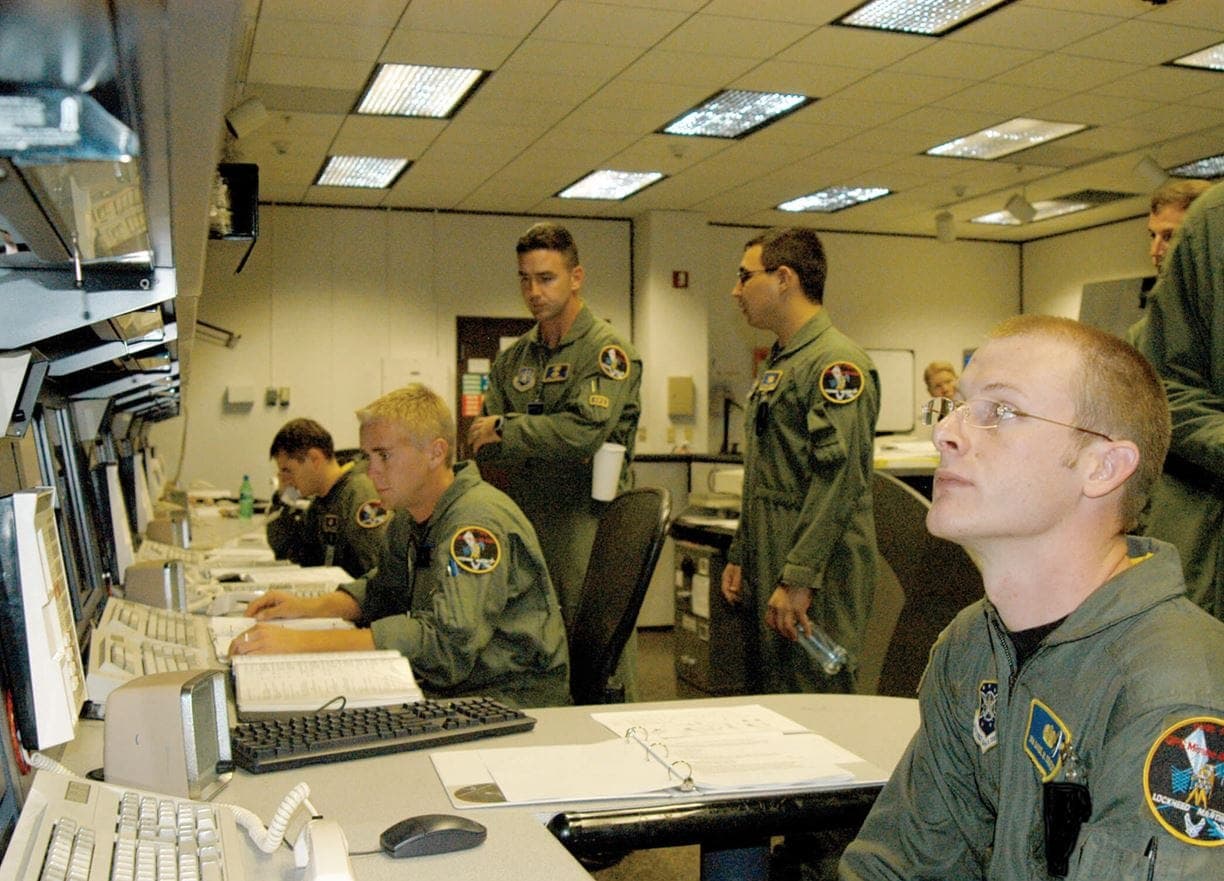
Manages or performs duties to develop, sustain, and enhance space capabilities to defend national interests from attack and to create effects in the space domain to achieve Service, Combatant Command, and national objectives. Conducts space control, space force enhancement, and space force support operations using established tactics, techniques, and procedures. Related DoD Occupational Subgroup: 122100.
Duties and responsibilities
- Detects, identifies, and maintains orbital parameters on earth satellite vehicles using optical and radar sensors.
- Protects friendly satellite communications and disrupts adversary satellite communications by operating defensive and offensive space control systems.
- Detects and tracks missile launches using a variety of ground and space-based sensors. Forwards information to appropriate command and control agencies.
- Plans and executes satellite contacts, resolves emergencies, and performs satellite commanding during launch, early orbit, daily operations, and end-of-life testing. Performs launch and on-orbit operations for military satellites.
- Plans and executes battlespace characterization, technology demonstrations and combat operations to deter and defeat on-orbit adversarial threats.
- Performs command and control functions at numerous C2 agencies such as the National Space Defense Center Combined Space Operations Center, regional Joint and Combined Air and Space Operations Centers, National Reconnaissance Operations Center, Missile Warning Center, and NORAD/USNORTHCOM Command Center.
- Ensures operational effectiveness and suitability of space capabilities through operational testing and evaluation.
- Replicates adversary space capabilities to improve combat training and increase readiness to respond and counter threats against space assets.
Specialty qualifications
Knowledge. Knowledge is mandatory of the following: Satellite C2 and principles of space and ground segments; space warning and control systems; orbital mechanics; electromagnetic spectrum; crew operations; data analysis procedures; sensor theory; data transmission, receiving, recording, and relaying theory; and administrative practices.
Education. For entry into this specialty, completion of high school with coursework in algebra is required. Coursework in physics, geometry, trigonometry, and/or computer science is desirable.
Training. For award of AFSC 1C631, completion of the 1C6 Enlisted Undergraduate Space Training (EUST).
Experience. The following experience is mandatory for award of the AFSC indicated:
- 1C651. Qualification in and possession of AFSC 1C631, completion of 1C651, 1 year of experience in a 1C6X1 position, and ability to recommend space capabilities for integration in the joint/operational planning process to achieve CCMD objectives.
- 1C671. Qualification in and possession of specialty code 1C651, experience performing or supervising space systems operations functions and activities, and assist in the development and integration of TTPs into operations.
- 1C691. Qualification in and possession of AFSC 1C671. Also, experience managing space systems operations activities.
Other. The following are mandatory as indicated:
- For entry into this specialty:
- See attachment 4 for entry requirements.
- Passing color vision as defined in DAFMAN 48-123 for FCI standards.
- For entry, award, and retention of AFSCs 1C611/31/51/71:
- Must maintain local network access IAW AFI 17-130, Cybersecurity Program Management Systems and AFMAN 17-1301, Computer Security.
- Specialty requires routine access to Tier 5 (T5) information, systems, or similar classified environment.
- Completion of a T5 investigation and T5 eligibility granted based upon the favorable adjudication and IAW DoDM 5200.02, AFMAN 16-1405, Air Force Personnel Security Program, is mandatory.
- When required for a current or future assignment, must successfully complete a polygraph test. NOTE: For non-prior service Airmen, submission of a T5 Investigation and favorable T5 eligible pre-screening is mandatory prior to entry into the AFSC 1C631 awarding course. NOTE: The 1C6X1 specialty code awarding course requires an interim or fully adjudicated T5 clearance by training day 70 or when access to course requires it, whichever comes first.
Civilian career paths
Comparable civilian careers for this field pay roughly $41,970 to $118,610 per year (median salaries; varies by role and location):
- Aerospace Engineering and Operations Technologists and Technicians: $68,570
- Aerospace Engineers: $118,610
- Atmospheric and Space Scientists: $99,740
- Cartographers and Photogrammetrists: $68,380
- Computer Network Support Specialists: $65,450
- Computer Systems Analysts: $93,730
- Computer User Support Specialists: $52,690
- General and Operations Managers: $103,650
- Geographic Information Systems Technologists and Technicians: $92,870
- Intelligence Analysts: $86,940
- Network and Computer Systems Administrators: $84,810
- Operations Research Analysts: $86,200
- Precision Agriculture Technicians: $41,970
- Remote Sensing Scientists and Technologists: $107,210
- Remote Sensing Technicians: $52,460
- Technical Writers: $74,650
ASVAB requirements
To qualify for 1C6X1, you need:
Enter your scores in the AFSC explorer and this section will check each requirement for you.
Entry requirements
Medical profile (PULHES)ShowHide
PULHES scale: lower numbers mean a stricter medical standard. Tap a letter for what it measures.
Vision requirementsShowHide
Medical disqualifiersShowHide
These screened conditions disqualify a candidate for this AFSC:
Education prerequisitesShowHide
High school courses required:
Security & backgroundShowHide
Where you could be stationed
Stateside (4)
- Barksdale, Louisiana
- JBSA Lackland, Texas
- Nellis, Nevada
- Shaw, South Carolina
Overseas (3)
- Einsiedlerhof, Germany
- JB Prl Hbr-Hickam, Hawaii
- Ramstein, Germany
Badges & identifiers
Duty badges
The occupational badge worn by Airmen in this career field.
- Space and Missile Badge
Degrees & training plan
While serving in 1C6X1 you can earn an associate degree through the Community College of the Air Force:
- Air and Space Operations Technology
- Career Field Education & Training Plan (CFETP)View CFETP (PDF, opens in a new tab)
The CFETP is the official Air Force document describing this career field's full training pipeline, from tech school through advanced skill levels.
Videos, Reddit & resources
1C6X1 videos(3)
These do not reflect official U.S. Air Force views and may contain inaccuracies — negative opinions are often overrepresented online.

The Journey to 1C6: Space Systems Operator
Julian Peterman · 2/12/2022
1 of 3 videos
Reddit discussions(10)
These do not reflect official U.S. Air Force views and may contain inaccuracies — negative opinions are often overrepresented online.
Official links & resources(1)
Researching other jobs too? Every career field's videos and discussions are collected the same way — browse all AFSCs.
Frequently asked questions
- What ASVAB score do you need for Space Systems Operations (1C6X1)?
- You need Electrical 60+ on the ASVAB to qualify for 1C6X1.
- Where can Space Systems Operations Airmen get stationed?
- 1C6X1 Airmen serve at 7 bases: 4 stateside and 3 overseas, including Einsiedlerhof, Germany, JB Prl Hbr-Hickam, Hawaii, Ramstein, Germany.
- Does 1C6X1 require a security clearance?
- Yes — Space Systems Operations requires a Top Secret clearance.
- How long is tech school for Space Systems Operations?
- Tech school for 1C6X1 runs about 51 days at Vandenberg, California.
Where this data comes from
Most of the data on this page comes from the Air Force Enlisted Classification Directory (AFECD) and recruiter TTMS readouts, which are no longer released publicly. Pulling it together and keeping it accurate takes real time, so I update these pages as often as I can.
Requirements do change between updates. Before you make any decisions, confirm the details with your recruiter. They always have the latest word.