1C5X1 · Operations
Battle Management Operations
Also known as: Battle Manager, Command & Control Battle Management Ops
Last updated
At a glance
- ASVAB minimums
- G 55
- Security clearance
- Top Secret
- Tech school
- Keesler, Mississippi · 30 days
- Career field size
- 1,220 Airmen
- Possible bases
- 25 stateside · 15 overseas
- Civilian equivalent pay
- $34k–$130k
- U.S. citizenship required
Table of ContentsShow
- What does the Battle Management Operations career field do?
- Duties and responsibilities
- Specialty qualifications
- Civilian career paths
- ASVAB requirements
- Entry requirements
- Where you could be stationed
- Badges & identifiers
- Degrees & training plan
- Specialties (shred-outs)
- Videos, Reddit & resources
- Frequently asked questions
What does the Battle Management Operations career field do?
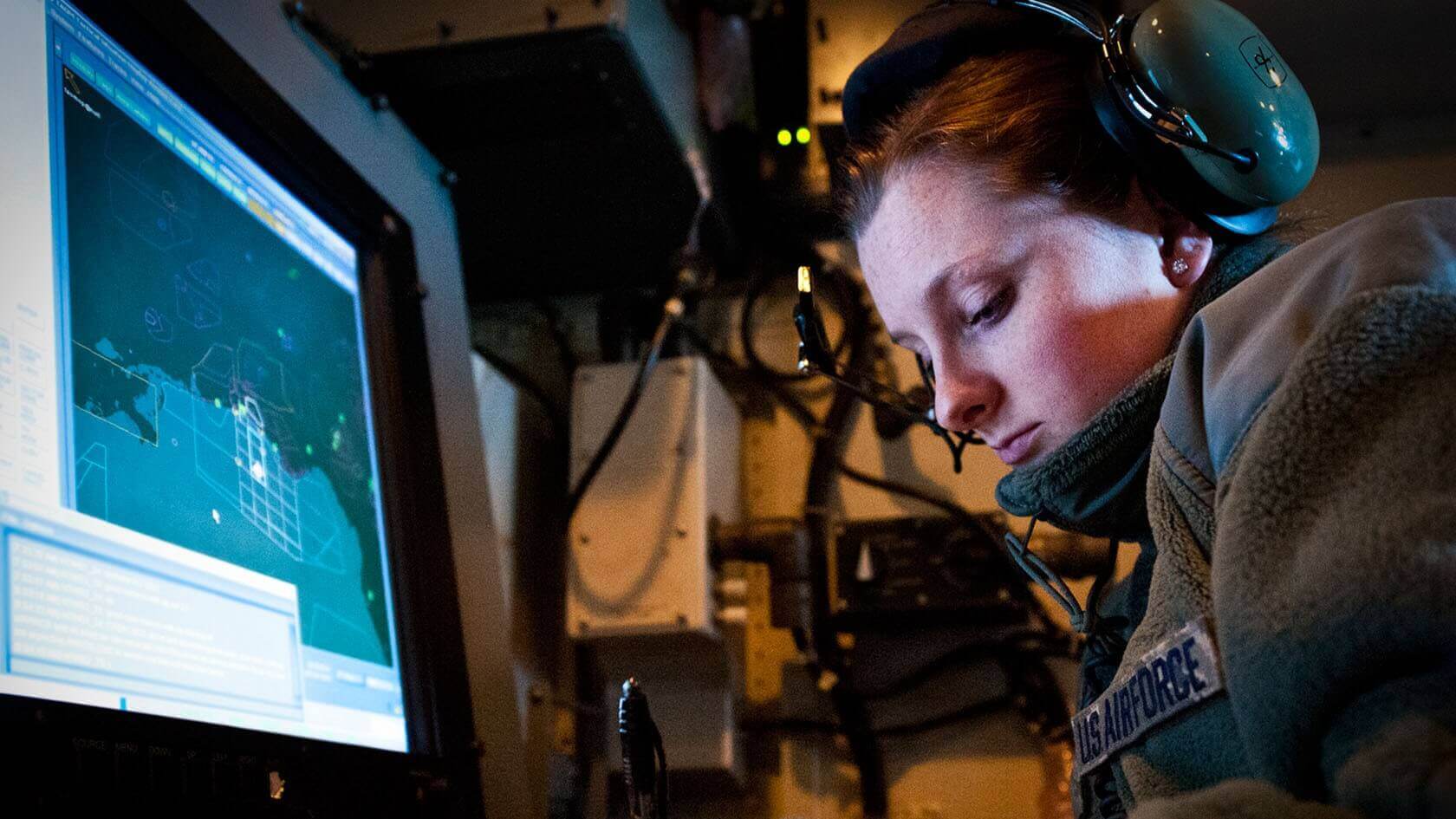
Oversees and coordinates dynamic high-stakes military operations across various domains which include air, space, land, and sea. Uses radio equipment and digital interfaces to communicate with aircraft and ensure pilots have the latest threat awareness, intelligence, and higher headquarters guidance to accomplish the mission. Merges disparate information flows and interprets data from multiple sensors and inputs, evaluates tactical situations, then makes time-critical decisions that routinely have direct life or death consequences with possible repercussions that range from the tactical level to the strategic. Battle Managers are Joint All-Domain Warfighters who are uniquely skilled force multipliers, force integrators, and decision makers that bring order and make sense from chaos. Related DoD Occupational Subgroup: 122100.
Duties and responsibilities
- Responsible as a crew member to utilize Battle Management Command and Control (BMC2) systems to direct dynamic airborne military activities in support of Combatant Commander’s objectives. Additionally, responsible for the safe ground and flight operation of aircraft and their onboard systems for duties essential to mission accomplishment.
- Manages and operates radio equipment in both fixed and austere environments to provide direction and guidance for air, space, and maritime forces where they serve as a conduit between Combatant Commanders and frontline assets.
- Provides mission planning expertise for both large- and small-scale operations providing pivotal expertise during exercises, wartime, or humanitarian crisis missions.
- Responsible as a crew member to perform battlefield surveillance functions, execute combat identification of aircraft, conduct network operations that provide global situational awareness to airborne forces and our Sister Service counterparts. Expected to maintain both network and radar equipment in support of airborne operations.
- Responsible for the publishing of official Air Force tasking orders and managing their execution from Air and Space Operations Centers.
- Performs training, planning, standardization and evaluation, and other staff duty functions. Performs staff assistance visits to subordinate units. Tests and evaluates capabilities of new equipment and propriety of new procedures.
Specialty qualifications
Knowledge. Knowledge is mandatory of: characteristics and limitations of aerospace surveillance and reporting systems; aircraft/missile detection and tracking systems and procedures; communication equipment capabilities and limitations; radar console and data link equipment presentations; receiving, recording and relaying system information; radar and radio capabilities and limitations; fixed and mobile command and control system characteristics; aircraft control procedures and techniques; aircraft performance characteristics and armament; meteorology concerning air weapons control operations and effects on radar operations.
Education. For entry into this specialty, completion of high school or general education development (GED) equivalency is mandatory. Also, completion of high school level courses in algebra and geometry is desirable.
Training. The following training is mandatory for award of the AFSC indicated:
- 1C531. Completion of a basic Battle Management Operations Apprentice course.
- 1C531D. Completion of the Battle Management Operations Apprentice course and the Undergraduate Weapons Director Ground-Based Training course.
- 1C551/1C551D. Completion of the 1C551 Battle Management Operations Journeyman Career Development Course. To be awarded AFSC 1C551/1C551D, the trainee must also complete unit-specific duty position training/tasks and obtain or maintain a duty position qualification/certification that is documented on a AF Form 8 or like form.
- To be awarded AFSC 1C571/1C571D, the trainee must complete unit-specific duty position training/tasks and obtain or maintain a duty position qualification/certification that is documented on an AF Form 8 or like form.
Experience. The following experience is mandatory for award of the AFSC indicated:
- 1C551. Qualification in and possession of AFSC 1C531. Also, experience performing tactical and/or operational BMC2 functions.
- 1C551D. Qualification in and possession of AFSC 1C551 or 1C531D. Experience in management of activities within the operational environment based on commander’s direction and guidance (JP3-01), surveillance and maintenance of operational BMC2 equipment and network functions.
- 1C571. Qualification in and possession of AFSC 1C551. Also, experience performing or supervising teams and crews executing functions such as aerospace surveillance, AOC operations, combat identification, data link operations, EA, and EP activities.
- 1C571D. Qualification in and possession of AFSC 1C571 or 1C551D. Also, experience performing or supervising teams and crews executing functions of surveillance and battle management in addition to maintaining BMC2 equipment and network functions.
Other. The following are mandatory as indicated:
- For entry, award, and retention of these AFSCs into this specialty.
- AFSC 1C5XX personnel are classified as Ground Based Operators (GBO) and must meet GBO physical qualification standards in accordance with DAFMAN 48-123, Medical Examinations and Standards. Although 1C5XX is not explicitly listed in the current version of DAFMAN 48-123 (dated December 2020), GBO standards apply. Reference to the Medical Standards Directory may be used to confirm applicability. *ANG NOTE: 1C5 transfers (cross-trainee candidates) will initiate the GBO physical and SAR 5 (Top Secret) clearance requirements within 60 days of unit in-processing. All GBO physical waiver requests are at the unit Commander's discretion and will be processed through the National Guard Bureau (NGB) for CFM concurrence.
- AFSC 1C5XXD must meet GBO standards for entry, award, and retention in accordance with DAFMAN 48-123, Medical Examinations and Standards. This includes the same physical qualification standards applicable to other GBO-designated AFSCs such as RPA pilots, sensor operators, and missile operators.
- Meet mandatory AFSC aptitude, physical profile, and citizenship entry requirements IAW attachment 4.
- Passing color vision, as defined by getting a 55 or better on the Cone Contrast Test (CCT), or correctly identifying at least 10 of 14 Ishihara Plates (PIP). (CCT should be primary testing choice, but PIP is acceptable if CCT is not available at testing site.) IAW DAFMAN 48-123, Medical Examinations and Standards.
- Must possess a valid state/territory/international driver’s license to operate government motor vehicles (GMV) in accordance with AFI 24-301, Ground Transportation prior to entry into the career field.
- Must pass Reading Aloud Test as defined in the current version of the Medical Standards Directory.
- Must maintain eligibility to deploy and mobilize worldwide. Personnel with an Assignment Limitation Code of C-1 or C-2 may retain AFSC 1C5XX or 1C5XXD if they are capable of successfully completing all core tasks in the 1C5X1 Career Field Education and Training Plan.
- Maintain local network access IAW AFI 17-130, Cybersecurity Program Management and AFMAN 17-1301, Computer Security.
- Specialty requires routine access to Tier 5 (T5) information, systems, or similar classified environments.
- Completion of a current T5 Investigation required IAW DoDM 5200.02, AFMAN 16-1405, Air Force Personnel Security Program NOTE: Award of the entry level without a completed T5 Investigation is authorized provided an interim Top-Secret security clearance has been granted according to DoDM 5200.02, AFMAN 16-1405, Air Force Personnel Security Program.
Civilian career paths
Comparable civilian careers for this field pay roughly $34,440 to $130,420 per year (median salaries; varies by role and location):
- Aerospace Engineering and Operations Technologists and Technicians: $68,570
- Air Traffic Controllers: $130,420
- Airfield Operations Specialists: $51,330
- Atmospheric and Space Scientists: $99,740
- Audio and Video Technicians: $47,920
- Broadcast Technicians: $43,570
- Cartographers and Photogrammetrist: $68,380
- Data Entry Keyers: $34,440
- Dispatchers: $40,980
- Emergency Management Directors: $76,250
- Public Safety Telecommunicators: $43,290
- Remote Sensing Scientists and Technologists: $107,210
- Remote Sensing Technicians: $52,460
- Switchboard Operators, Including Answering Service: $31,430
- Training and Development Specialists: $62,700
ASVAB requirements
To qualify for 1C5X1, you need:
Enter your scores in the AFSC explorer and this section will check each requirement for you.
Entry requirements
Medical profile (PULHES)ShowHide
PULHES scale: lower numbers mean a stricter medical standard. Tap a letter for what it measures.
Vision requirementsShowHide
Medical disqualifiersShowHide
These screened conditions disqualify a candidate for this AFSC:
Physical requirementsShowHide
Education prerequisitesShowHide
Security & backgroundShowHide
Where you could be stationed
Stateside (25)
- Barksdale, Louisiana
- Davis-Monthan, Arizona
- Eglin, Florida
- Fort Bliss, Texas
- Fort Campbell, Kentucky
- Fort Carson, Colorado
- Fort Drum, New York
- Fort Hood, Texas
- Fort Riley, Kansas
- Fort Stewart, Georgia
- Hill, Utah
- Hurlburt Field, Florida
- JBSA Lackland, Texas
- Joint Base Lewis-McChord, Washington
- Joint Base McGuire-Dix-Lakehurst, New Jersey
- Key West, Florida
- Kirtland, New Mexico
- Luke, Arizona
- Mountain Home, Idaho
- Nellis, Nevada
- Pope, North Carolina
- Scott, Illinois
- Shaw, South Carolina
- Travis, California
- Tyndall, Florida
Overseas (15)
- Al Udeid AB, Qatar
- Aviano, Italy
- Einsiedlerhof, Germany
- JB Elmendorf-Rich, Alaska
- JB Prl Hbr-Hickam, Hawaii
- James Armstrong R, Canada
- Kadena, Japan
- Misawa, Japan
- North Bay, Canada
- Osan AB, South Korea
- Poggio Renatico, Italy
- Ramstein, Germany
- Torrejon, Spain
- Wheeler, Hawaii
- Yokota, Japan
Badges & identifiers
Duty badges
The occupational badge worn by Airmen in this career field.
- Command and Control Badge
Duty identifiers
Special duty patches and identifiers associated with this AFSC.
- C2BMO Duty Identifier
Degrees & training plan
- Career Field Education & Training Plan (CFETP)View CFETP (PDF, opens in a new tab)
The CFETP is the official Air Force document describing this career field's full training pipeline, from tech school through advanced skill levels.
1C5X1 specialties (shred-outs)
This career field splits into 1 specialties — you may be assigned to one of these:
- 1C5X1DWeapons Director
Shred-outs share the 1C5X1 career path; where a specialty sets its own minimums or screens, they're noted above.
Videos, Reddit & resources
1C5X1 videos(9)
These do not reflect official U.S. Air Force views and may contain inaccuracies — negative opinions are often overrepresented online.
2026 1C5X1 Command and Control Battle Management Ops SKT Practice Test and Mastery Guide
Newestexamprep · 3/18/2026
1 of 9 videos
Reddit discussions(10)
These do not reflect official U.S. Air Force views and may contain inaccuracies — negative opinions are often overrepresented online.
Official links & resources(1)
Researching other jobs too? Every career field's videos and discussions are collected the same way — browse all AFSCs.
Frequently asked questions
- What ASVAB score do you need for Battle Management Operations (1C5X1)?
- You need General 55+ on the ASVAB to qualify for 1C5X1.
- Where can Battle Management Operations Airmen get stationed?
- 1C5X1 Airmen serve at 40 bases: 25 stateside and 15 overseas, including Al Udeid AB, Qatar, Aviano, Italy, Einsiedlerhof, Germany.
- Does 1C5X1 require a security clearance?
- Yes — Battle Management Operations requires a Top Secret clearance.
- How long is tech school for Battle Management Operations?
- Tech school for 1C5X1 runs about 30 days at Keesler, Mississippi.
Where this data comes from
Most of the data on this page comes from the Air Force Enlisted Classification Directory (AFECD) and recruiter TTMS readouts, which are no longer released publicly. Pulling it together and keeping it accurate takes real time, so I update these pages as often as I can.
Requirements do change between updates. Before you make any decisions, confirm the details with your recruiter. They always have the latest word.