1C3X1 · Operations
All-Domain Command & Control Operations
Also known as: Command Post, Command & Control Operations
Last updated
At a glance
- ASVAB minimums
- A 50+G 50
- Security clearance
- Top Secret
- Tech school
- Keesler, Mississippi · 31 days
- Career field size
- 1,597 Airmen
- Possible bases
- 53 stateside · 23 overseas
- Civilian equivalent pay
- $38k–$130k
- U.S. citizenship required
Table of ContentsShow
- What does the All-Domain Command & Control Operations career field do?
- Duties and responsibilities
- Specialty qualifications
- Civilian career paths
- ASVAB requirements
- Entry requirements
- Where you could be stationed
- Badges & identifiers
- Degrees & training plan
- Videos, Reddit & resources
- Frequently asked questions
What does the All-Domain Command & Control Operations career field do?
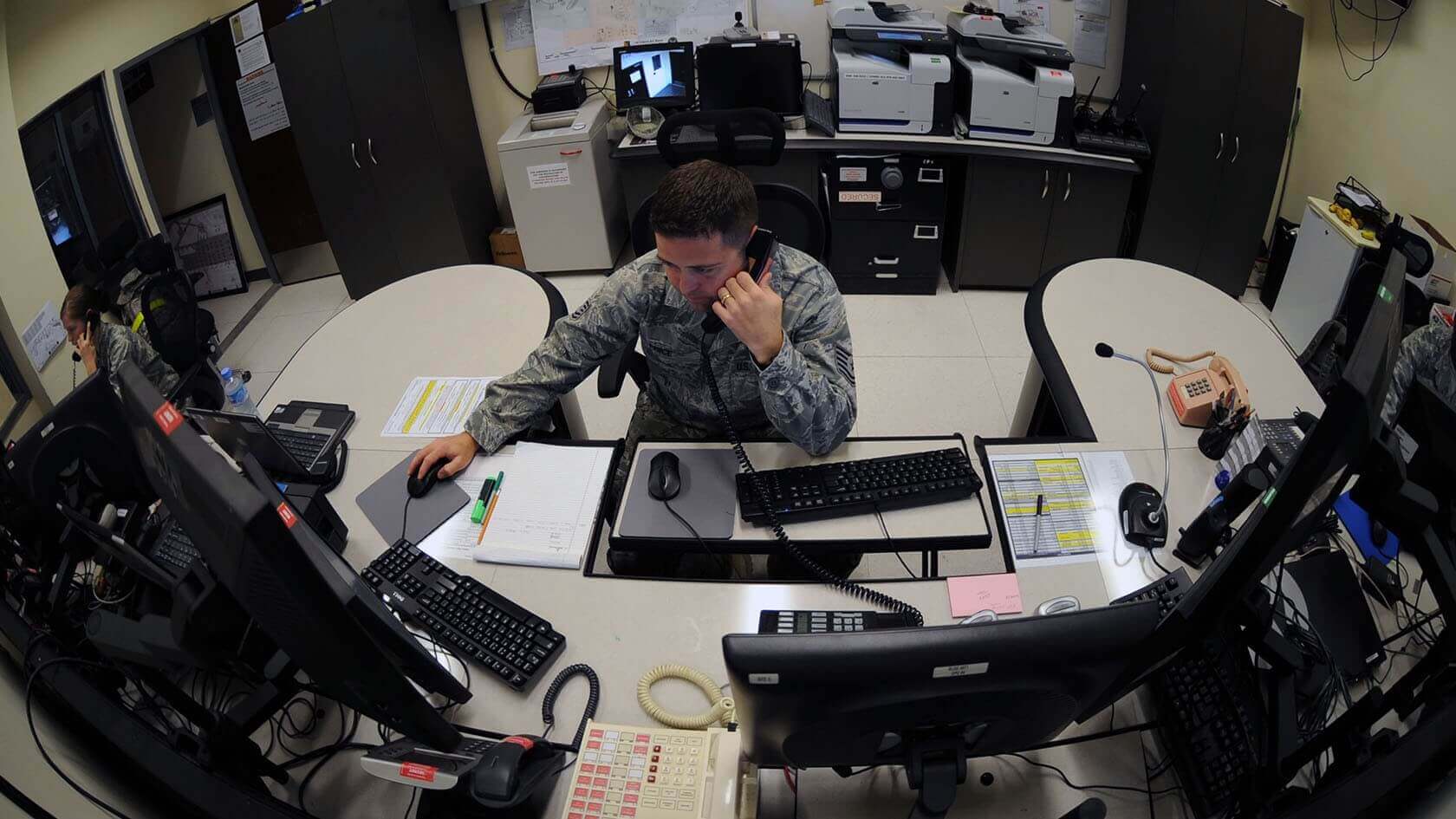
Oversees and coordinates emergency action procedures, operational reporting, mission management, crisis management, and threat detection across all echelons of command. Manages and executes command and control (C2) operations within fixed, mobile, and airborne facilities, including installation and expeditionary operations centers, wing operations centers, rescue coordination centers, and higher headquarters. Provides command, control, communications, and information supporting National Defense, Homeland Security, and Department of the Air Force operations across the full spectrum of operations from peacetime to war, including emergency and disaster response, crisis management, contingency operations. Receives and disseminates critical directives and emergency action messages from national and combatant command authorities. Implements DAF and command operational reporting procedures and employs communication systems to maintain positive control of assigned forces and weapon systems. Supports chemical, biological, radiological, and nuclear (CBRN), and conventional warning and reporting activities. AFSC Duty Identifier: C2OPS. Related DoD Occupational Subgroup: 125000.
Duties and responsibilities
- Receives, processes, and disseminates emergency action messages. Encodes, decodes, transmits, and relays presidential decisions to execute or terminate nuclear and conventional operations within the National Military Command System. Performs command, control, and communications (C3) functions supporting emergency plans and operations orders. Monitors execution of assigned missions - including tenant, joint, and combined operations - by integrating data from multiple C2 nodes. Coordinates and transmits mission-type orders, including warning, tasking, planning, prepare-to-deploy, fragmentary, operation, alert, and execution orders.
- Manages and executes the DAF reporting program. Prepares and submits operational reports (OPREP), Commander’s Critical Information Requirements (CCIR), attainment/deviation reports, nuclear execution reports (NEREP), and international treaty reports. Assesses and disseminates information derived from DAF reporting.
- Conducts flight following and manages aerospace resources, including aircraft, crews, cargo, and support elements. Relays aircraft movement and mission status between aircrews and operations centers. Coordinates mission delays with installation and external agencies.
- Develops and maintains procedures to protect resources, preserve life, and rapidly disseminate time-sensitive information. Implements crisis actions in response to sabotage, nuclear incidents, natural disasters, missile threats, aircraft accidents, evacuations, and aerospace anomalies. Provides time-critical communications between commanders, internal agencies, and external partners during daily operations, crises, and wartime contingencies to maintain positive control of assigned forces and weapon systems. Coordinates and executes search and rescue operations. Directs immediate activation and recall of resources during disasters and monitors recovery efforts to restore essential operations following attacks, accidents, or natural disasters.
- Coordinates with internal and external agencies during planning, execution, and evaluation of C2 operations. Executes Aerospace Control Alert missions as quick-response actions for intercept, inspection, or defeat of airborne threats. Monitors launch and space asset status.
Specialty qualifications
Knowledge. Knowledge is mandatory of: Air Force organization and administration; Emergency Management the National Incident Management System and Air Force Incident Management System; C2 data systems and reporting; automated data processing equipment use, capabilities, and limitations; techniques of presenting data; data collection procedures and summary techniques; purpose of C2 nodes for preparing, executing, and controlling assigned forces; emergency action procedures and directives; command weapon systems movement and transfer procedures; encode, decode; and authorization procedures used by command of assignment.
Education. For entry into this specialty, completion of high school or General Education Development Equivalency is mandatory. Courses in English or oral communication is desirable.
Training. For award of the AFSC 1C331, completion of the All-Domain Command and Control Operations Apprentice Course or the All-Domain Command and Control Operations Apprentice Distance Learning Course is mandatory
Experience. The following experience is mandatory for award of the AFSC indicated:
- 1C351. Qualification in and possession of AFSC 1C331. Also, experience performing functions of C2 operations.
- 1C371. Qualification in and possession of AFSC 1C351. Also, experience performing or supervising functions of C2 operations.
- 1C391. Qualification in and possession of AFSC 1C371. Also, experience managing and directing C2 Operations functions.
For entry, award, and retention of these AFSCs:
- Meet mandatory AFSC aptitude, physical profile, and citizenship entry requirements as identified in attachment 4.
- Entry into AFSC 1C3X1 is not open to non-United States Citizens or members with dual-citizenship status.
- Must pass Reading Aloud Test as defined in current version of Medical Standards Directory (MSD).
- No history of emotional instability, personality disorder, or other unresolved mental health problems, which precludes execution of daily AFSC duties and reasonable judgment, as determined by a Chief Medical Officer or competent medical authority.
- Must maintain eligibility to deploy and mobilize worldwide. Personnel with an Assignment Limitation Code of C-1 or C-2 may retain AFSC 1C3X1 if capable of successfully completing all core tasks in the 1C3X1 Career Field Education and Training Plan.
- Must maintain qualification IAW higher-headquarters guidance.
- Initial qualification must be obtained within 180 calendar days from the date entered into training.
- Must maintain local network access IAW AFI 17-130, Cybersecurity Program Management, and AFMAN 17-1301, Computer Security (COMPUSEC).
- Specialty requires routine access to Tier 5 (T5) information, systems, or similar classified environments. Completion of a current T5 investigation IAW DoDM 5200.02 and AFMAN 16-1405, Air Force Personnel Security Program
- Individuals unable to obtain a clearance within 180 days will be considered for removal from the AFSC.
- Individuals with suspended clearances greater than 180 calendar days will be considered for removal from the AFSC.
- Individuals retraining into the career field may enter with a Secret clearance.
- Award of the entry level without a completed T5 investigation is authorized provided an interim Top Secret security clearance has been granted according to DoDM 5200.02 and AFMAN 16-1405, Air Force Personnel Security Program.
- For entry into this specialty for personnel in retraining status:
- E-1 through E-5 (no (TIS) restrictions), E-6 (less than 10 years TIS). SNCOs are not accepted without prior coordination of the 1C3 Career Field Manager.
- TIS restrictions do not apply to the ARC.
- ANG and AFRC members are required to coordinate with their respective 1C3 AFRC Function Manager and 1C3 ANG Career Field Manager for approval.
- Interviewed and recommended by a 1C3 SNCO. Retraining interview does not apply to the ARC.
- Screened for eligibility and meets requirements of the Personnel Reliability Program (PRP) as outlined in HQ AETC PRP prescreening guidance. PRAP screening does not apply to the ARC.
- 1C3 Career Field Manager and MAJCOM Function Managers will be notified of all AFSC withdrawals.
- The 1C3 Career Field Manager may consider entry, award, and retention waivers exceeding mandatory AFSC requirements on a case-by-case basis.
- Individuals with suspended clearances greater than 180 calendar days will be considered for removal from the AFSC.
- Reclassified and/or retraining personnel may enter the career field with a Secret clearance. NOTE: Award of the entry level without a completed T5 Investigation is authorized provided an interim Top Secret security clearance has been granted according to DoDM 5200.02, AFMAN 16-405, Air Force Personnel Security Program.
- Must have a S-1 profile (for PULHES clearance). For retention, Commanders should contact the 1C3 Career Field Manager, or their respective 1C3 MAJCOM Functional Manager, for questions on retraining a member in the 1C3 AFS.
- NOTE: All AFSC withdrawals must be coordinated with 1C3 Career Field Manager.
Civilian career paths
Comparable civilian careers for this field pay roughly $37,710 to $130,420 per year (median salaries; varies by role and location):
- Air Traffic Controllers: $130,420
- Airfield Operations Specialists: $51,330
- Broadcast Technicians: $43,570
- Dispatchers: $40,980
- Emergency Management Directors: $76,250
- Intelligence Analysts: $86,940
- Public Safety Telecommunicators: $43,290
- Security Management Specialists: $77,420
- Security Managers: $98,890
- Telephone Operators: $37,710
ASVAB requirements
To qualify for 1C3X1, you need:
Enter your scores in the AFSC explorer and this section will check each requirement for you.
Entry requirements
Medical profile (PULHES)ShowHide
PULHES scale: lower numbers mean a stricter medical standard. Tap a letter for what it measures.
Medical disqualifiersShowHide
These screened conditions disqualify a candidate for this AFSC:
Education prerequisitesShowHide
Security & backgroundShowHide
Where you could be stationed
Stateside (53)
- Altus, Oklahoma
- Barksdale, Louisiana
- Beale, California
- Cannon, New Mexico
- Columbus, Mississippi
- Davis-Monthan, Arizona
- Dover, Delaware
- Dyess, Texas
- Edwards, California
- Eglin, Florida
- Ellsworth, South Dakota
- F E Warren, Wyoming
- Fairchild, Washington
- Fort George Meade, Maryland
- Fort Sam Houston, Texas
- Goodfellow AFB, Texas
- Grand Forks, North Dakota
- Hanscom, Massachusetts
- Hill, Utah
- Holloman, New Mexico
- Hurlburt Field, Florida
- JB Andrews, Maryland
- JB Charleston, South Carolina
- JB Langley-Eustis, Virginia
- JBSA Randolph, Texas
- Joint Base Lewis-McChord, Washington
- Joint Base McGuire-Dix-Lakehurst, New Jersey
- Keesler, Mississippi
- Kirtland, New Mexico
- Laughlin, Texas
- Little Rock, Arkansas
- Luke, Arizona
- MacDill, Florida
- Malmstrom, Montana
- Maxwell, Alabama
- McConnell, Kansas
- Minot, North Dakota
- Moody, Georgia
- Mountain Home, Idaho
- Nellis, Nevada
- Offutt, Nebraska
- Pope, North Carolina
- Robins, Georgia
- Scott, Illinois
- Seymour Johnson, North Carolina
- Shaw, South Carolina
- Sheppard, Texas
- Tinker, Oklahoma
- Travis, California
- Tyndall, Florida
- Vance, Oklahoma
- Whiteman, Missouri
- Wright Patterson, Ohio
Overseas (23)
- Al Udeid AB, Qatar
- Andersen, Guam
- Aviano, Italy
- Buchel, Germany
- Diego Garcia NSA, Diego Garcia
- Eielson, Alaska
- Geilenkirchen, Germany
- Ghedi, Italy
- Incirlik AB, Turkey
- JB Elmendorf-Rich, Alaska
- JB Prl Hbr-Hickam, Hawaii
- Kadena, Japan
- Kleine Brogel, Belgium
- Kunsan, South Korea
- Lakenheath, United Kingdom
- Mildenhall, United Kingdom
- Misawa, Japan
- Osan AB, South Korea
- Ramstein, Germany
- Rota NS, Spain
- Spangdahlem AB, Germany
- Volkel, Netherlands
- Yokota, Japan
Badges & identifiers
Duty badges
The occupational badge worn by Airmen in this career field.
- Command and Control Badge
Duty identifiers
Special duty patches and identifiers associated with this AFSC.
- C2OPS Duty Identifier
Degrees & training plan
While serving in 1C3X1 you can earn an associate degree through the Community College of the Air Force:
- Emergency Management
- Career Field Education & Training Plan (CFETP)View CFETP (PDF, opens in a new tab)
The CFETP is the official Air Force document describing this career field's full training pipeline, from tech school through advanced skill levels.
Videos, Reddit & resources
1C3X1 videos(12)
These do not reflect official U.S. Air Force views and may contain inaccuracies — negative opinions are often overrepresented online.
Command and Control Operations | Command Post (1C3X1)
Airman Vision · 4/15/2025
1 of 12 videos
Reddit discussions(10)
These do not reflect official U.S. Air Force views and may contain inaccuracies — negative opinions are often overrepresented online.
Official links & resources(4)
Researching other jobs too? Every career field's videos and discussions are collected the same way — browse all AFSCs.
Frequently asked questions
- What ASVAB score do you need for All-Domain Command & Control Operations (1C3X1)?
- You need Administrative 50+ and General 50+ on the ASVAB to qualify for 1C3X1.
- Where can All-Domain Command & Control Operations Airmen get stationed?
- 1C3X1 Airmen serve at 76 bases: 53 stateside and 23 overseas, including Al Udeid AB, Qatar, Andersen, Guam, Aviano, Italy.
- Does 1C3X1 require a security clearance?
- Yes — All-Domain Command & Control Operations requires a Top Secret clearance.
- How long is tech school for All-Domain Command & Control Operations?
- Tech school for 1C3X1 runs about 31 days at Keesler, Mississippi.
Where this data comes from
Most of the data on this page comes from the Air Force Enlisted Classification Directory (AFECD) and recruiter TTMS readouts, which are no longer released publicly. Pulling it together and keeping it accurate takes real time, so I update these pages as often as I can.
Requirements do change between updates. Before you make any decisions, confirm the details with your recruiter. They always have the latest word.