1A8X2 · Operations
Airborne Intelligence, Surveillance, and Reconnaissance (ISR) Operator
Also known as: Airborne ISR Operator
Last updated
At a glance
- ASVAB minimums
- G 72
- Security clearance
- Top Secret
- Tech school
- Goodfellow AFB, Texas · JBSA Lackland, Texas · 66 days
- Career field size
- 495 Airmen
- Possible bases
- 10 stateside · 2 overseas
- Civilian equivalent pay
- $44k–$107k
- Aircrew
- U.S. citizenship required
Table of ContentsShow
- What does an Airborne Intelligence, Surveillance, and Reconnaissance (ISR) Operator do?
- Duties and responsibilities
- Specialty qualifications
- Civilian career paths
- ASVAB requirements
- Entry requirements
- Where you could be stationed
- Badges & identifiers
- Degrees & training plan
- Videos, Reddit & resources
- Frequently asked questions
What does an Airborne Intelligence, Surveillance, and Reconnaissance (ISR) Operator do?
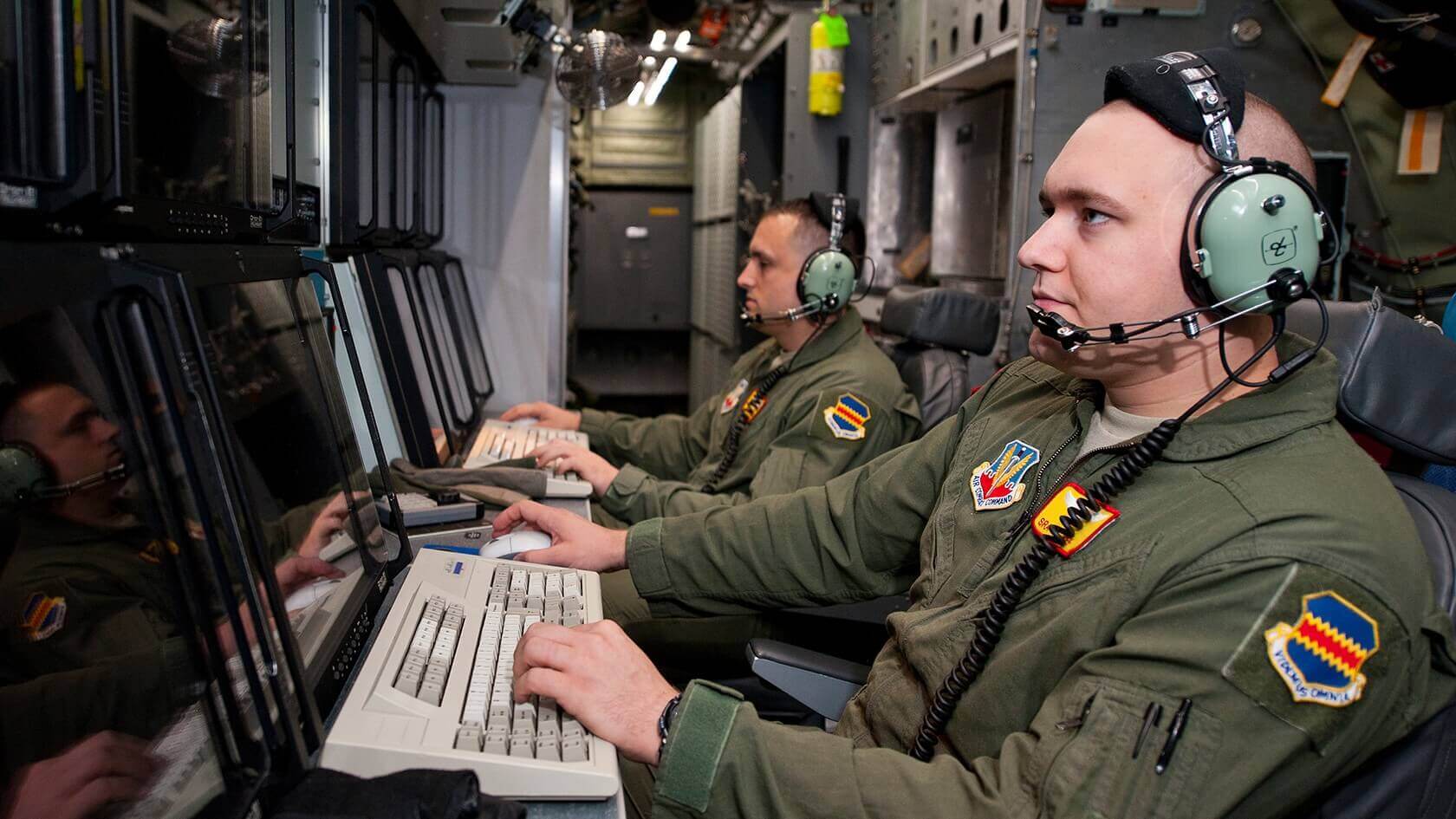
Operates, evaluates, and manages airborne ISR information systems, operations activities and related intelligence and analysis activities on ground processing systems. Performs identification, acquisition, recording, analysis, and reporting of assigned ISR tasks. Provides ISR threat warning support and interfaces with other units. Performs and assists with mission planning. Maintains assigned aviation publications and currency items and is knowledgeable on DoD/Intelligence Community and Air Force Intelligence regulations. Participates in theater and tactical-level ISR coordination networks. Processes, analyzes, and disseminates ISR information obtained from onboard sensors during missions activities and conducts follow on analysis of assigned collection as required. Related DoD Occupational Subgroups: 123100, 123200, and 155600.
Duties and responsibilities
- Performs and assists in mission planning. Provides mission planning inputs to maximize mission success. Prepares and distributes operational intelligence information to crew. Coordinates mission profile requirements and priorities. Prepares mission data files. Review status of mission aircraft, targets, and air tasking order information. Monitors employment of other assigned air assets and operations.
- Processes, exploits, analyzes, and disseminates intelligence information in an airborne environment. Operates airborne intelligence systems and executes mission within standard requirements. Conducts environmental surveys of radio frequency spectrum with sophisticated computerized radio receiver suites. Tunes and records data as needed. Annotates electromagnetic events, measures parameters, compares sensor data results with in-flight databases of previously catalogued signals to determine likely emitter source, and determines location of signal. Analyzes structure and content of machine-based communications. Digitally archives key events for follow-on processing. Extracts essential elements of information for reportable significance. Disseminates threat warning information to affected entities via established channels. Maintains logs to document mission results. Prepares in-flight and post-mission reports. Ensures accuracy, completeness, format, and compliance with current directives and mission system performance engineering preventive maintenance programs, and aircrew procedures.
- Provides threat warning and actionable intelligence to customers as required. Achieves and maintains situational awareness of impending/ongoing air, ground, and maritime combat operations. Employs intelligence information systems to satisfy air, ground, and maritime force intelligence and threat warning requirements. Provides threat warning information to aircrews and other agencies. Coordinates with airborne, ground, and maritime agencies to distribute and relay operational threat and identification data. Transmits identification and other mission information. Knowledgeable of U.S. and allied operations such as interception, interdiction, Close Air Support (CAS), Combat Search and Rescue (CSAR), Combat Air Patrol (CAP), reconnaissance, Offensive or Defensive Counter Air (OCA/DCA), Suppression of Enemy Air Defenses (SEAD), and Special Operations Forces (SOF). See MDS specific doctrine mission statements.
- Coordinates and exchanges identification information. Coordinates with aerospace rescue and recovery services and operations. Maintains liaison with reporting agencies required for mission execution.
- Perform aircrew duties. Demonstrates and maintains proficiency in emergency equipment use and procedures, and egress. Performs pre-flight, through-flight, and post-flight inspections. Operates aircraft systems and equipment, such as electrical, interphone, door, and exits. Performs preventive maintenance on mission equipment. Ensures equipment and resources are externally clean, functional, and free from safety hazard. Reports malfunctions and observations. Supervises loading and off-loading of classified material and personal aircrew gear. Applies restraint devices, such as cargo straps and nets, to prevent shifting during flight. Ensures access to escape exits.
- Performs ground intelligence duties. Reviews signals information from airborne missions and correlates additional intelligence data to further refine analytic assessments. Works with other analysts to evaluate information and provide refined analysis as required. Injects new information back into mission planning and preparations processes.
- Performs office duties as assigned. Duties can include functions such as operations, analysis, mission planning, tactics, training, standardization and evaluations, scheduling, deployment operations, or other administrative, aviation or ISR management functions
Specialty qualifications
Knowledge. ISR operations and related Cryptologic support to national agencies, service Cryptologic elements and theater elements; joint service relationships and operations concepts; organization of national intelligence structure, tasking strategies; radio propagation and modulation theory; radio communications networks, operations, and techniques; collection and processing procedures; signals and traffic analysis techniques; tasking strategies; reporting concepts, formats and procedures; mission planning and management; basic computer and electronic equipment operations; and methods for handling, distributing and safeguarding information and aircraft emergency equipment and procedures.
Education. For entry into specialty completion of high school or general educational development equivalency is mandatory. Also, completion of courses in advanced mathematics, computers, electronics, and typing is desirable.
Training. For award of AFSC 1A832, completion of Basic Military Training, the CEA Fundamentals Course; Apprentice Signals Analysis Course; and the designated survival schools are mandatory.
Experience. The following experience is mandatory for award of the AFSC indicated:
- 1A852. Qualification in and possession of AFSC 1A832. Completion of I/MQT and CMR. Completion of B-CDP and six months experience performing or supervising airborne Intelligence Surveillance Reconnaissance functions.
- 1A872. Qualification in and possession of AFSC 1A852. Minimum grade of SSgt Select. Meet Aircrew Position Indicator (API) requirements in accordance with DAFMAN 11-402, Table 3.1 and the Unit Manpower Document. Complete minimum 60 hours instructor-led cryptologic training. Upon Completion of training, attain twelve months experience performing or supervising airborne Intelligence Surveillance Reconnaissance functions. Completion of I-CDP expected within one year after date of rank to Technical Sergeant.
Other. The following are mandatory as indicated:
- For entry into this specialty:
- No record or history of temporomandibular joint pain or disorder.
- See attachment 4 for additional entry requirements.
- For entry, award, and retention of these AFSCs-1A832/52/72:
- Physical qualification for aircrew duty according to DAFMAN 48-123, Medical Examinations and Standards, Flying Class III medical standards and AFS height requirements as listed in the Medical Standards Directory.
- Qualification for aviation service according to AFI 11-402, Aviation and Parachutist Service, Aeronautical Ratings and Aviation Badges.
- Specialty requires routine access to Tier 5 (T5) information, systems, or similar classified environments.
- Completion of a current T5 Investigation IAW DoDM 5200.02, DAFMAN 16-1405, Department of the Air Force Personnel Security Program. NOTE: Award of the entry level without a completed T5 Investigation is authorized provided an interim Top Secret security clearance has been granted according to DoDM 5200.02, and DAFMAN 16-1405.
- Must successfully complete a polygraph examination and meet customer mission access eligibility requirements. NOTE: Airmen unable to maintain T5 Investigation, unable to complete polygraph or gain mission access to systems and or facilities will be retrained or separated. Begin the process no later than day 365 of lack of access.
- Must maintain local network access IAW AFI 17-130, Cybersecurity Program Management and DAFMAN 17-1301, Computer Security (COMPUSEC).
- Must maintain eligibility to deploy and mobilize worldwide. Airmen coded who are unable to maintain deployment eligibility or worldwide clearance in excess of 12 months will be considered for retrain or separated.
Civilian career paths
Comparable civilian careers for this field pay roughly $43,570 to $107,210 per year (median salaries; varies by role and location):
- Aviation Inspectors: $78,400
- Broadcast Technicians: $43,570
- Cartographers and Photogrammetrists: $68,380
- Computer Systems Analysts: $93,730
- Database Administrators: $98,860
- Detectives and Criminal Investigators: $86,940
- General and Operations Managers: $103,650
- Geographic Information Systems Technologists and Technicians: $92,870
- Intelligence Analysts: $86,940
- Interpreters and Translators: $52,330
- Network and Computer Systems Administrators: $84,810
- Operations Research Analysts: $86,200
- Remote Sensing Scientists and Technologists: $107,210
- Remote Sensing Technicians: $52,460
- Surveying and Mapping Technicians: $46,200
ASVAB requirements
To qualify for 1A8X2, you need:
Enter your scores in the AFSC explorer and this section will check each requirement for you.
Entry requirements
Medical profile (PULHES)ShowHide
PULHES scale: lower numbers mean a stricter medical standard. Tap a letter for what it measures.
Vision requirementsShowHide
Medical disqualifiersShowHide
These screened conditions disqualify a candidate for this AFSC:
Physical requirementsShowHide
Education prerequisitesShowHide
Security & backgroundShowHide
Where you could be stationed
Stateside (10)
- Cannon, New Mexico
- Davis-Monthan, Arizona
- Denver, Colorado
- Fort George Meade, Maryland
- Goodfellow AFB, Texas
- Hurlburt Field, Florida
- JB Langley-Eustis, Virginia
- Offutt, Nebraska
- Robins, Georgia
- Will Rogers World, Oklahoma
Overseas (2)
- Kadena, Japan
- Mildenhall, United Kingdom
Badges & identifiers
Duty badges
The occupational badges worn by Airmen in this career field.
- Enlisted Aircrew Badge
- Intelligence Badge
Duty identifiers
Special duty patches and identifiers associated with this AFSC.
- A-ISR Duty Identifier
Degrees & training plan
While serving in 1A8X2 you can earn an associate degree through the Community College of the Air Force:
- Intelligence Studies and Technology
- Career Field Education & Training Plan (CFETP)View CFETP (PDF, opens in a new tab)
The CFETP is the official Air Force document describing this career field's full training pipeline, from tech school through advanced skill levels.
Videos, Reddit & resources
1A8X2 videos(6)
These do not reflect official U.S. Air Force views and may contain inaccuracies — negative opinions are often overrepresented online.
U.S. Air Force: Airborne ISR Operators – The Eyes in the Sky
U.S. Air Force Recruiting · 8/28/2020
1 of 6 videos
Reddit discussions(10)
These do not reflect official U.S. Air Force views and may contain inaccuracies — negative opinions are often overrepresented online.
Official links & resources(2)
Researching other jobs too? Every career field's videos and discussions are collected the same way — browse all AFSCs.
Frequently asked questions
- What ASVAB score do you need for Airborne Intelligence, Surveillance, and Reconnaissance (ISR) Operator (1A8X2)?
- You need General 72+ on the ASVAB to qualify for 1A8X2.
- Where can Airborne Intelligence, Surveillance, and Reconnaissance (ISR) Operator Airmen get stationed?
- 1A8X2 Airmen serve at 12 bases: 10 stateside and 2 overseas, including Kadena, Japan, Mildenhall, United Kingdom.
- Does 1A8X2 require a security clearance?
- Yes — Airborne Intelligence, Surveillance, and Reconnaissance (ISR) Operator requires a Top Secret clearance.
- How long is tech school for Airborne Intelligence, Surveillance, and Reconnaissance (ISR) Operator?
- Tech school for 1A8X2 runs about 66 days at Goodfellow AFB, Texas · JBSA Lackland, Texas.
Where this data comes from
Most of the data on this page comes from the Air Force Enlisted Classification Directory (AFECD) and recruiter TTMS readouts, which are no longer released publicly. Pulling it together and keeping it accurate takes real time, so I update these pages as often as I can.
Requirements do change between updates. Before you make any decisions, confirm the details with your recruiter. They always have the latest word.