4V0X1 · Medical
Ophthalmic
Last updated
At a glance
- ASVAB minimums
- G 52
- Tech school
- Fort Sam Houston, Texas · 53 days
- Career field size
- 221 Airmen
- Possible bases
- 55 stateside · 13 overseas
- Civilian equivalent pay
- $34k–$44k
Table of ContentsShow
What does the Ophthalmic career field do?
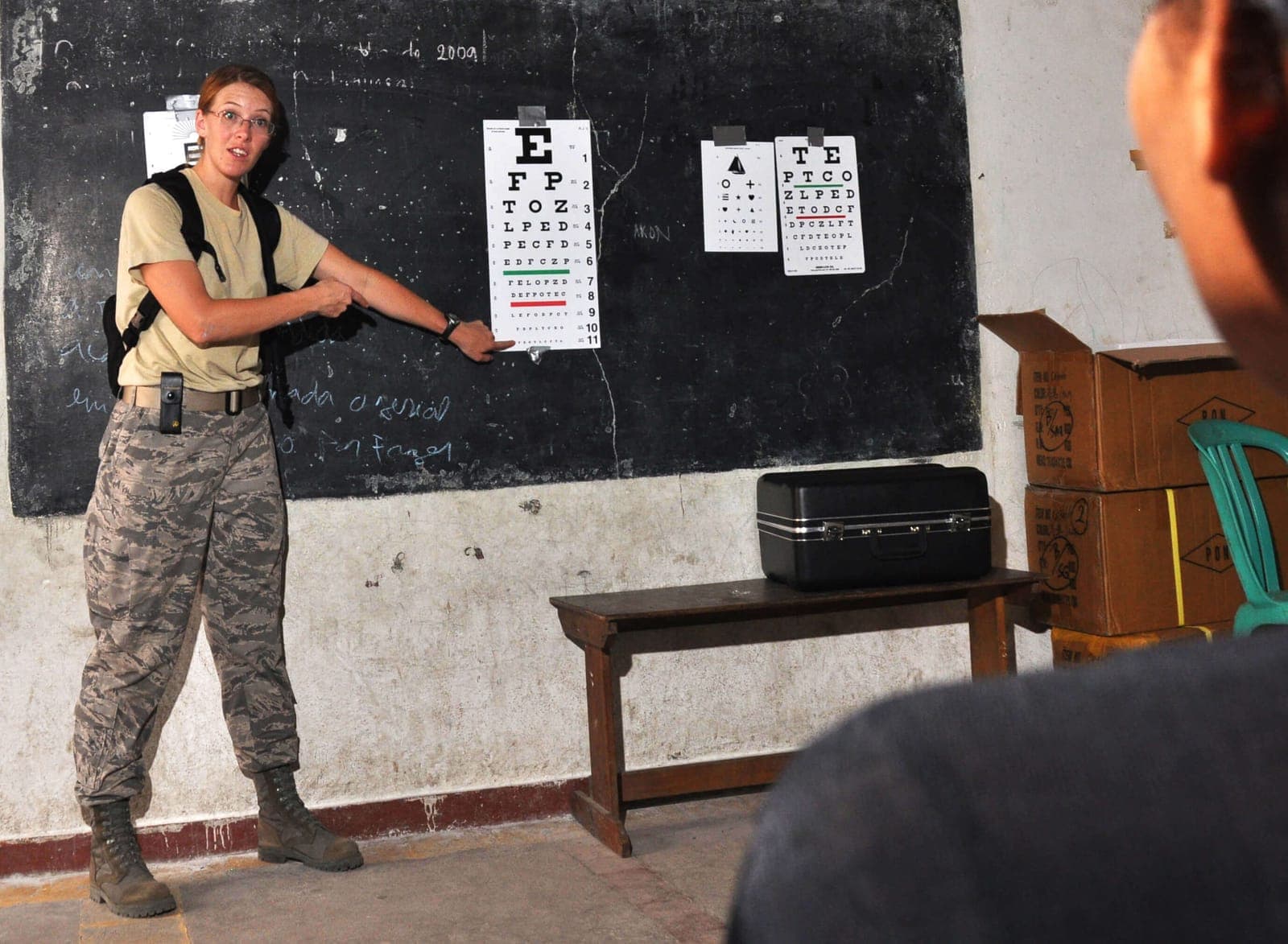
Performs and manages visual screening tests and assists in patient treatment. Processes prescriptions for military eyewear. Performs and manages optometry and ophthalmology clinic activities. Manages and directs ophthalmic service personnel, materiel, equipment, and programs. Supervises technical and administrative activities of ophthalmic services. Related DoD Occupational Subgroup: 132300.
Duties and responsibilities
- Performs ophthalmic services. Assists the health care provider in the examination and treatment of patients by performing visual tests or procedures. Records patient case history, conducts visual screening tests such as visual acuity, cover test, pupillary testing, color vision, depth perception, visual field charting, corneal topography, and tonometry for analysis and interpretation. Takes ophthalmic photographs. Administers ophthalmic drops and ointments and applies ocular dressings.
- 4V0X1 specific: Orders, fits, and dispenses military eyewear. Instructs patients on contact lens procedures. Assists air crew members in aviator contact lens and night vision goggle program. Assist personnel in occupational vision and refractive surgery programs.
- 4V0X1S specific: Performs as an ophthalmic surgical assistant and prepares preoperative and postoperative patients. Prepares injectable ophthalmic anesthetics and antibiotics. Assists with suture removal and obtains eye cultures. Performs ancillary testing such as ocular ultrasonography, retinal imaging, slit lamp photography, and fluorescein angiography.
- Manages ophthalmic resources. Determines requirements for supplies, equipment, and personnel. Develops and maintains a working environment to provide timely, economical, and operational support. Directs budget and manages ophthalmic activities. Ensures periodic maintenance and calibration checks on clinic diagnostic equipment are completed.
- Manages ophthalmic administrative services. Directs safety, infection control, training, and other clinic specific programs. Coordinates technical and administrative activities of ophthalmic services to ensure effective and efficient use of ophthalmic personnel. Executes self-inspections, reviews reports and records for accuracy and compliance. Reports findings and service’s activities. Establishes or recommends ophthalmic standards, regulations, policies, or procedures to ensure quality patient care in a safe, efficient, and effective ophthalmic environment.
Specialty qualifications
Knowledge. Knowledge is mandatory of: Ocular anatomy; ophthalmic medications; visual physiology, optics; use and maintenance of ophthalmic instruments and testing equipment; ophthalmic and medical instructions; medical terminology; ophthalmic technology; asepsis; ocular referrals and emergency medical treatment; patient transportation; medical ethics; medical administration; and medical service organization and function. Surgical instruments and equipment, ophthalmic injectable medications, anesthetic solutions, and ocular disorders.
- 4V0X1S. Surgical instruments and equipment, gowning, and gloving, maintaining sterile field, common ocular surgical procedures, ophthalmic injectable medications, fluorescein angiography, and ocular disorders.
Education. For entry into this specialty, completion of high school courses in algebra, geometry, trigonometry, physics, biology, anatomy, or physiology is desirable.
Training. The following is mandatory for award of the AFSC indicated:
- 4V031/S. Completion of the Medical Education Training Campus (METC) Ophthalmic Technician program.
- 4V031S. Completion of the basic ophthalmology surgical course.
Experience. The following experience is mandatory for award of the AFSC indicated:
- 4V051. Qualification in and possession of AFSC 4V031/S. Also, proficiency through on-the-job training of all applicable optometry tasks listed in 4V0X1/S CFETP. Experience in caring for and treating ophthalmic patients and in operating and maintaining ophthalmic equipment such as lensometers, vision screening instruments, visual field measuring instruments, tonometers, and fitting optical and ophthalmic devices.
- 4V051S. Qualification in and possession of AFSC 4V031/S. Proficiency through on-the-job training of all applicable ophthalmology tasks listed in 4V0X1/S CFETP. Experience as an ophthalmic surgical assistant in preparing preoperative and postoperative patients; injectable ophthalmic anesthetics and antibiotics; performing suture removal and obtaining eye cultures. Also, experience in performing ancillary testing such as ocular ultrasonography, retinal imaging, slit lamp photography, and flourescein angiography.
- 4V071. Qualification in and possession of AFSC 4V051/S. Also, experience performing or supervising ophthalmic functions such as caring for and treating patients, operating ophthalmic testing equipment, and fitting optical and ophthalmic devices.
- 4V071/S. Proficiency through on-the-job training of all applicable ophthalmology tasks listed in 4V0X1 CFETP.
- 4V091. Qualification in and possession of AFSC 4V071/S. Also, experience managing optometry or ophthalmology activities.
Other. The following are mandatory as indicated:
- For entry into AFSCs 4V0X1/S:
- Vision correctable to at least 20/30 in either eye.
- No detectable central scotoma in either eye with best acuity.
- See attachment 4 for additional entry requirements.
- For entry into shredout, prior qualification and possession of AFSC 4V031.
- For entry, award, and retention of AFSC 4V0X1S, the following are mandatory as indicated:
- No record of emotional instability according to the provisions of AFI 48-123, Medical Examinations and Standards.
- No limitations of continuous standing according to provisions of AFI 48-123.
- No latex sensitivity or dermatosis resulting in rashes or inflammation of the skin preventing surgical task completion.
- Medically qualified in accordance with AFI 48-137, Respiratory Protection Program.
- For award and retention of AFSC 4V051/S, National certification, and recertification from one of the following:
- American Optometric Association (AOA), with a minimum certification level of Certified Paraoptometric Technician (CPOT) or
- Joint Commission on Allied Health Personnel in Ophthalmology (JCAHPO) with a minimum certification level of Certified Ophthalmic Assistant (COA).
- Award of certification is required within 24 months of obtaining 5-skill level.
- For award and retention of AFSC 4V091, National certification and recertification from one of the following:
- American Optometric Association (AOA), with a minimum certification level of Certified Paraoptometric Assistant (CPOA) or
- Joint Commission on Allied Health Personnel in Ophthalmology (JCAHPO) with a minimum certification level of Certified Ophthalmic Assistant (COA).
- Award of certification is required within 24 months of obtaining 5-skill level.
- For award and retention of AFSC 4V071/S, National certification and recertification from one of the following:
- AOA with a minimum certification level of CPOA, or
- JCAHPO with a minimum certification level of COA.
- For award and retention of AFSC 4V091, National certification and recertification from one of the following:
- AOA with a minimum certification level of CPOA, or
- JCAHPO with a minimum certification level of COA.
- For award and retention of these AFSCs, must maintain local network access IAW AFI 17-130, Cybersecurity Program Management and AFMAN 17-1301, Computer Security.
Civilian career paths
Comparable civilian careers for this field pay roughly $34,440 to $44,090 per year (median salaries; varies by role and location):
- Ophthalmic Laboratory Technicians: $34,440
- Ophthalmic Medical Technicians: $37,940
- Ophthalmic Medical Technologists: $44,090
- Opticians, Dispensing: $38,530
ASVAB requirements
To qualify for 4V0X1, you need:
Enter your scores in the AFSC explorer and this section will check each requirement for you.
Entry requirements
Medical profile (PULHES)ShowHide
PULHES scale: lower numbers mean a stricter medical standard. Tap a letter for what it measures.
Medical disqualifiersShowHide
These screened conditions disqualify a candidate for this AFSC:
Security & backgroundShowHide
Where you could be stationed
Stateside (55)
- Altus, Oklahoma
- Barksdale, Louisiana
- Beale, California
- Bolling, District Of Columbia
- Cannon, New Mexico
- Columbus, Mississippi
- Davis-Monthan, Arizona
- Dover, Delaware
- Dyess, Texas
- Edwards, California
- Eglin, Florida
- Ellsworth, South Dakota
- F E Warren, Wyoming
- Fairchild, Washington
- Goodfellow AFB, Texas
- Grand Forks, North Dakota
- Hanscom, Massachusetts
- Hill, Utah
- Holloman, New Mexico
- Hurlburt Field, Florida
- JB Andrews, Maryland
- JB Charleston, South Carolina
- JB Langley-Eustis, Virginia
- JBSA Lackland, Texas
- JBSA Randolph, Texas
- Joint Base Lewis-McChord, Washington
- Joint Base McGuire-Dix-Lakehurst, New Jersey
- Keesler, Mississippi
- Kirtland, New Mexico
- Laughlin, Texas
- Little Rock, Arkansas
- Luke, Arizona
- MacDill, Florida
- Malmstrom, Montana
- Maxwell, Alabama
- McConnell, Kansas
- Minot, North Dakota
- Moody, Georgia
- Mountain Home, Idaho
- Nellis, Nevada
- Offutt, Nebraska
- Pentagon, Virginia
- Pope, North Carolina
- Robins, Georgia
- Scott, Illinois
- Seymour Johnson, North Carolina
- Shaw, South Carolina
- Sheppard, Texas
- Tinker, Oklahoma
- Travis, California
- Tyndall, Florida
- USAF Academy, Colorado
- Vance, Oklahoma
- Whiteman, Missouri
- Wright Patterson, Ohio
Overseas (13)
- Andersen, Guam
- Aviano, Italy
- Eielson, Alaska
- Incirlik AB, Turkey
- JB Elmendorf-Rich, Alaska
- JB Prl Hbr-Hickam, Hawaii
- Kadena, Japan
- Lakenheath, United Kingdom
- Misawa, Japan
- Osan AB, South Korea
- Ramstein, Germany
- Spangdahlem AB, Germany
- Yokota, Japan
Badges & identifiers
Duty badges
The occupational badge worn by Airmen in this career field.
- Enlisted Medical Badge
Degrees & training plan
While serving in 4V0X1 you can earn an associate degree through the Community College of the Air Force:
- Ophthalmic Technician
- Career Field Education & Training Plan (CFETP)View CFETP (PDF, opens in a new tab)
The CFETP is the official Air Force document describing this career field's full training pipeline, from tech school through advanced skill levels.
4V0X1 specialties (shred-outs)
This career field splits into 1 specialties — you may be assigned to one of these:
- 4V0X1SOphthalmology
Shred-outs share the 4V0X1 career path; where a specialty sets its own minimums or screens, they're noted above.
Videos, Reddit & resources
4V0X1 videos(6)
These do not reflect official U.S. Air Force views and may contain inaccuracies — negative opinions are often overrepresented online.
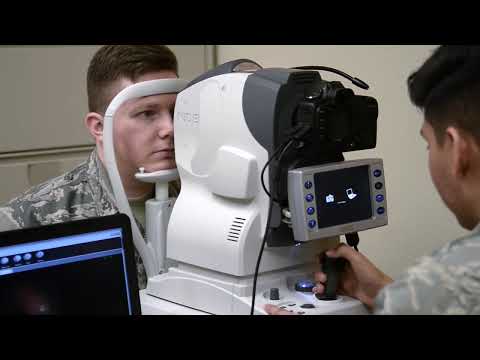
Air Force Ophthalmic Technician - 4V0X1
Airman Vision · 9/22/2025
1 of 6 videos
Reddit discussions(2)
These do not reflect official U.S. Air Force views and may contain inaccuracies — negative opinions are often overrepresented online.
Official links & resources(3)
Researching other jobs too? Every career field's videos and discussions are collected the same way — browse all AFSCs.
Frequently asked questions
- What ASVAB score do you need for Ophthalmic (4V0X1)?
- You need General 52+ on the ASVAB to qualify for 4V0X1.
- Where can Ophthalmic Airmen get stationed?
- 4V0X1 Airmen serve at 68 bases: 55 stateside and 13 overseas, including Andersen, Guam, Aviano, Italy, Eielson, Alaska.
- How long is tech school for Ophthalmic?
- Tech school for 4V0X1 runs about 53 days at Fort Sam Houston, Texas.
Where this data comes from
Most of the data on this page comes from the Air Force Enlisted Classification Directory (AFECD) and recruiter TTMS readouts, which are no longer released publicly. Pulling it together and keeping it accurate takes real time, so I update these pages as often as I can.
Requirements do change between updates. Before you make any decisions, confirm the details with your recruiter. They always have the latest word.