
Adopt a Study System that Works for You
Find the study system that best suits your needs and will help you meet the challenges of BMT. If you had study habits that worked well for you in the past, continue using those techniques.
Regardless of what methods you use, the important thing is to develop an approach that works for you and gives you great results. Applying these skills can be an excellent way to identify gaps in your learning, retain key information, clarify materials, reinforce what you learned and prepare for performance evaluations.
Study Habits:
- Plan ahead: at night and on weekends, review what you have learned and preview the next day’s or week’s classes for main ideas. Studying a little every day is far better than trying to cram at the last minute
- Keep a positive attitude: your attitude toward studying will influence how well you learn. If you do not feel like studying, make excuses or rationalize why you cannot do well, you set yourself up to do poorly. Believe in yourself and keep a positive attitude; if you convince yourself you can succeed, you will
- Avoid distractions: many distractions exist, but try to minimize them. One area of concern is personal issues; if you have minor issues, try to temporarily put them aside. If there are items you need to deal with immediately, do so and gain assistance from your wingman or Military Training Instructor (MTI), if needed
- Overcome barriers: barriers can take many forms and can include distractions; lack of concentration; fatigue; stress; low self esteem; noise; insufficient lighting; and poor vocabulary, study habits and time management skills
- Study time: study for 30 - 60 minutes with a 5 - 10 minute break between sessions. You tend to learn more by the repetition of these shorter sessions. Also, since time is so limited, study when allowed while standing in formation
- Recalling: after studying or returning from a break, force yourself to mentally recall what you just learned
- Ask questions: formulate questions to help you increase understanding and to clarify main points. If you do not understand the material, ask questions during class
- Designate a study area and time: this may be difficult in BMT, but do your best. Find the most appropriate area, and then study at the designated time every day
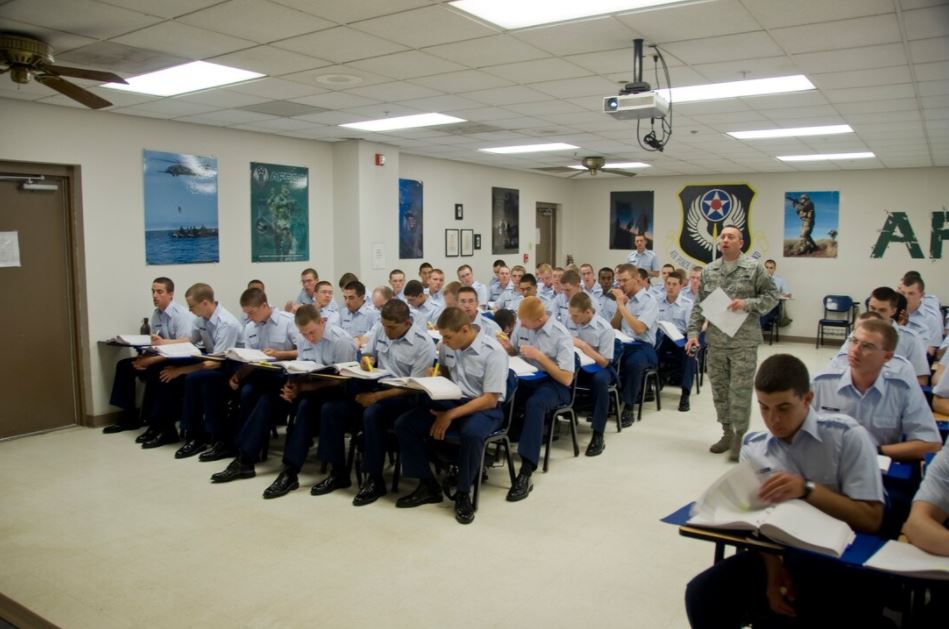
Reading
Reading forms the basis of your study skills so improving your reading skills can be very beneficial.
Reading Skills:
- Adjust your reading speed to the difficulty level: speed up on the easy parts and slow down on the more difficult areas. If something is familiar to you, read faster; if it is unfamiliar, read slower
- Minimize the need to vocalize (read aloud) while reading: stop vocalizing by looking for key words, main ideas or images. One technique is to shift your focus from a small area of print to a larger area
- Do not read individual words one at a time: doing this is very ineffective. Let your eyes follow your hand or another object quickly. Concentrate on reading groups of words or every second or third word
- Avoid re-reading passages: to prevent constantly re-reading, avoid distractions, concentrate and find the best study area you can. It may help to cover up what you just read so you will not get distracted by it
- Do not let unknown words slow you down: figure out the meaning of words by seeing how they are used in a sentence. To improve your vocabulary and comprehension, read more and study the meaning of words
- Practice reading to improve your skills: most of us depend on habits we formed when we learned to read and never put much effort into improving these skills. If you have not taken steps to improve, start now
Reading for Study
A tried and true method is to use the survey, question, read, recall and review method:
- Survey: preview the material to gain an idea of the main ideas (e.g., headings or bold print)
- Question: after surveying, write questions about the subject you want answered
- Read: read carefully to find out more detailed information and to search for answers to your questions
- Recall: to help you retain the information, try to summarize each section. Your goal is not to remember everything you read, but to rephrase or summarize main ideas or important points
- Review: now review what you just read. Skim a section or chapter immediately after reading it, and then review any notes or questions you wrote
Reading to Remember
- Organize the information: arrange ideas into small groups to help you remember
- Make the information relevant: connect the new information to things you already know
- Learn actively: try to use all of your senses. Get up and move around as if you are practicing for a speech
- Use your long-term memory: do this by reviewing the information several times. It often helps to change the order of information you recite during this review

Effective Listening
You will spend a lot of time in your life listening. You may as well make the most of it by using it to enhance your learning experience. In BMT, it can help you become a better trainee and wingman, but it does require effort and practice.
Listening skills:
- Prepare: the night before class, review the next day’s chapters (ask your flight’s Academic Monitor, if needed)
- Concentrate: during class, focus on the message (what is being said) instead of judging the delivery and mannerisms (the way something is said) of the WSMS Instructor
- Take notes: stay focused on the material by taking notes
- Stay physically alert: maintain a comfortable position and try not to slouch. If you feel sleepy, hydrate; if this does not help, take your gear, move to the back of the class and stand up
- Stay mentally alert: keep your mind engaged by asking questions or comparing the lecture to the chapter
- Use the time gap to your advantage: the average speaking rate is 120 words per minute and the average processing rate is 500 words per minute. Use the extra time to recall, rephrase and summarize the material
Note Taking
Learning to take better notes can help your overall study habits. You may find the following techniques helpful:
- Write short notes or highlight areas in the BMTSG that the WSMS Instructor emphasizes or repeats (do not write everything down as it may overwhelm you and cause you to miss key points)
- Concentrate on finding, summarizing and understanding main points
- Define key words
- Paraphrase key items by writing them in your own words
- Pay attention to the entire class; it is easy to lose focus towards the middle and end parts of a class
- Organize your notes and rewrite them if necessary
- Pay attention to the visual aids
Make it a habit to review your notes and your BMTSG at the end of each day as repetition aids the learning process.
On average, you can usually only recall about 50% of material after 48 hours. To counteract this, use your long-term memory by reviewing the information several times. You can also participate in study groups if you find this method helpful.