

Summary
The Chaplain Corps capabilities are Religious Accommodation, Spiritual Fitness and Advising Leaders. The Religious Affairs Career Field builds a culture of spiritual fitness and facilitates the free exercise of religion for assigned service members, their families, and other authorized personnel.
As experts in principles of religious diversity, religious accommodation, major faith group requisites, privileged communication and religious program management, Religious Affairs advise leaders at all levels on religious accommodation, ethical, moral and morale issues, especially for the enlisted force.
Religious Affairs meet the diverse needs of military communities through religious program management, administrative, financial, and facility support. They recruit, train, and organize volunteers for Chaplain Corps programs and events.
As the enlisted component of Religious Support Teams (RST), Religious Affairs are uniquely trained in crisis intervention to include intervention counseling in moments of crisis, response to crises and suicide prevention and intervention.
In addition, Religious Affairs are actively engaged and intentionally integrated into unit engagement plans to include unit meetings, commander calls, training with the unit and other unit activities. They also are trained to equip one’s self and teammates to perform religious support and force protection functions to successfully operate in any give environment or Area of Responsibility (AOR).
Religious Affairs conduct themselves in a manner that brings credit, pride and honorable distinction to the United States Air Force and its Chaplain Corps.
Technical School
Unknown
Other Names
Chaplain Assistant
Bonus
4-Year Bonus: None
6-Year Bonus: $5,000
Badge

Chaplain's Assistant Badge
Duty Identifier

HC Duty Identifier
Clearance
None
Open Aptitude Category
Administrative and General
AFSC Entry Requirements
Demographics
Males: 196
Females: 95
Total: 291
Community College of the Air Force Degree
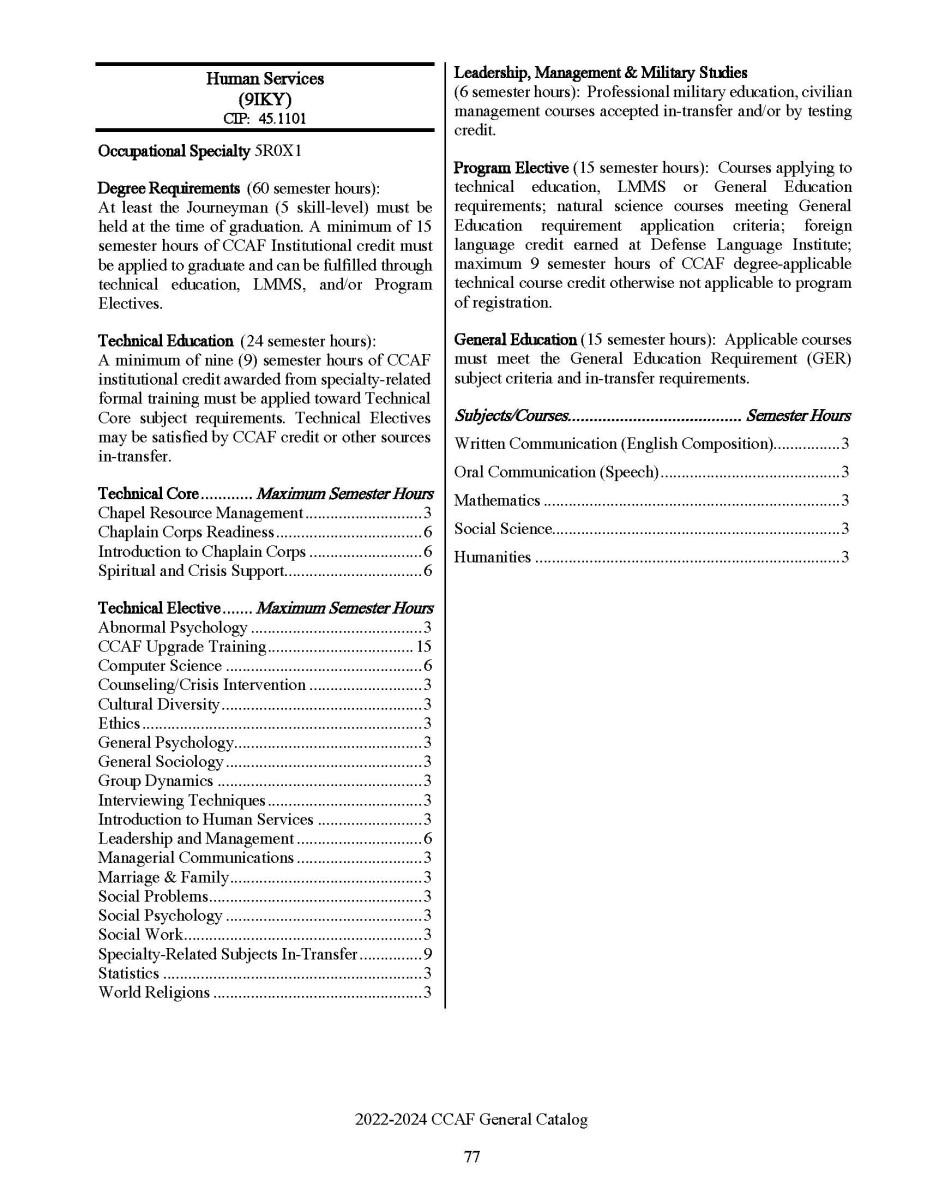
Human Services
CCAF Degree Plan
AFSC YouTube Videos
AFSC Reddit Posts
Duties and Responsibilities
Religious Accommodation: Manage religious programs. Religious Affairs partner with chaplains to develop, manage, control, and evaluate religious programs to ensure effectiveness. This capability is critical to Airmen, Guardians, and their dependents in contingency and steady state environments.
Resource and manage support of religious observances to include worship, liturgies, rites, and other religious requirements for all faith groups.
Manage, in conjunction with Chaplain Corps personnel (e.g., Chaplains, GS [General Service] employees) manage manpower positions, personnel, volunteers, appropriated funds, Chapel Tithes and Offerings Funds (CTOF), non-appropriated and MWR funds, religious facilities, supplies and equipment.
Manage chapel administration to include records management, forms, publications, publicity, professional correspondence, background checks, operating instructions, suspense actions and other administrative needs of the Chaplain Corps mission.
Spiritual Fitness:
Conduct crisis intervention counseling. The Chaplain Corps is the only function with 100% privileged communication (see 10 U.S.C. Chapter 47A, Military Rules of Evidence, Rule 503) and Religious Affairs are commonly the first line of care for Airmen in need. Facilitating care for Airmen early in a crisis enhances resiliency, mission readiness and capability.
Crisis intervention counseling is an immediate, interventional approach to providing mental and moral support with the aim of restoring the person to the level of functioning prior to the crisis. This capability includes counseling in moments of crisis, response to crises and suicide prevention and intervention.
While every NCO performs counseling (see AFPAM 36-2241, Professional Development Guide, and Section 10E), Religious Affairs possess the core capability to care for Airmen and Guardians at the point of crisis. They are specially trained to identify potential problems and assist individuals get the professional help they need. Through crisis intervention counseling, Religious Affairs mitigate crises such as suicide, grief, traumatic stress, or other forms of crisis.
Religious Affairs will not, at any time, conduct spiritual counseling and will immediately refer people in need of spiritual counseling to a Chaplain. Religious Affairs may make referrals to other agencies for issues not of a spiritual nature as appropriate.
Conducts Unit Engagement. Intentionally integrate, as part of the RST, into unit ministry and engagement plans as a resource for meeting the spiritual needs of Airmen, Guardians, and their families.
Unit Engagement is best defined when unit members embrace Religious Affairs Airmen as “one of them” through participation in unit meetings, commander calls and other unit activities. Religious Affairs conduct unit engagement jointly with their RST partner(s) or independently.
Manage RST functions, personnel readiness, and deployment taskings. Develops, coordinates and reviews operation plans and annexes. Coordinates religious and pastoral support requirements with base supporting agencies.
Manages religious support during contingencies for combat or humanitarian relief operations. Coordinates religious and pastoral support requirements with base agencies.
Prepares and presents religious customs and culture briefings. Responds to aircraft crash and mass casualty sites, hostage situations, casualty collection points, evacuation and deployment processing points and work centers. Conducts spiritual triage by applying listening, observation, and interviewing skills.
Protects privileged communication obtained through chaplain pastoral counseling and intervention counseling. Coordinates and facilitates force protection and security measures for the RST.
Advising Leaders:
Advise leadership at all levels on religious accommodation, ethical, moral, morale issues and needs, primarily for, and regarding, the enlisted force. Commanders, Command Chiefs, group superintendents, first sergeants and supervisors at all levels, should know the issues affecting their Airmen and Guardians and how to best address them. Religious Affairs are a trusted source for valid, real-time information.
As the faces and voices of our enlisted Airmen and Guardians, Religious Affairs Airmen integrate into units and appropriately advise leaders on the issues and challenges Airmen and Guardians face.
Specialty Qualifications
Knowledge is mandatory of the concepts and principles of:
- Religious diversity.
- Religious accommodation.
- Major faith group requirements.
- Privileged communications.
- Conflict management.
- Screening and interviewing techniques.
- Crisis intervention counseling.
- Trauma response.
- Suicide intervention and prevention.
- Volunteer management.
- Chaplain Corps.
- Programs management.
- Resource administration and internal controls.
- Contingency planning.
- Deployment and mobilization procedures.
- Personnel readiness.
- Force protection.
- Physical security of resources.
For entry into this specialty, completion of courses in English composition, accounting, computer operations, world religions and human behavior is desirable.
Training-
For award of AFSC 5R031, completion of the Air Force Religious Affairs Apprentice Course is mandatory.
Experience-
The following experience is mandatory for award of the AFSC indicated:
- 5R051. Qualification in and possession of AFSC 5R031. Also, experience in religious program management, advising leadership, crisis intervention counseling and unit engagement. Observable behavior should align with intermediate occupational competency level.
- 5R071. Qualification in and possession of AFSC 5R051. Also, experience in managing personnel and resources to advise leadership, conducting crisis intervention counseling, engaging in units, and managing religious programs, which align with the advanced occupational competency levels.
- 5R091. Qualification in and possession of AFSC 5R071. Also, experience in leading and managing Chaplain Corps activities, with observable competency levels.
Ability to speak English clearly and distinctly.
Reg AF Only Entry Requirements:
Non-Prior Service students must undergo a standardized entry interview process; the CFM is the POC for current process. CFM coordinates with the Air Force Recruiting Service (AFRS) to identify eligible applicants and Religious Affairs interview panels are leveraged to identify AFSC prior to Basic Military Training shipment. (AFRC and ANG access Non-Prior Service students into 5R0 career field).
Non-Prior Service students in a reclassification status must undergo a standardized entry interview process; the AETC MFM is the POC. AETC MFM coordinates with 2 AF/Det 1 to identify eligible applicants and process administrative requirements for new AFSC assignment is leveraged alongside Religious Affairs interview panels at technical training locations. (AFRC and ANG access Non-Prior Service students into 5R0 career field on a limited basis, see para 3.5.4. and 3.5.5. for more information).
Air Force Reserve Entry Requirements:
Applications are accepted for SrA (E-4) – TSgt (E-6). MSgt (E-7) will be considered with the understanding and prior agreement to begin at the TSgt (E-6) grade.
Non-prior Service members going into a TR Unit will be considered. Non-prior Service members desiring an IMA position, along with SMSgt (E-8) – CMSgt (E-9) IMA or TR will not be considered.
Current qualification in any AFSC at the 5-skill level or higher (or 3-skill level if no 5-skill level exists). (Retraining Only)
Recommendation by the Wing Chaplain and Superintendent/NCOIC, Chapel Operations, that the individual is acceptable for entry into the career field and recommended approval by the MAJCOM Religious Affairs Functional Manager. (Retraining only)
Non-Prior Service students must undergo a standardized entry interview with a chaplain and Superintendent/NCOIC, Chapel Operations or delegated substitutes at Joint Base San Antonio and be recommended for entry.
Air National Guard Entry Requirements:
ANG/HC CFM must approve all ANG Accessions. With exception to policy, ANG/HC CFM must access all Non-prior Service before shipping to Basic Military Training and entering the Religious Affairs Career Field.
All components (Reg AF, Reserve & Guard) Entry Requirements:
Current qualification in any AFSC at the 5-skill level or higher (or 3-skill level if no 5-skill level exists). (Retraining Only)
A memorandum of record from the applicant’s commander, superintendent/SEL, and/or first sergeant stating that the Automated Military Justice Analysis and Management System (AMJAMS) and PIF have been reviewed and there is no record of disciplinary action (LOR or Article 15) within the last 3 years. Memo also confirms that applicant has no unresolved mental health problems, maintains local network access, and conducts themselves in a manner that brings credit, pride and honorable distinction to the United States Air Force and the United States Space Force. (Retraining & Reclassification Applicants)
Retraining applicants must shadow a Religious Affairs Airman for a minimum of eight hours, interview and provide a letter of recommendation by the Wing Chaplain and Senior Enlisted Leader /NCOIC, Chapel Operations, that the individual is acceptable for entry into the career field and receive a recommended approval by the MAJCOM Religious Affairs Functional Manager.
Retraining recommendation letters are valid for the current fiscal year (FY). If the retraining window overlaps a FY and/or applicant wants to re-apply for 5R0X1 retraining at a later date, an updated recommendation letter is required that confirms that the applicant is still qualified for retraining into the 5R0X1 career field.
The following are mandatory for entry, award, and retention of 5R0X1 AFSCs:
- No unresolved mental health problems (e.g., failure to engage in help-seeking behaviors, chronic mental health disorders, a pattern of relapse in symptoms/illness, unwillingness, or inability to overcome mental health disorder)
- No convictions by courts-martial or convictions by a civilian court except for minor traffic violations and similar infractions listed in AFI 36-2002, Regular Air Force and Special Category Accessions.
- No record of disciplinary action for financial irresponsibility, sexual assault, sexual harassment, discrimination, domestic violence, or child abuse.
- Never convicted in civil or UCMJ proceedings (to include judicial and nonjudicial punishment) for any type of drug abuse or drug-related offense.
- No history of disciplinary action (Letter of Reprimand (LOR), Article 15) in the Personnel Information File (PIF) for displaying religious bias or unauthorized disclosure of privileged/confidential communication.
- No history of disciplinary action (Article 15 or court-martial) for engaging in an unprofessional or inappropriate relationship as defined in AFI 36-2909, Professional and Unprofessional Relationships.
- No record of disciplinary action (Letter of Reprimand [LOR] or Article 15) for lack of integrity, for violating ethical standards, or failure to exercise sound leadership with respect to morale or welfare of subordinates.
- If member is under investigation for above mentioned offenses, coordination with Commander (with G-Series Orders) and First Sergeant for suitability, award, and retention of AFSC and/or recommendation to remain in previously held AFSC is required.
- 5R031 Religious Affairs Apprentice Course class dates/training seat will be removed from retraining applicant if disqualifying offenses occur between selection for retraining and class start date.
- Must maintain local network access IAW AFI 17-130, Cybersecurity Program Management and AFMAN 17-1301, Computer Security.
Civilian Career Options
High Salary: $79,820
Low Salary: $45,110
- Clergy: $51,940
- Clinical and Counseling Psychologists: $79,820
- Directors, Religious Activities and Education: $45,110
- Marriage and Family Therapists: $51,340
- Mental Health and Substance Abuse Social Workers: $48,720
- Mental Health Counselors: $47,660
- Philosophy and Religion Teachers, Postsecondary: $76,160
***This information was retrieved from Veterans Job Matcher at CareerOneStop (www.careeronestop.org), sponsored by the U.S. Department of Labor, Employment and Training Administration.
Shreadouts
None