AF099 · Lesson 52 of 71
Military Entitlements and Educational Opportunities
Table of ContentsShow
- Overview
- Air Force Pay and Allowance System
- Basic Pay (taxable)
- Special and Incentive Pay (taxable)
- Allowances (non-taxable)
- Clothing Replacement Allowance (CRA)
- Involuntary deductions
- Allotments and voluntary deductions
- Family Servicemember's Group Life Insurance (FSGLI)
- Leave and Passes
- Leave
- Passes
- Other Entitlements
- Servicemembers' Civil Relief Act (SCRA)
- Air Force Wounded Warrior Program (AFW2)
- Medical & Dental
- TRICARE
- Mental Health Services
- Military OneSource
- Commissary
- Exchange
- Base Services
- Legal Services
- Educational Opportunities
- Community College of the Air Force (CCAF)
- College credits by attending classes off-duty
- College credit by examination
- Commissioning Programs
- ANG and AFRC Entitlements and Educational Opportunities
- New Allowance - Basic Needs Allowance (BNA)
- General
- Eligible service members
- Special BNA eligibility considerations
- Ineligible service members
- Pay effects
- Standard amount of the allowance
- Screening requirements
- Informing requirements
- Counseling requirements
- Recertification requirements
- Service POC for Additional Information
- Total Force Service Center
- Summary
The Air Force provides a lot of benefits and entitlements to people who serve. Pay, housing, food, leave, and education were probably part of why you joined. Now that you're in BMT, it's worth knowing how these things actually work and how they can help you down the road.
This section covers the Air Force Pay and Allowance System, leave and passes, other entitlements (medical, dental, legal, base services), educational opportunities including the Community College of the Air Force (CCAF) and Military Tuition Assistance, commissioning programs, Air National Guard / AF Reserve entitlements, and the Basic Needs Allowance (BNA).
Overview
Objective: Identify basic facts and general principles about resilience in the Air Force.
Learning Outcomes
- Describe the Air Force Pay and Allowance System.
- Identify basic facts regarding leave and passes.
- Recognize the other entitlements the Air Force has to offer.
- Discuss educational opportunities for Active Duty, including the Air Force Virtual Education Center (AFVEC).
- Recognize the various Air Force commissioning programs.
- Discuss entitlements and education for Air National Guard (ANG) and Air Force Reserve personnel.
Foundational Competencies
- Decision Making - Makes well-informed, effective, and timely decisions; uses sound judgment to integrate and weigh situational constraints, risks, and rewards.
- Information Seeking - An underlying curiosity; a desire to know more about things, people, oneself, the mission, or issues; an eager, aggressive learner.
- Digital Literacy - Using technology to identify, evaluate, and synthesize data and information; explore, create, and manage digital content; and appropriately interact in a virtual environment.
Summary
- AF Pay and Allowance System
- Leave and Passes
- Other Entitlements
- Educational Opportunities
- Commissioning Programs
- ANG and AF Reserves Entitlements and Educational Opportunities
Air Force Pay and Allowance System
Defense Finance and Accounting Service (DFAS) pays you on the 1st and 15th of each month. If a payday falls on a weekend or holiday, you'll be paid on the last duty day before that weekend or holiday.
You may also request one monthly paycheck distributed on the 1st of the month.
A few days before your pay date, you can access your Leave and Earnings Statement (LES) electronically through the myPay website. The LES is a comprehensive statement of your entitlements, deductions, allotments, leave, tax withholding, and Thrift Savings Plan (TSP) information.
In BMT you won't receive an LES - your MTI will provide pay information.
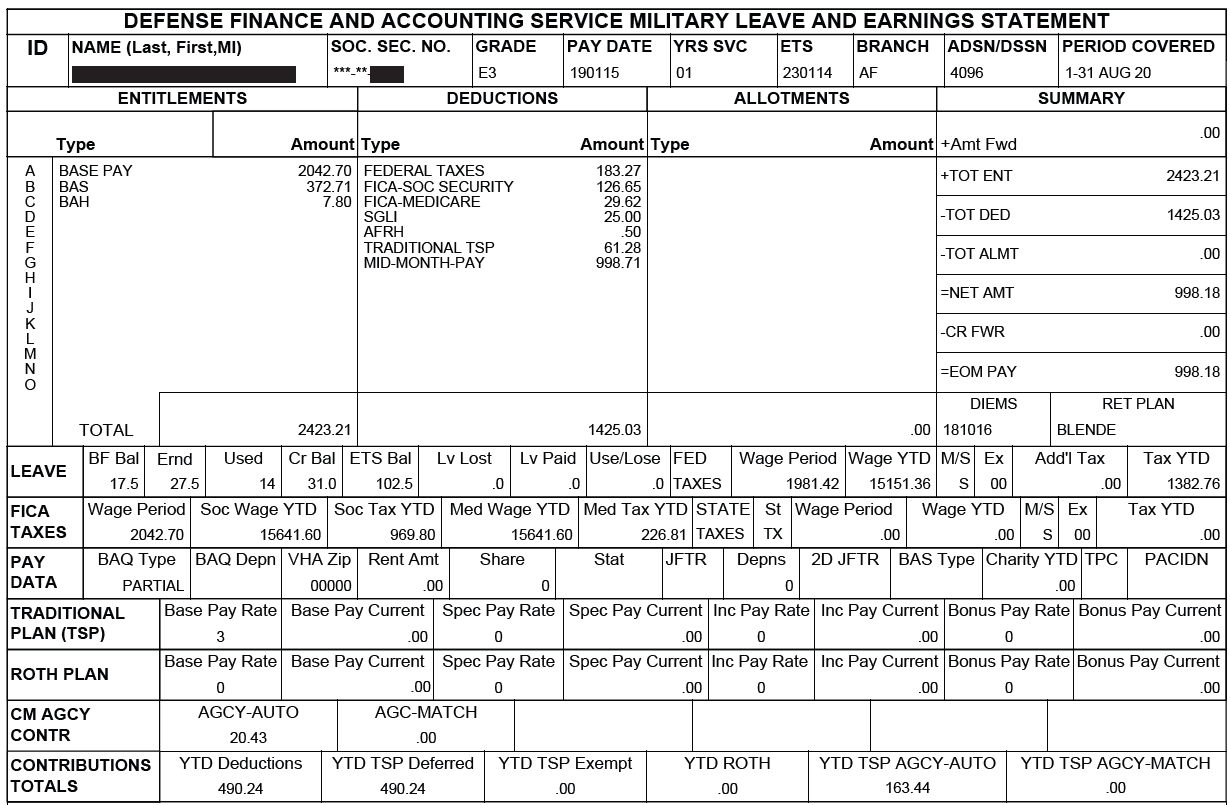
Fig 26-1: Example LES from myPay.
On your pay date, DFAS automatically deposits your pay into your bank account. Direct deposit is mandatory for all Air Force members. DFAS will also credit your account if you're on leave, TDY, or during a PCS.
Basic Pay (taxable)
The largest part of your military pay. Based on your grade and length of military service.
Special and Incentive Pay (taxable)
Recognizes certain aspects of duty. Examples:
- Hazardous duty incentive pay
- Imminent danger pay
- Special duty assignment pay
- Enlistment, reenlistment, and retention bonus pay
- Foreign language proficiency pay
- Combat-related injury rehabilitation pay
- Extending duty at designated locations overseas pay
Allowances (non-taxable)
Money provided for specific needs like food or housing - and non-taxable. The two most common:
BAS - Basic Allowance for Subsistence
A non-taxable allowance to offset the cost of meals. Members assigned to single-type government quarters at their permanent duty station are required to eat in government dining facilities, receive BAS, and are charged the discounted meal rate (deducted from their pay). When certified by the commanding officer or designee, you can claim reimbursement for missed meals.
BAH - Basic Allowance for Housing
Provides accurate and equitable housing compensation based on local civilian housing markets - payable when government quarters are not provided. Specific rates are on the Finance & Travel section of the AF Portal.
Clothing Replacement Allowance (CRA)
Enlisted members receive an annual allowance to maintain, repair, and replace initial-issue uniform items. Two types:
- CRA Basic - preliminary replacement allowance, paid annually between the 6th and 36th month of active duty.
- CRA Standard - automatically replaces CRA Basic after 36 months of active duty.
CRA is paid on or near the anniversary of active duty and appears on the LES opposite CLOTHING under the ENTITLEMENTS heading.
Involuntary deductions
Base, special, and incentive pay are subject to involuntary deductions in the form of taxes or special programs.
Withholding income tax
Includes FICA, Federal Income Tax Withholding (FITW), and State Income Tax Withholding (SITW). FICA and FITW are mandatory federal deductions. The tax laws of the state of your legal residence determine SITW.
Armed Forces Retirement Home (AFRH)
A small amount (usually about $1) is deducted from all enlisted pay to support the United States Soldiers' and Airmen's Home and Naval Home (Washington, DC and Gulfport, MS).
Allotments and voluntary deductions
You can establish voluntary deductions to manage personal finances. Two types:
- Nondiscretionary - limited uses: bonds, charitable contributions, child or spousal support, commercial debts, delinquent travel charge card debt.
- Discretionary - financial obligations like mortgage or rent, personal savings, supporting family.
Family Servicemember's Group Life Insurance (FSGLI)
Provides group term life insurance to spouses and dependent children of servicemembers insured full-time under SGLI. Non-military spouses are automatically covered (coverage may be reduced, declined, or canceled). Maximum $100,000 for spouses (not exceeding the servicemember's SGLI amount), $10,000 for dependent children. The servicemember pays the premium for spousal coverage. Dependent children are insured at no cost and cannot be reduced, declined, or canceled.
Leave and Passes
Leave
Leave is paid vacation away from duty for recreation, relief from job-related duties, personal reasons, and emergencies. Air Force officials encourage you to use leave as it accrues to avoid losing it at the end of the fiscal year (FY) or upon separation/retirement.
Accrual
You earn 30 days of leave each fiscal year (1 Oct - 30 Sep) at 2½ calendar days per month. Use it as you earn it (with supervisor approval) or save it. Any leave over 60 days drops on 1 October - known as "use or lose."
Taking leave
Before taking leave, complete AF IMT 988, Leave Request/Authorization - accessed electronically through Leave Web. Print part II to take with you. If Leave Web is unavailable, complete AF IMT 988 manually and take it to your supervisor for approval.
It's your responsibility - Service Before Self - to forecast leave as far in advance as possible. The form provides specific guidelines about which days will and won't be charged. Call your supervisor if you have questions.
Leave must begin and end in the local area. The DAF defines "local area" as the place from which you commute to and from your duty station daily. You must be back in the local area available for duty by 2400 hours on the last day of leave. Leave is calculated based on actual departure and return dates.
Common misconception: trainees think they're only charged leave for actual workdays. That's not how it works. Normal off-duty days and holidays during your leave period are chargeable. If your leave includes a weekend, you can't conclude leave on a Friday and resume on Monday - even if you normally don't work weekends, those days are still charged.
You're subject to duty 24 hours a day, 7 days a week, 365 days a year. If you're unable to report due to illness or injury upon expiration of leave, contact your commander with a statement from a military medical officer or civilian physician.
Common types of leave
- Accrued Leave - earned leave you haven't used (2½ days/month). Charged against your leave balance when used.
- Ordinary (Annual) Leave - granted for rest and relaxation; charged to your leave balance.
- Emergency Leave - for urgent or personal situations like verified death or serious illness in your immediate family. The American Red Cross must verify an emergency condition exists.
- Convalescent Leave - must be approved by your commander. Non-chargeable when your absence is part of a treatment prescribed by a physician or dentist for recuperation - including pregnancy.
Passes
A pass is another way to take a break. It's an authorized absence from duty for a short time. Passes can be combined with leave but cannot be taken back-to-back with other passes.
- Regular Pass - begins at the end of normal work hours on a given day and expires with the start of normal working hours on the next duty day. Includes public holidays and weekends; not to exceed 72 hours. You're considered to be in regular pass status after duty hours.
- Special Pass - must include one duty day; usually 72 hours long.
Other Entitlements
Servicemembers' Civil Relief Act (SCRA)
The SCRA protects active-duty members from adverse legal consequences that may result from service. Some protections also apply to reservists and guardsmen called to active duty. Other protections apply to members just entering active duty, members who have always been on active duty, and military dependents (spouse, children, and anyone you provide with more than one-half of their support).
You must take action before or during activation for some protections. Other protections allow action 30-180 days after completing an active-duty assignment. Contact any military legal office with questions.
Common SCRA protections:
- Rental Lease - terminate a rental lease that was entered into before being called to active duty, receiving PCS orders, deploying for 90+ days, or separating/retiring.
- Interest Rates - on purchases made before serving on active duty, interest rates cannot exceed 6% - including credit cards and mortgages, but not student loans.
- State & Federal Income Taxes - if active-duty service materially affects your ability to pay, taxes may be deferred. You're subject to state taxes based on military income or other property only to your state of legal residency.
Air Force Wounded Warrior Program (AFW2)
A Congressionally-mandated, federally-funded program providing personalized care, services, and advocacy to total-force seriously injured (SI) or very seriously injured (VSI), ill or injured Airmen.
The program covers Recovery Coordination and Resiliency, Family Liaison Officer (FLO), Caregiver Support, Special Compensation for Assistance with Activities of Daily Living (SCAADL), Emergency Family Member Travel (EFMT), Adaptive Sports & Ambassador, Recovering Airman Mentorship (RAMP), and Empowerment in Transition.
Eligibility and enrollment
Total-force Active, Guard/Reserve members identified with highly complex medical conditions by a medical authority - including PTSD diagnosis and being under consideration for Medical Evaluation Board (MEB).
Medical & Dental
You're entitled to complete medical and dental care while on active duty, and in most cases so are your dependents.
TRICARE is the DoD healthcare program designed to improve beneficiary access to care, ensure affordable high-quality care, provide choice, and control costs.
TRICARE
Uniformed servicemembers and their families are eligible - including National Guard / Reserve members and their families. The two most common plans:
- TRICARE Prime - no annual deductible, unless dependents use the point-of-service option. POS deductibles: $300/individual or $600/family.
- TRICARE Select - annual deductible varies based on sponsor's status and rank. E-4 or below: $52/individual or $104/family. E-5 or above: $156/individual or $313/family.
- TRICARE Dental Program - coverage for a wide range of dental services for enrolled families of active-duty sponsors.
More info at the local TRICARE office after basic.
Mental Health Services
Available at every base and every deployed location. Two paths to access:
- Self-referral - voluntarily make an appointment (even if referred by your PCM). It's not mandatory to follow through if you decide not to be seen.
- Commander Directed Evaluation (CDE) - involuntarily sent. The commander gets feedback after someone observes duty impairment that may relate to mental health issues. Used to determine future course of action.
The Family Advocacy Program (FAP) is similar to Child Protective Services in the civilian sector. FAP investigates abuse (victim or perpetrator), reports findings to the member's command, and provides educational classes and supportive programs like the New Parent Support Program.
Military OneSource
A DoD-sponsored program that provides information and resources to service members and families. Offers face-to-face counseling, online counseling, and telephonic counseling, plus consultations on adoptions, adult disability care, education, special needs, health and wellness coaching, elder care, and more.
Commissary
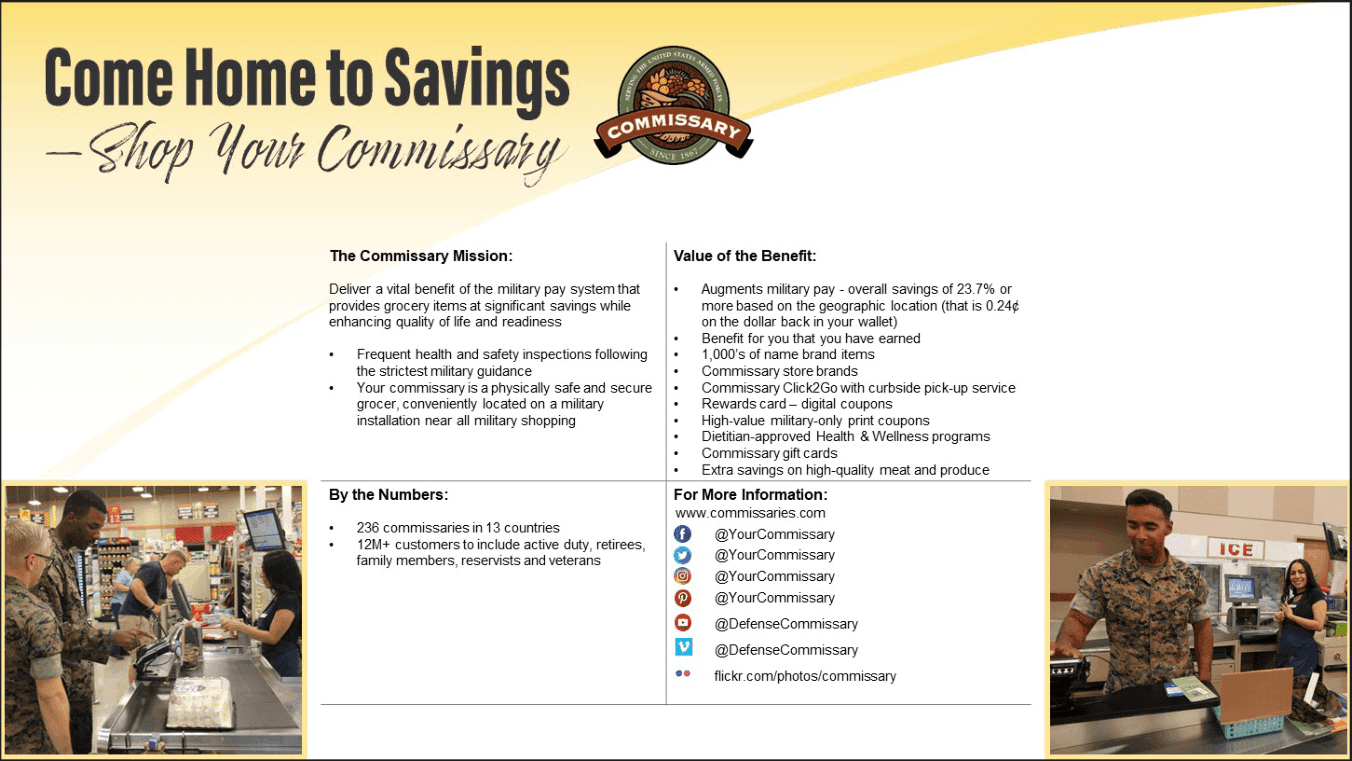
Commissaries augment military pay. Located on military bases worldwide; provide groceries to military personnel, retirees, disabled veterans, Purple Heart recipients, former POWs, and their families. Patrons purchase items at cost plus a 5% surcharge (covers building/renovating commissaries).
Consistent commissary shopping saves an average of 24% or more compared to commercial prices - savings amounting to thousands of dollars annually.
Exchange
You've already benefited from your Exchange privileges during BMT. Prices are cheaper than off-base and the Exchange offers a "Best Price Program" - shows match a lower price offered by an off-base store (with proof, like a newspaper ad). The biggest advantage: no sales tax on any items purchased.
Base Services
The Force Support Squadron improves productivity through fitness, esprit de corps, and quality-of-life programs. Various clubs offer dining and entertainment for military, retired civilians, and families. The base fitness center offers weight training, running, intramural sports. Discount tickets to theme parks, cruises, and local attractions are available. Reasonably priced activities for everyone.
Legal Services
Free professional legal advice and consultation - power of attorney, wills, notary public, adoptions, divorce, general advice. Staff Judge Advocate (SJA) acts on behalf of the government to prosecute UCMJ offenses.
Area Defense Counsel (ADC) represents military members free of charge as defense attorney. ADC cannot represent you in civilian court, but can provide legal advice.
Educational Opportunities
Education is vital. Whether directly tied to your career field or for personal use, take advantage. Each base has an education office with counselors who help service members from the time they enter service until separation/retirement.
Military Tuition Assistance is available for courses applicable to Associate, Bachelor's, and Master's degrees. You must provide transcripts of previous college credits and work toward the next higher degree.
Other resources:
- AF COOL - Air Force Credentialing Opportunities On-Line - employment training and professional credentials for your future civilian career.
- Skillbridge - same purpose as AF COOL.
- More than 2,400 American colleges/universities offer degree programs for enlisted personnel on or near AF installations (stateside and overseas), including online courses.
- Air Force Virtual Education Center (AFVEC) - your one-stop shop for education needs. New users register with CAC at https://afvec.us.af.mil/afvec/account/register.
Community College of the Air Force (CCAF)
Established 1972 - a multi-campus, federally chartered institution. CCAF awards the Associate of Applied Science (AAS) degree as part of Air University (accredited) for enlisted members of Regular AF (Active Duty), ANG, and AFRC.
The AAS is awarded for completion of a degree program specifically designed for an Air Force Specialty. Many AF courses are accredited college courses that combine with college credits and military training.
Air University requires at least 25% of credit hours be earned through CCAF. CCAF degree requires 64 or 60 semester hours, of which 16 or 15 (respectively) must relate to your AFS. The rest must be in courses satisfying the educational requirements for your degree at your school of choice.
College credits by attending classes off-duty
The local education office helps select a college/university and program. Coordinate off-duty voluntary education with your immediate supervisor, who must approve or disapprove MilTA funding requests.
Military Tuition Assistance (MilTA)
- Up to $250.00 per semester hour (SH) credit
- Up to $166.66 per quarter hour (QH) credit
- Fiscal year annual cap of $4,500.00 - applicable to all eligible Airmen
- Courses taken for CCAF don't count toward this total
- Total Lifetime Cap: Undergraduate 124 credit hours / Graduate 42 credit hours
- Lower or lateral degrees are not allowed (except for CCAF degrees)
- The member pays the remaining fees (ID card, parking, etc.) plus the cost of books and supplies
- GPA requirement: 2.0 for undergraduate, 3.0 for graduate. Reimbursement actions occur for "D" or below (undergrad) and "C" or below (grad). Reimbursement also for missing, incomplete, or withdrawn grades.
- Grades must be updated within 60 days of term end or money is owed back.
- A course load exceeding part-time study increases risk of failing or grade slippage - which means repaying tuition.
College credit by examination
A great way to advance your education. Earn up to 60 semester hours through:
- DSST (DANTES Subject Standardized Tests) - college subject tests for knowledge you already learned outside a traditional classroom. More than 30 subject exams in Business, Math, Physical Science, Social Sciences, and Technology.
- CLEP (College Level Examination Program) - 34 exams covering introductory-level material. Topics include History and Social Sciences, Composition and Literature, Science and Mathematics, Business, and World Languages.
Commissioning Programs
Some of you may have set a goal of becoming a commissioned officer. The USAF has various programs available to Airmen on active duty who meet eligibility requirements. See your local education center for details.
ANG and AFRC Entitlements and Educational Opportunities
Air National Guard and Air Force Reserve members have a variety of unique education benefits that differ from the Regular Air Force. The information in this lesson is geared toward Regular AF benefits, but all AF members must still know this material for the end-of-course written test.
It's virtually impossible to describe how Guard/Reserve benefits differ since they vary state-to-state and unit-to-unit. Address questions when you return to your home unit, or contact the ANG or AFRC Training Liaison at Lackland, Sheppard, or Keesler AFB.
New Allowance - Basic Needs Allowance (BNA)
General
Per Section 402b of Title 37, U.S.C., the BNA Program provides a monthly allowance for service members who voluntarily apply and whose Gross Household Income (GHI) and household size place them below 150% of Federal Poverty Guidelines (FPG) for their geographical location.
Eligible service members
Service members with dependents (CONUS or OCONUS) are eligible for BNA and may be certified if:
- They've completed Initial Entry Training (IET).
- GHI during the most recent calendar year (the year preceding the application year) didn't exceed 130% of FPG for their location and household size, per HHS publications.
- They voluntarily applied for BNA and provided required information.
Special BNA eligibility considerations
Households with multiple eligible service members
- Only one allowance may be received per household.
- Service members jointly elect which eligible service member receives the allowance.
Ineligible service members
You are ineligible for BNA if:
- You don't have dependents.
- You haven't completed IET.
- GHI during the most recent calendar year exceeded 150% of FPG.
- You're a cadet at USMA, USAFA, USCGA; a midshipman at USNA; or a cadet/midshipman serving elsewhere in the Military Services.
- After being notified of potential BNA eligibility, you fail to submit a BNA application within 180 calendar days (or the submission deadline established by implementing guidance).
- You elect in writing not to receive the allowance.
- You're in a No Pay Status.
- A change in household size puts GHI above 150% of FPG.
- You don't recertify on the anniversary date.
- You're a Reserve Component (RC) Service Member not receiving Active Pay and Allowances.
Pay effects
Receiving BNA may affect participation in certain federal assistance programs - subsidized school lunch, WIC (Women, Infants, and Children), Family Subsistence Supplemental Allowance, low-income utility assistance, day care, and other income-based programs.
Standard amount of the allowance
- Certified applicants are paid monthly.
- BNA is taxable income per Section 61 of Title 26, U.S.C.
- A service member can voluntarily discontinue BNA at any time.
- For partial-month certification, BNA is paid at 1/30th per day.
- Monthly BNA is payable from the date the application is certified.
Computed as follows
- 1.5 times most recent annual FPG for the calendar year
- Based on Service Member's Permanent Duty Station
- Current dependents reported in DEERS, including the service member
- Minus the service member's GHI during the preceding calendar year, divided by 12
- BNA is rounded to the nearest whole dollar
- The amount of decrease in household income from a fine, forfeiture, or reduction in rank may not be used to increase BNA
- OCONUS computation uses the same FPG table as the 48 contiguous states + DC. Alaska and Hawaii use separate FPG tables.
Federal Poverty Guideline link
https://aspe.hhs.gov/topics/poverty-economic-mobility/poverty-guidelines
For additional details about BNA, see DoDI 1341.15.
Eligibility example
- A1C (E-3) Jackson is stationed at Cannon AFB (CONUS); monthly basic pay $2,259.90, BAS $452.56, BAH $1,101.00; 5 dependents. Spouse doesn't work and didn't work the preceding year.
- Current year (2023) annualized GHI = ($2,259.90 + $452.56 + $1,101) × 12 = $45,761.52.
- Preceding calendar year (2022) GHI = $42,726.96.
- Preceding year FPG (2022) for household of 6 = $37,190 × 1.5 = $55,785.
- Both annualized current and preceding GHI are below 150% of FPG. Member qualifies.
Example BNA computation
Assumptions:
- Household of 6 (member + 5 dependents)
- Cannon AFB, New Mexico
- Preceding calendar year (2022) GHI: $42,726.96
- Applicable (2023) annual FPG: $40,280
Computation:
- $40,280 × 1.5 = $60,420 (current-year FPG for household of 6 at 150%)
- $60,420 − $42,726.96 = $17,693.04
- $17,693.04 / 12 = $1,474.42
- Round to nearest whole dollar = $1,475 per month
Note: Payment could be prorated the first month.
Screening requirements
- Service members will be screened for potential BNA eligibility before completing IET.
- Members will be screened at least annually for BNA eligibility after IET.
Informing requirements
- If eligible, members will be informed in writing - but notification doesn't guarantee certification.
- Eligible members must submit a BNA application with substantiating documentation (tax returns, W-2s, LESs, civilian pay stubs).
- Application instructions and submission deadlines will be provided.
Counseling requirements
Upon certification, applicants will be counseled to report any changes affecting eligibility, such as:
- Increases or decreases in monthly GHI of $150 or more.
- Increases or decreases in household size.
- Changes must be reported within 60 calendar days.
- Failure to report may result in termination of BNA eligibility.
Recertification requirements
- Annually on the anniversary date (or annual recertification date - whichever is most current).
- When monthly GHI increases by $150 or more.
- When household size changes.
- Whenever a service member receiving BNA executes a PCS to another FPG area - recertification occurs upon arrival at the new duty location using the FPG of the new location. PCS to/from the 48 contiguous states + DC and outside the United States does not require recertifying the amount of BNA.
Service POC for Additional Information
Total Force Service Center
- DSN: 665-0102
- Commercial: (210) 565-0102
- Toll-Free: 1-800-525-0102
- Log in to https://mypers.af.mil to chat with an Active Duty myPers Total Force Service Center Agent (Mon - Fri, 0800-1700 CT).
- Log in to https://mypers.af.mil/app/ask to email myPers / TFSC.
Summary
The Air Force provides many entitlements to people who serve. Take advantage of the many benefits available - they'll help you become the best Airman you can be. The decisions you make down the road depend on the information you understand now. Everything is there, just waiting for you to take it.