

Summary
Manages and performs public health activities and programs in support of the Air Force Operational Medicine Programs. There are two major divisions within Public Health: Community Health Management and Force Health Management.
Community Health Management encompasses communicable disease control and prevention, food safety and defense, medical entomology, facility sanitation, and public health contingency response. Force Health Management encompasses medical deployment clearance processing, and administrative oversight of occupational health examinations (including performing audiograms).
Technical School
Days: 47
Locations: Wright Patterson, Ohio
Other Names
None
Bonus
4-Year Bonus: None
6-Year Bonus: $5,000
Badge

Medical Badge
Duty Identifier
None
Clearance
None
Open Aptitude Category
Administrative
AFSC Entry Requirements
Demographics
Males: 533
Females: 605
Total: 1158
Community College of the Air Force Degree
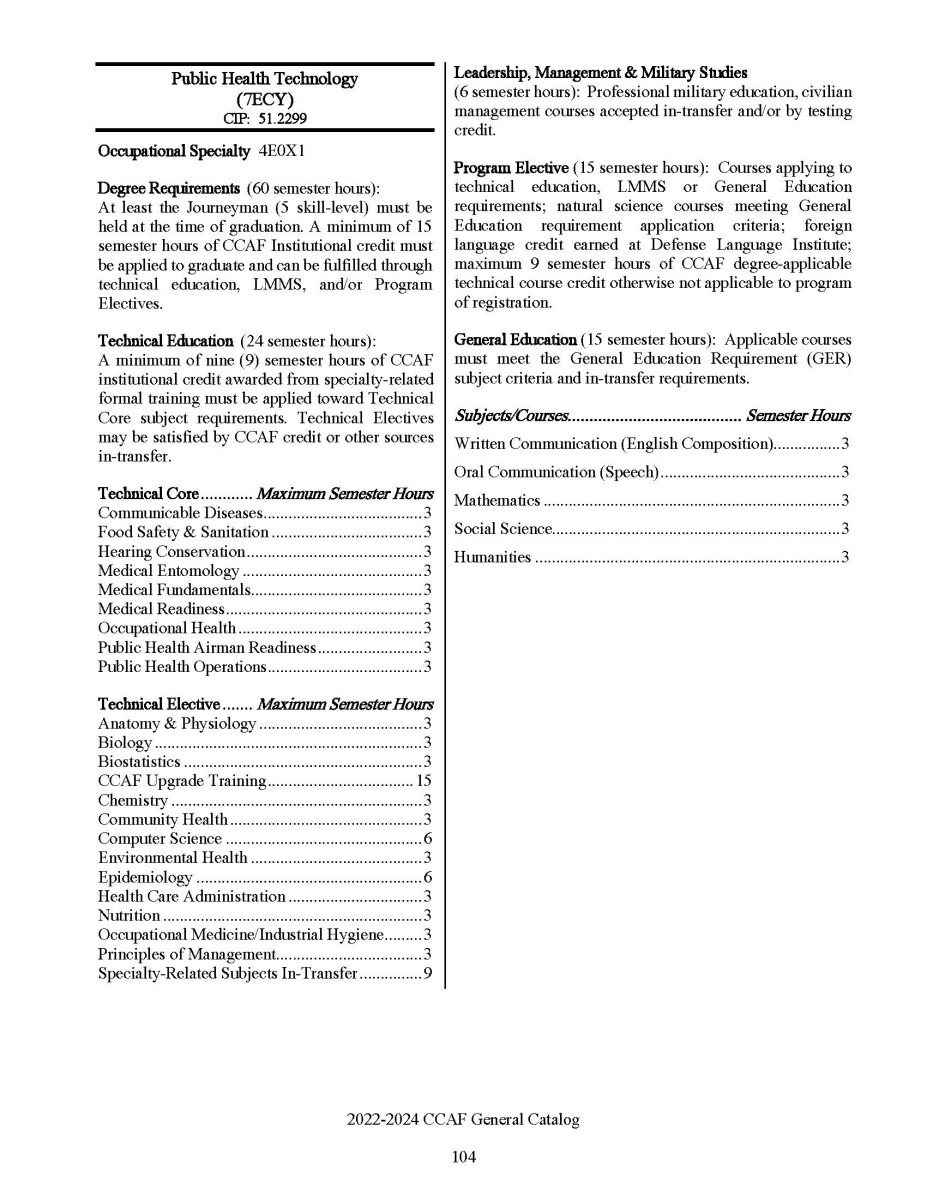
Public Health Technology
CCAF Degree Plan
AFSC YouTube Videos
AFSC Reddit Posts
Duties and Responsibilities
Advises professionals on control measures. Updates and completes associated records and forms. Investigates disease outbreaks. Collects and compiles epidemiological data. Identifies, evaluates, and reports trends.
Conducts food safety and defense programs. Inspects sanitary condition of containers and vehicles. Ensures food origin and distribution are from approved sources. Inspects foods for wholesomeness and contract compliance.
Makes recommendations for disposition of deteriorated or distressed foods. Assesses risks associated with production, transportation, storage, preparation and serving of food.
Recommends measures to prevent contamination (unintentional as well as intentional), deterioration and completes Food Vulnerability Assessments. Inspects operational rations. Collects and ships food for laboratory analysis. Investigates customer complaints and food recalls. Evaluates and completes inspection records.
Plans and conducts medical entomology program. Evaluates vector-borne disease risk. Conducts disease and pest/vector surveillance. Monitors compliance and effectiveness of vector and pest management control measures.
Recommends prevention and control measures. Provides education and training on prevention and control of vector-borne diseases.
Plans and conducts sanitation programs. Conducts sanitary evaluations of food, public facilities, and military and civilian contract aircraft. Determines compliance with sanitary standards and reports discrepancies. Provides food handler, disease outbreak, and community health education and training. Plans, organizes, and conducts public health contingency response programs.
Force Health Management-
Assists in Occupational Health Programs. Ensures personnel receive appropriate pre-employment, periodic and termination occupational examinations. Conducts occupational audiometric evaluations. Provides consultation to supervisors and workers in personal hygiene, occupational hazards, hazard communications and personal protective equipment.
Performs occupational epidemiology and monitors results of occupational health examinations to detect adverse trends. Investigates occupational illnesses and assists with completion of fitness and risk evaluations. Advises healthcare providers on workplace hazards.
Manages and provides quality control of occupational health examinations. Conducts shop visits at the discretion of the Occupational & Environmental Health Working Group.
Grants Aeromedical Services Information Management System (ASIMS) access to authorized medical group personnel. Maintains Commander Designee requests from non-medical users (e.g., Unit Deployment Managers), Unit Health Monitors, Unit Fitness Program Managers, First Sergeants, and Commanders.
Plans and conducts deployment medicine programs. Oversees medical clearances for deploying personnel.
Provides deploying personnel with medical intelligence briefs to include the threat of vector borne disease and prevention, use of personal protective equipment. Also oversees medical reintegration by ensuring all re-deployers complete required post-deployment medical requirements.
Specialty Qualifications
Knowledge is mandatory of:
- Basic biological and physical sciences.
- Preventive medicine.
- Fundamentals of microbiology, chemistry, anatomy, physiology, and pathology of the human body.
- Medical terminology, medical entomology programs.
- Food science and technology.
- Food handler training.
- Food and water safety and defense principles.
- Food inspection.
- Laboratory procedures.
- Sanitary evaluations.
- Public facility sanitation.
- Prevention and control of food borne, water-borne, and vector-borne diseases.
- Communicable disease prevention and control.
- Epidemiology.
- Occupational health (including hearing conservation).
- Medical readiness (including medical intelligence, deployment processing, and deployment surveillance).
- Personnel management and administration.
- Medical service organization and function.
- Basic medical information management (including database management) and written and oral communication.
For entry into this specialty, completion of high school courses in biology, chemistry, and general science is desirable.
Training-
The following training is mandatory as indicated:
For award of AFSC 4E031, completion of public health apprentice course is mandatory.
For award of AFSC 4E071, completion of the Operational Entomology in-residence course and the USAFSAM Epidemiology Distance Learning course are mandatory.
Experience-
The following experience is mandatory for award of the AFSC indicated:
- 4E051. Qualification in and possession of AFSC 4E031.
- Routine food safety and defense inspection.
- Sanitary evaluations.
- Communicable disease control and disease intervention.
- Occupational health.
- Force health management activities, medical entomology programs and deployment health programs.
- 4E071. Qualification in and possession of AFSC 4E051. Also, experience performing public health programs.
- 4E091. Qualification in and possession of AFSC 4E071. Also, experience managing public health activities.
The following are mandatory as indicated:
For entry into this specialty:
- Passing color vision, as defined by getting a 55 or better on the Cone Contrast Test (CCT), or, correctly identifying at least 10 of 14 Ishihara Plates (PIP). (CCT should be primary testing choice, but PIP is acceptable if CCT is not available at testing site.) Normal color vision as defined in AFI 48-123, Medical Examinations and Standards and Medical Standards Directory.
- For award and retention of AFSCs 4E031/4E051/4E071, Hearing Conservation certification is mandatory.
- Passing Read Aloud Test, as defined in the 4N0X1F Career Field Education Training Plan.
- Valid state driver’s license and qualification to operate government motor vehicles according to AFI 24-301, Ground Transportation.
- For award and retention of these AFSCs, must maintain local network access IAW AFI 17-130, Cybersecurity Program Management and AFMAN 17-1301, Computer Security.
Civilian Career Options
High Salary: $208,000
Low Salary: $42,000
- Community Health Workers: $42,000
- Environmental Science and Protection Technicians, Including Health: $46,850
- Environmental Scientists and Specialists, Including Health: $73,230
- Epidemiologists: $74,560
- Health and Safety Engineers: $94,240
- Health Education Specialists: $56,500
- Occupational Health and Safety Specialists: $76,340
- Occupational Health and Safety Technicians: $53,340
- Preventive Medicine Physicians: $208,000
***This information was retrieved from Veterans Job Matcher at CareerOneStop (www.careeronestop.org), sponsored by the U.S. Department of Labor, Employment and Training Administration.
Shreadouts
None