

Summary
Manages and conducts safety programs. Plans, organizes, directs, and controls safety activities. Analyzes mishap causes and trends and assesses risk.
Evaluates, inspects, and surveys areas and activities to eliminate mishap potentials. Conducts mishap investigations. Provides risk management consultation.
Technical School
Days: 35
Locations: JBSA Lackland, Texas
Other Names
None
Bonus
None
Badge

Safety Badge
Duty Identifier

SFTY Duty Identifier
Clearance
Top Secret
Open Aptitude Category
None
AFSC Entry Requirements
Demographics
Males: 261
Females: 76
Total: 337
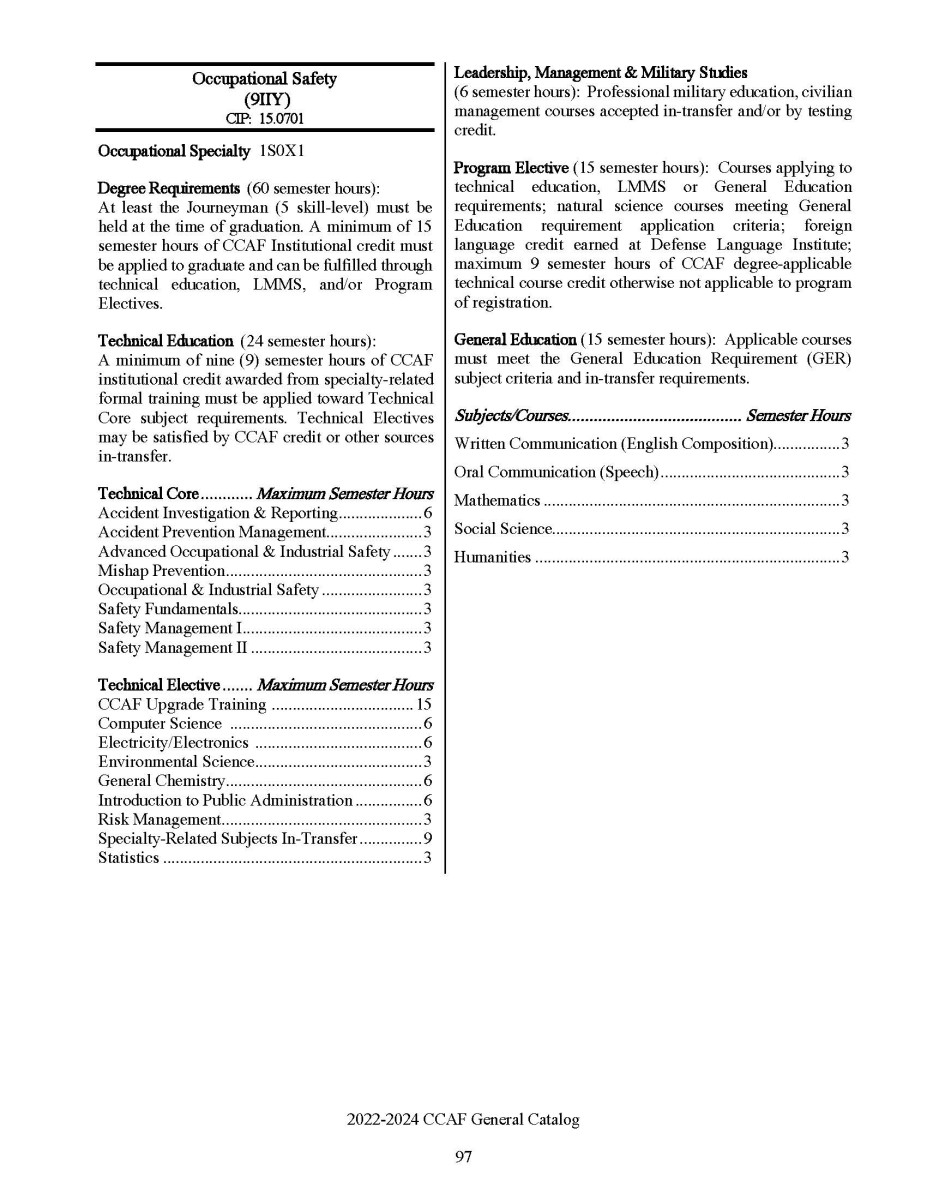
Community College of the Air Force Degree
Occupational Safety
CCAF Degree Plan
AFSC YouTube Videos
AFSC Reddit Posts
Duties and Responsibilities
Plans, organizes, and directs safety activities. Develops policies and procedures for implementing and evaluating safety programs. Coordinates with staff activities and operational sections to ensure safety requirements are integrated into the organization program.
Maintains close liaison with federal, state, municipal, and private agencies sharing common safety concerns. Establishes work priorities and maintains systems to effect accomplishment of program processes. Arranges for group meetings or individual instruction through coordination with commanders and supervisors.
Conducts and assists in managing safety programs. Evaluates safety program effectiveness. Coordinates with agencies and staff activities on safety related matters. Prepares and conducts briefings, meetings, training classes, and associated functions.
Determines safety education requirements for groups or individuals. Develops training plans to ensure worker qualification and training. Prepares and conducts training programs for collateral duty safety personnel. Performs inspections, surveys, and program evaluations of areas and operations to identify mishap potentials and assess integration of risk management approach, safety equipment, and procedures.
Performs periodic and special inspections of facilities, flightlines, maintenance, and industrial areas; missile launch complexes and support functions; munitions facilities and operations; and non- industrial and recreational areas. Operates motor vehicles to perform inspection and surveys.
Reports findings, assigns risk assessment codes, recommends corrective actions, and conducts follow- up inspections.
Participates in Hazardous Communication programs and other environmental programs. Reviews explosives quantity distance waivers and deviations, and processes hazardous air traffic reports.
Reviews purchase, service, and construction contracts. Prepares safety criteria. Reviews contract proposals, statements of work, local purchase orders, and work requests for inclusion of safety criteria.
Participates in workload planning and preconstruction conferences, pre and post award meetings, and pre and final inspections.
Reviews engineering plans and drawings. Reviews base master plans and site plans affecting construction, airfield, and explosive safety criteria. Recommends revision in drawing or rearranging materials.
Performs and assists in mishap investigations, prepares reports, and maintains records. Gathers factual mishap data, identifies causes, and recommends corrective actions to prevent recurrence of a similar mishap. Maintains a follow-up system.
Analyzes mishap data. Performs trend analysis and recommends measures to correct unfavorable conditions or procedures. Provides safety consultation to commanders, supervisors, and functional managers on technical directives, safety criteria, and operational techniques.
Conducts safety education. Performs or assists in planning and scheduling safety education programs. Prepares or assists in preparing and distributing safety promotional and informative materials.
Specialty Qualifications
Knowledge is mandatory of fundamentals of safety education, public speaking, mishap prevention, human factors, industrial hygiene principles, industrial safety criteria, risk management, blueprint interpretation, mishap investigation techniques, methods of obtaining and distributing safety education materials, missile maintenance and servicing techniques, and the application of data automation to the safety function.
Education-For entry into this specialty, completion of high school or general educational development equivalency is mandatory.
Training-
The following training is mandatory:
- For award of AFSC 1S031, completion of Occupational Safety Apprentice course (L3ALR1S031 0S2C).
- For award of AFSC 1S071, completion of the Safety Craftsman course (L3ACR1S071 0S2B), Mishap Investigation Non- Aviation (MINA_WCIP 059, PDS Code I9Q), and Pre-Craftsman Safety Course (PCSC_L6ANW1S071 00AA). PCSC must be completed no later than 7 days prior to the craftsman course (L3ACR1S071 0S2B).
- For award of AFSC 1S091, completion of Safety Manager Course (SMC_ WCIP 05D, PDS Code EPF).
The following experience is mandatory for award of the AFSC indicated:
- 1S051. Qualification in and possession of AFSC 1S031. Also, experience in functions such as conducting safety programs, assisting in performing inspections and investigations, training principles, or risk assessment techniques.
- 1S071. Qualification in and possession of AFSC 1S051. Also, experience performing, or supervising functions related to safety activities.
- 1S091. Qualification in and possession of AFSC 1S071. Also, experience managing safety activities and functions.
The following are mandatory as indicated:
For entry into this specialty:
- Prior qualification at the 5-skill level (3-skill level if no 5 level exists) in any AFSC.
- Must complete an assessment period of no less than 3 duty days but no more than 7 duty days with the local Safety Office, on condition that travel to the local safety office does not require TDY funding and have a memorandum/recommendation letter from the Occupational Safety Manager, or designated representative, summarizing assessment activities.
- Ability to communicate effectively in writing.
- Recommendation by unit commander.
- Requires AF Career Field Manager approval for retraining.
- Minimum grade E-4.
- Passing color vision, as defined by getting a 55 or better on the Cone Contrast Test (CCT), or, correctly identifying at least 10 of 14 Ishihara Plates (PIP). (CCT should be primary testing choice, but PIP is acceptable if CCT is not available at testing site.)
- Never been convicted by a general, special, or summary courts-martial.
- No record of acrophobia or claustrophobia.
- No unresolved mental health issues (Including, but not limited to: failure to engage in help-seeking behaviors, a pattern of relapse in symptoms/illness, unwillingness, or inability to overcome mental health disorder, or history of prolonged absence from one’s official duties due to mental health issues).
- No medical conditions preventing prolonged standing, repetitive movements, walking up to one mile, or walking up and down stairs.
- Must maintain local network access IAW AFI 17-130, Cybersecurity Program Management and AFMAN 17-1301, Computer Security.
- Must maintain a valid state driver’s license to operate government motor vehicles (GMV) in accordance with AFI 24-301, Vehicle Operations.
- For retention of these AFSCs, never been convicted by a civilian court of a Category 1, 2, or 3 offenses, nor exceeded the accepted number of Category 4 offenses. Category 3 and 4 traffic offenses alone are not disqualifying.
Civilian Career Options
High Salary: $116,350
Low Salary: $42,000
- Community Health Workers: $42,000
- Compliance Managers: $116,350
- Environmental Compliance Inspectors: $71,100
- Financial Risk Specialists: $83,660
- Health and Safety Engineers: $94,240
- Health Education Specialists: $56,500
- Occupational Health and Safety Specialists: $76,340
- Occupational Health and Safety Technicians: $53,340
- Training and Development Specialists: $62,700
***This information was retrieved from Veterans Job Matcher at CareerOneStop (www.careeronestop.org), sponsored by the U.S. Department of Labor, Employment and Training Administration.
Shreadouts
None
Assignments
Unknown