Air Force BMT PT Test: The Exact Standards to Graduate (2026)
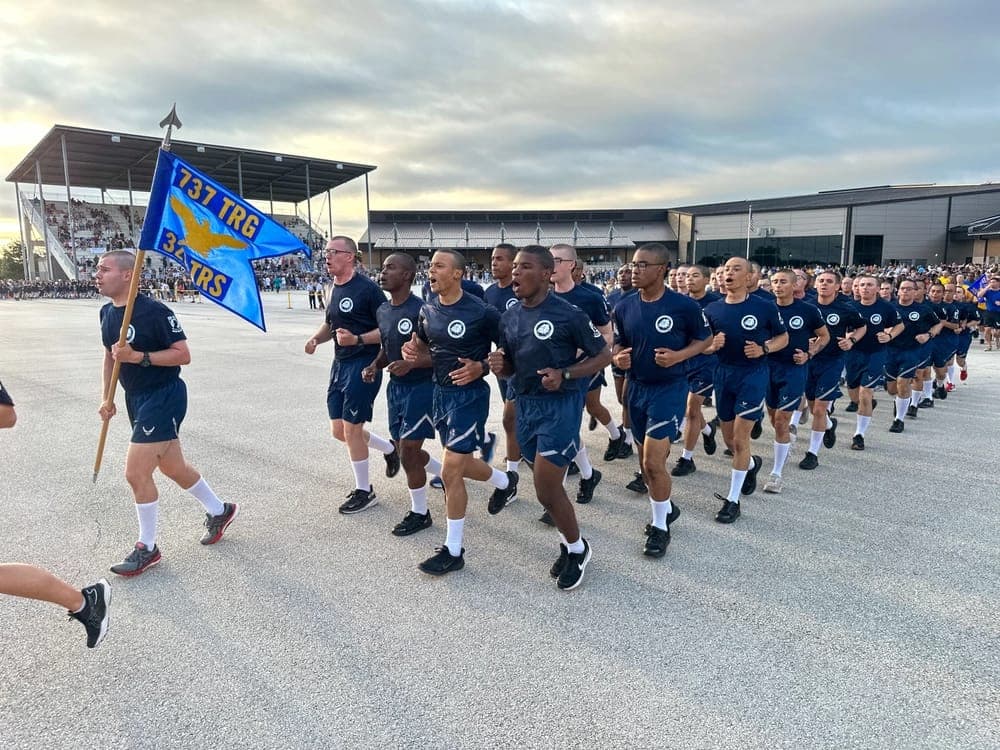
Table of ContentsShow
- The test: three events, 100 possible points
- Wait - didn't the Air Force just change its PT test?
- The run groups (this is the part nobody publishes)
- What happens if you fail the PT test?
- What PT actually looks like week to week
- How should I prepare before shipping?
- Here comes the motivational speech
- Want more?
Let's talk about the question every future trainee eventually types into a search bar at 1 a.m.: what exactly do I have to do, physically, to graduate Air Force basic training? Not vibes. Not "just show up in decent shape, you'll be fine." Numbers. Good news - the numbers exist, they're knowable, and by the end of this post you'll know them better than most trainees standing on the PT pad.
TL;DR - the BMT PT test:
- Three components: 1.5-mile run, push-ups (1 minute), sit-ups (1 minute)
- Scoring: run worth 60 points, push-ups 20, sit-ups 20
- To graduate: composite of 75+ AND the minimum in every component
- Final evaluation in the 5th week of training, with checkpoints at arrival and week 3
- Fail a component now and you retake the test - no alternate exercises (that changed in 2025)
- This is not the same test the operational Air Force takes - BMT kept the classic version
The test: three events, 100 possible points
The BMT fitness evaluation is the classic Air Force trio:
| Component | Time | Max Points |
|---|---|---|
| 1.5-mile run | timed | 60 |
| Push-ups | 1 minute | 20 |
| Sit-ups | 1 minute | 20 |
To graduate you need two things at once: a composite score of 75 or higher, and the minimum score in every single component. That second rule is the trap - the minimums alone don't add up to 75, so you can't minimum your way through two events and ace the third. The test is built to force well-rounded fitness.
Scoring is by age and sex, and you'll be measured against the standards at three checkpoints: your initial appraisal when you arrive, week 3, and the final PT evaluation in week 5. Your flight gets at least two nights of rest from PT sessions before the final eval - the Air Force wants your real score, not your exhausted one.
Score categories work like the rest of the Air Force: 90+ is Excellent (and it's one of the requirements if you're chasing Honor Graduate), 75-89.9 is Satisfactory, below 75 is a failure.
Wait - didn't the Air Force just change its PT test?
Yes, and this is where almost every article online gets it wrong. In 2026 the operational Air Force rolled out the new PFRA - 2-mile run, waist-to-height ratio, hand-release push-up options, the works. BMT didn't adopt it. Trainees still test on the classic 1.5-mile/push-ups/sit-ups, and in April 2025 BMT actually removed the alternate exercises to keep one standard across the training pipeline.
So your training plan is simple: the 1.5-mile trio gets you through BMT, and the 2-mile PFRA is waiting at your first duty station. Train both and neither will surprise you.
The run groups (this is the part nobody publishes)
Your 1.5-mile time doesn't just score points - it sorts you. BMT assigns trainees to ability groups for aerobic training, each with its own lane on the track:
| Group | 1.5-mile time |
|---|---|
| A | under 11:39 |
| B | 11:39 - 12:53 |
| C | 12:54 - 14:25 |
| D | 14:26 - 17:35 |
Formal aerobic run training starts in week 3, built around interval work - roughly 24-minute sessions alternating controlled effort on the curves with harder pushes on the straightaways - and a running cadence target of about 180 steps per minute. If you want a concrete pre-ship goal: show up running a 1.5-mile that lands you in group A or B, and PT at BMT becomes maintenance instead of a crisis.
What happens if you fail the PT test?
Straight from the current playbook, the escalation goes:
- First failure - you stay with your flight and retest the failed components.
- Second failure - formal counseling from your MTI before the next attempt.
- Third failure - referred for further action under DAFMAN 36-2905, which is where washback (repeating weeks of training with another flight) or worse enters the conversation.
And the 2025 change matters here: there used to be alternate exercises you could swap in on a retest (HAMR shuttle run, hand-release push-ups, crunches). Gone. Fail now and you retake the whole test in the original components. The Air Force's stated reason is standardization across the pipeline - my translation: there is no side door, so train for the front door.
What PT actually looks like week to week
You won't just be tested - you'll be trained, hard. BMT runs three programs in parallel, and under the BMT 2.0 overhaul that launched in late 2025, daily PT time expanded significantly:
- Aerobic (run) training - the ability-group interval work above
- Cardio Interval Training (CIT) - circuit rounds of bodyweight movements (jumping jacks, frog jumps, planks, squats) on a work-to-rest clock that tightens as the weeks go on: 20-second efforts in weeks 1-3, 30-second efforts from week 4
- Muscular fitness - push-up, sit-up, pull-up, and core work, some done in pairs with a wingman spotting form
There are also supplemental strength sessions for trainees below standard, and a method the study guide calls One-by-Three for safely building your push-up and sit-up numbers - take your best 1-minute count, divide by three, and that's your per-set training target. Simple, and it works. (The full program - every exercise, the exact schedules, the supplemental sessions - is laid out lesson by lesson in the AF099 course; more on that below.)
How should I prepare before shipping?
Train the test, then train past it:
- Run, mostly. The run is 60% of your score and the thing that sorts your daily training life. Three runs a week minimum, mixing steady 2-mile runs with intervals. Goal: a 1.5-mile comfortably under 12 minutes before you ship.
- One minute is a format - practice the format. Max-effort 1-minute push-up and sit-up sets, with proper form, on a schedule. Use the One-by-Three method between test days.
- Show up already hydrating and sleeping like a trainee. South Texas heat is a component of every event whether the scorecard says so or not.
- Don't ignore pain. The study guide's own advice: anything that hurts more than 48 hours gets medical attention. An injury you hide at week 1 is a washback at week 5.
Here comes the motivational speech
Here's what I want you to take from all this: the BMT PT test is a known test. Known events, known scoring, known dates, known failure policy. Nothing about it is a surprise anymore - which means the outcome is decided in the weeks before you ship, on ordinary Tuesday runs nobody watches. Do those, and week 5 is just another morning in Texas. I believe in you.
The complete BMT PT program - every CIT exercise with step-by-step form, the warm-up and cool-down sequences, the supplemental strength sessions, and the current official scoring charts - is all inside the free AF099 Basic Training course, exactly as BMT teaches it.
Want more?
- The Air Force Fitness Test in 2026 - the New PFRA, Explained - the test waiting for you after BMT
- Is Air Force Basic Training Difficult?
- What Happens If You Fail Basic Training in the Air Force?
- Official BMT preparation page (airforce.com) - includes the DEP fitness app and 14-week training schedule
Keep Reading
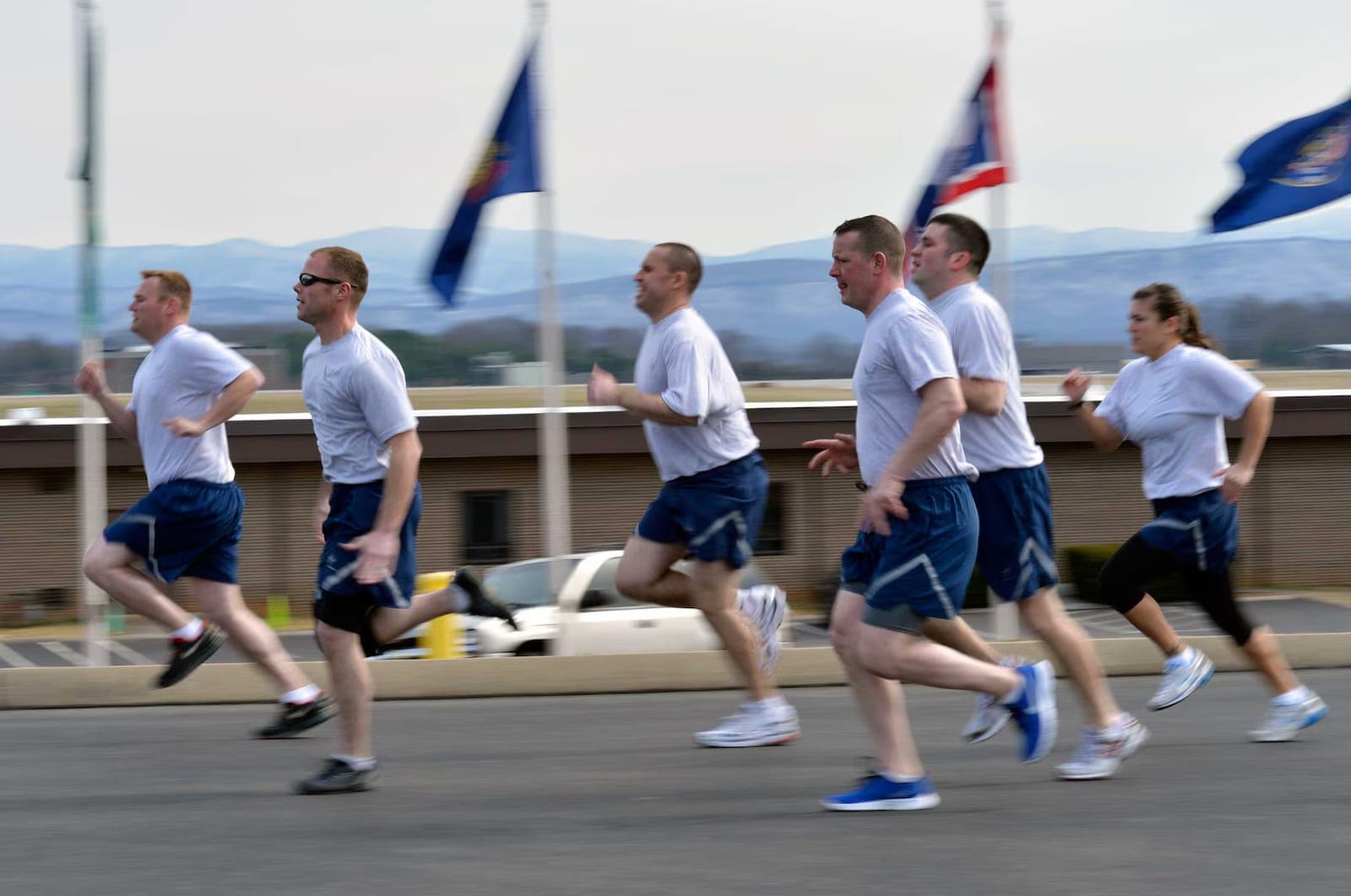
The Air Force Fitness Test in 2026: The New PFRA, Explained
The Air Force PT test changed in 2026. The new PFRA explained: 2-mile run, waist-to-height ratio, scoring, and exactly what it takes to pass.

The BMT End of Course (EOC) Test: What's on It and How to Pass
Yes, there's a final exam at Air Force basic training. The BMT EOC test explained: 100 questions, the 22 subjects covered, passing scores, and how to study.
How to Write to Your Trainee at Air Force BMT (Exact Mailing Address Format)
The exact BMT mailing address format at JBSA-Lackland, how to get your trainee's specific address, when mail arrives, and who to call in an emergency.
How Long Is Air Force Basic Training? (7.5 Weeks, Explained)
Air Force BMT is 7.5 weeks of training, about 8.5 weeks door to door. Why you see three different numbers, the weekly rhythm, and what can add time.