8B300 · Special Duty Identifiers
Officer Accessions Instructor
Also known as: AFROTC Training Instructor
Last updated
At a glance
- Civilian equivalent pay
- $60k–$66k
- Prior service only
Table of ContentsShow
What does an Officer Accessions Instructor do?
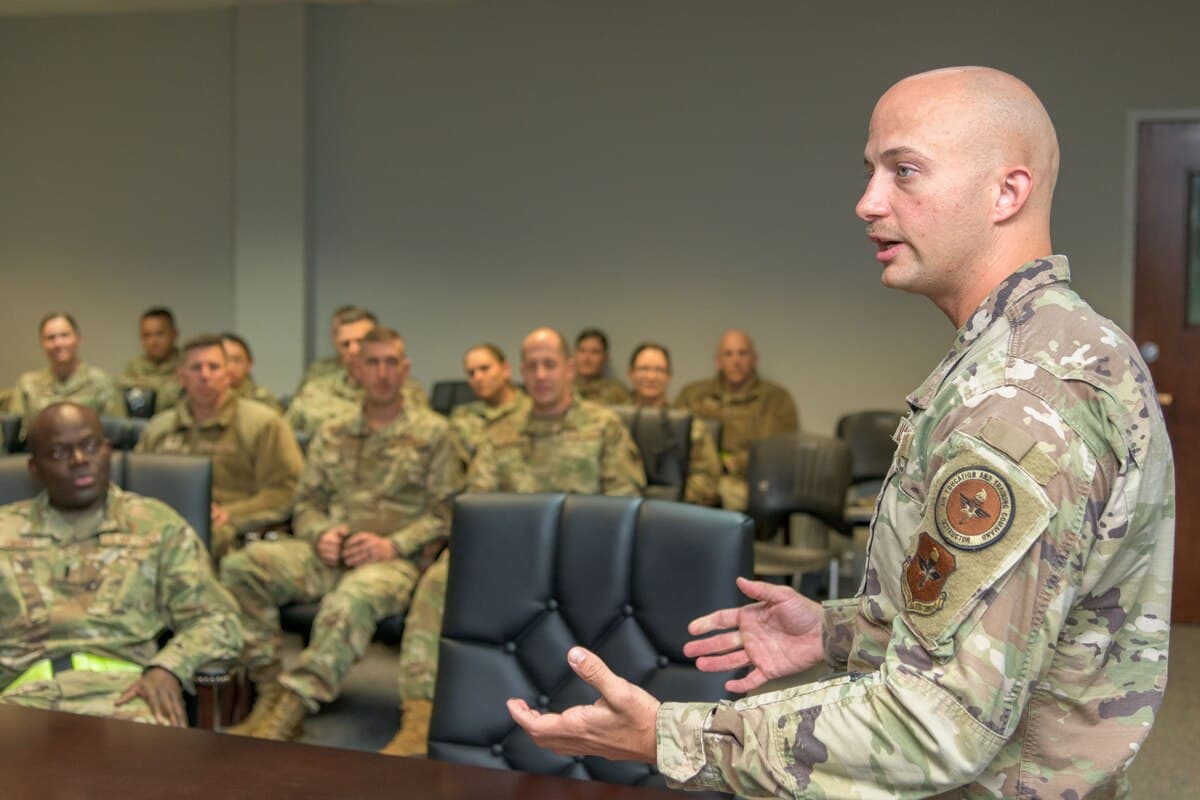
An Officer Accessions Instructor provides mentorship and guidance to aspiring officers and is a key advisor to the Assistant Director of Operations or Instructor Supervisor. Duties include providing guidance on effective leadership techniques, shared personnel experiences and offering insight into the enlisted corps. Instructors will deliver classroom lessons and will be spread throughout all the different phases of training bringing specialized knowledge, technical proficiency, and extensive experience in specific areas. Member will also be trained, and potentially certified, to teach Air Force Combatives, evaluate field training events and participate in occasional physical training. This is an exceptional opportunity to mold and mentor future Air and Space Force officers while working alongside Active Duty, Air Force Reserve and Air National Guard members from diverse backgrounds and AFSCs. Member is responsible for effective implementation of education and training activities as well as advising students on a broad range of topics. Additionally, the member critiques field leadership and debrief evaluations. Further, Officer Accessions Instructors facilitate group discussions, problem solving and subsequently provides written recommendations as required. Upon completion of a successful tour, the Special Duty Ribbon is earned along with an opportunity to compete for AETC Master Instructor while instructing. Applicants must possess a high level of attention to detail and demonstrate exceptional military bearing.
Duties and responsibilities
- Must remain vigilant and move to resolve issues that would adversely impact cadet readiness. Prepares cadets to support mission requirements and exercises the necessary leadership to ensure Detachment success. Maintains and enforces military standards, Uniform Code of Military Justice, drill and ceremony training/execution, human relations, and safety.
- Advises the PAS/APAS on a wide range of topics including the health, esprit de corps, mentoring, well-being, training, professional development, and recognition of all assigned cadets. Assists with preparation and execution of course instruction, commissioning, Extended Active Duty (EAD), contracting, enlistment, Body Mass Index (BMI) checks, Civil Involvements (CIs), Cadet Personnel Actions (CPARs), Personnel Reliability Assurance Program (PRAP), training and other events (e.g., commander’s call, staff meetings, etc.).
- Conducts cadet mid-term feedbacks & counseling sessions.
- Prepares and maintains cadet personnel records. Maintains oversight of cadet schedules to include academic, military, clubs and program requirements. Prepares reports and records about cadet accountability.
- Ensures military/academic/personnel standards are maintained across the Cadet Wing. Guides and assists in selecting, training, and evaluating cadet leaders. Ensures/enforces safety within all formations and events.
- Maintains control of proper uniform issuance and enforces standards on wear.
- Mentors & assists cadets in adapting to the detachment environment and military standards. Manages programs to meet all commissioning requirements. Assists cadets in all facets of training, development, and planning.
- Develops morale and welfare initiatives. Oversees special detachment training events (cadet professional development training, expeditionary skills training, etc.). Leads and attends detachment events (dining in/out, awards, commissioning ceremonies, graduation, etc).
Specialty qualifications
Knowledge. Knowledge is mandatory on: personnel management; counseling; Air Force organizational structure; principles, techniques, and methods of instruction; learning processes; training evaluation; Military Training; Drill and Ceremonies; Customs and Courtesies; Sanitation and Hygiene; and Military Justice.
Education. For entry into this SDI, the following are mandatory:
- CCAF degree or Associates degree or higher from a nationally or regionally accredited academic institution.
Training. For retention of this SDI, completion of the AFROTC NCO Cadre Course (ROTC Specific assignments), and Academic Instructor Certification is mandatory.
Experience. N/A
Other. The following are mandatory as indicated:
- For entry into this SDI, the following are mandatory:
- Approved candidate on the developmental duty volunteer list.
- E-5 - E-8 and must be able to obtain 3 or more years retainability prior to High Year Tenure (HYT). Preferred that E-5's have at least 2 years of Time in Grade by the RNLTD and 6 years of Time in Service.
- Skill-level commensurate with grade. Highest proficiency in functional role is highly desired.
- Overall rating of "Exceeded some, but not all expectations" or "Exceeded most, if not all expectations" on the last 3 Enlisted Performance Reports (EPRs).
- Ability to speak clearly and communicate well with others.
- Must have no current PT exemptions (with the exception of those due to pregnancy and/or deployment).
- Member must receive a favorable recommendation by their current local leadership.
- Must have no record of financial irresponsibility.
- Complete Special Duty Application IAW SPECAT.
- Complete an interview either teleconference, VTC, or in person with the hiring organization.
- For entry and retention of this SDI:
- No record of disciplinary action resulting in an Article 15 or Unfavorable Information File in the last five years. No convictions by a General, Special, or Summary Courts-Martial. In some cases, Letters of Reprimand, Administrative Demotion, and referral EPR may be disqualifying factors for retention in this SDI.
- No record of substance abuse, domestic violence, child abuse, or unprofessional relationships.
- No substantiated abuse findings defined in AFI 40-301, Family Advocacy Program.
- No conviction by a civilian court of Category 1, 2, or 3 offenses, nor exceeded the accepted number of Category 4 offenses. Category 3 and 4 traffic offenses alone are not disqualifying. Categories are described in AFI 36-2002, Regular Air Force and Special Category Accession, Uniform Guide List of Typical Offenses.
- Maintain local network access IAW AFI 17-130, Cybersecurity Program Management and AFMAN 17-1301, Computer Security.
- No record of emotional instability, personality disorder, or other unresolved mental health problems that interfere with the ability to perform AFROTC Training Instructor duties.
Utilization note (RegAF only):
- Award of this SDI is only authorized when an Airman is filling a funded 8B300 unit manpower document (UMD) authorization. When the member is filling a valid 8B300 UMD authorization, 8B300 is authorized as the awarded (secondary, third or fourth), Control and Duty AFSC. The Control AFSC will be updated after the member graduates from the formal school and signs into the new duty position (this is the same time the Duty AFSC changes). If there is no formal school, then the Control AFSC will be updated using the same effective date as the Duty AFSC. Once the member is no longer filling a valid 8B300 UMD authorization, 8B300 is no longer authorized as the Control and Duty AFSC but will remain as an awarded (secondary, third or fourth) AFSC IAW AFMAN 36-2100. unless the member is disqualified from the SDI then it will not remain as an awarded AFSC. Further, 8B300 is not authorized for award as the Primary AFSC when filling a funded 8B300 UMD authorization unless incumbent has no other awarded AFSCs. Airmen performing 8B300 duties but not filling a funded 8B300 UMD authorization will have no change in their awarded and control AFSCs. Ensure airmen employed outside of their Control AFSC are managed IAW AFMAN 36-2100, Military Utilization and Classification. Use Outside of Control AFSC.
Civilian career paths
Comparable civilian careers for this field pay roughly $59,840 to $66,490 per year (median salaries; varies by role and location):
- Career/Technical Education Teachers, Middle School:$62,630
- Career/Technical Education Teachers, Postsecondary: $59,840
- Career/Technical Education Teachers, Secondary School: $62,500
- Instructional Coordinators: $66,490
- Training and Development Specialists: $63,080
Entry requirements
Medical disqualifiersShowHide
These screened conditions disqualify a candidate for this AFSC:
Security & backgroundShowHide
Videos, Reddit & resources
8B300 videos(1)
These do not reflect official U.S. Air Force views and may contain inaccuracies — negative opinions are often overrepresented online.

TSgt Tyler Boudreau ROTC Training Instructor Interview
AFROTC Detachment 025 · 5/13/2023
Reddit discussions(3)
These do not reflect official U.S. Air Force views and may contain inaccuracies — negative opinions are often overrepresented online.
Researching other jobs too? Every career field's videos and discussions are collected the same way — browse all AFSCs.
Where this data comes from
Most of the data on this page comes from the Air Force Enlisted Classification Directory (AFECD) and recruiter TTMS readouts, which are no longer released publicly. Pulling it together and keeping it accurate takes real time, so I update these pages as often as I can.
Requirements do change between updates. Before you make any decisions, confirm the details with your recruiter. They always have the latest word.