3E8X1 · Support
Explosive Ordnance Disposal
Also known as: EOD, Bomb Squad, Bomb Disposal
Last updated
At a glance
- ASVAB minimums
- PSM 54
- Security clearance
- SecretTop Secret for some positions
- Tech school
- Eglin, Florida · Sheppard, Texas · 169 days
- Career field size
- 1,247 Airmen
- Possible bases
- 37 stateside · 13 overseas
- Civilian equivalent pay
- $45k–$116k
- Special warfare / operational
- U.S. citizenship required
Table of ContentsShow
What does the Explosive Ordnance Disposal career field do?
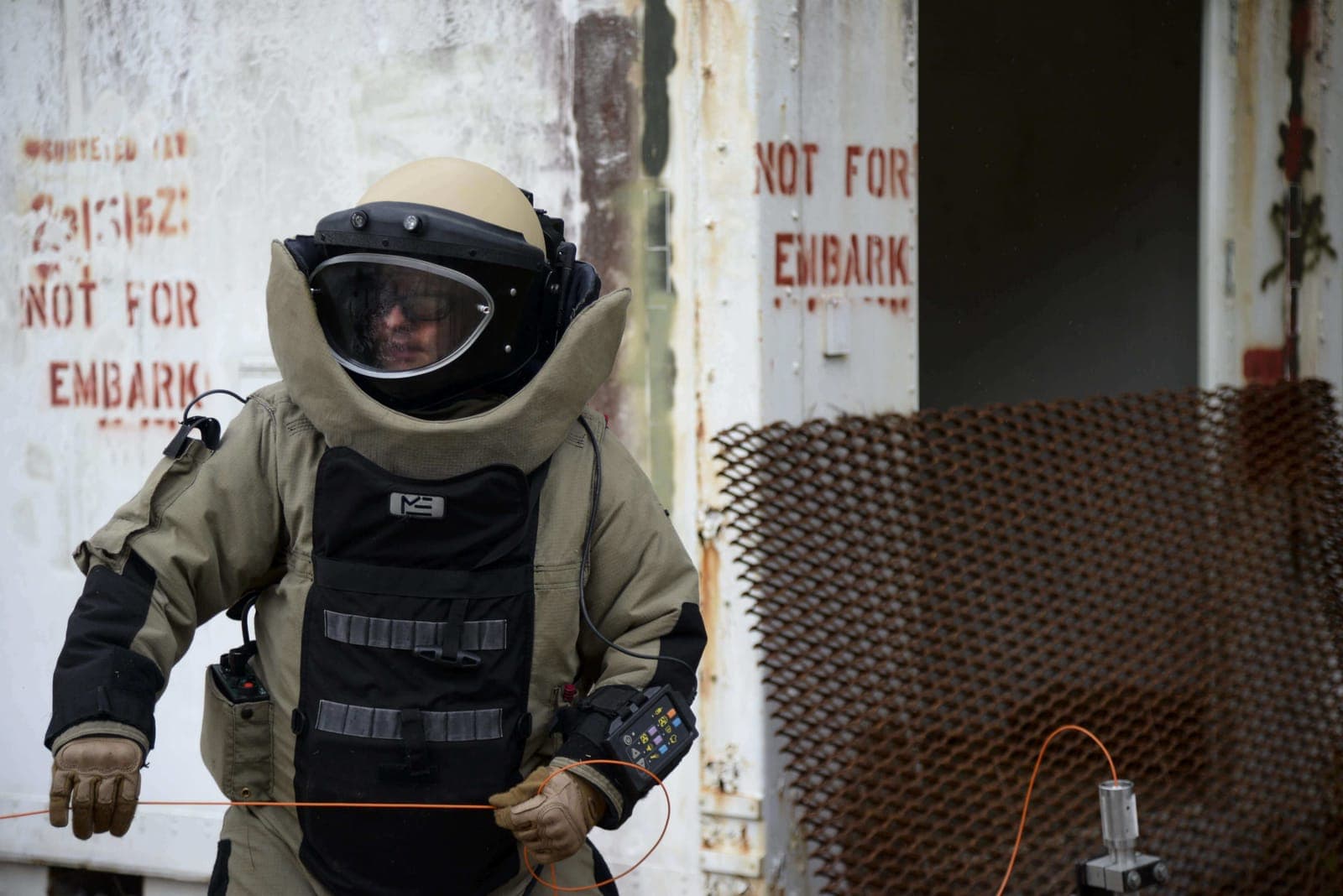
Performs explosive ordnance disposal (EOD) operations to protect personnel, resources, and the environment from the effects of hazardous explosive ordnance (EO), improvised explosive devices (IED) and weapons of mass destruction (WMD) which may include; incendiary, chemical, biological, radiological, and nuclear (CBRN) hazards. Employs specialized tools, techniques, and personal protective equipment to detect/identify EOD objectives and to accomplish diagnostics, monitoring, evaluation, interrogation, mitigation, render safe, recovery, and disposal operations on ordnance/devices delivered, placed, or made dangerous by accident/incident or other circumstance. Utilizes and maintains advanced equipment, such as, robotics, x-ray, landmine and CBRN detection equipment. Transports demolition explosives and equipment to authorized disposal areas, fabricates explosive demolition charges, and disposes of hazardous devices, ordnance, and explosives. EOD may be employed alone or as part of an AF, Joint, Interagency, or Coalition force, to support Combatant Commander and/or Air Force objectives. Provides rapid response capability and operates in five geographic disciplines: mountain, desert, arctic, urban and jungle, day, or night, to include austere combat environments independent of an established airbase or its perimeter defenses in mounted, dismounted, and limited airborne/aerial insertion operations. EOD at the five, seven, and nine level plan, organize, and direct EOD operations. Related DoD Occupational Subgroup: 143100 and 143300.
Duties and responsibilities
- Plans, organizes, and directs EOD operations. Develops operational orders/plans, instructions, concepts of operation, and safety plans (ORM Assessments) concerning EOD employment. Translates commander’s objectives/mission taskings into effective employment of EOD capability. Uses advanced technological and manual methods to perform long range/close-in reconnaissance, identification, assessment of ordnance/hazardous device conditions and filler materials, then advises commanders on recommended EOD actions and safe withdrawal distances. Prepares personnel and equipment for military operations.
- Supports U.S. and foreign aerospace systems/vehicles and conventional munitions operations; sortie generation and space launch operations by responding to airfield/launch complex explosive related ground/in-flight emergencies or crash situations; and research and development testing of weapons, aircraft, and space systems.
- Executes counter-IED (CIED) operations. Eliminates or mitigates explosive hazards and terrorist/criminal devices, to include missions outside the base boundary or Base Security Zone to enable freedom of maneuver for air or surface operations. Performs IED defeat actions to include (but not limited to) the following: recover/destroy weapon caches; perform immediate actions to defeat emplaced IEDs; conduct post-blast analysis of IED events; provides military authorities with technical intelligence, analysis, and exploitation; and provide key insights to enable development of CIED tactics, techniques, and procedures to mitigate IED effectiveness.
- Executes counter-WMD operations. Peacetime EOD force WMD response efforts are limited in scope to provide initial threat confirmation, risk mitigation, situational awareness, and site stabilization; however, EOD forces may also provide additional technical support as required. During contingencies, EOD forces provide full-spectrum response capability to incidents involving CBRN, incendiary and explosive devices.
- Conducts Nuclear Weapon Response. Provides immediate initial support to nuclear weapon accidents or incidents in order to evaluate nuclear weapon/delivery status, mitigate risk, provide site stabilization, and situational awareness. Custodial units certified on specific weapon systems and aerospace platforms form the core of weapons recovery teams and must respond in conjunction with the Tactical Response Force to explosively overcome obstacles, conduct passive diagnostics and provide technical assessments through secure communications with National Render Safe assets while supporting the National Military Command Center and Response Task Force (RTF) incident/accident or recapture/recovery efforts.
- Performs unexploded explosive ordnance (UXO) recovery operations. Provides emergency response (on or off installation) to neutralize hazards posed by EO related incidents presenting a threat to operations, installations, personnel or materiel, including but not limited to, excavation and renders safe, evaluation of individual ordnance items, exploitation for technical intelligence value, support of developmental and operational ordnance/weapons system testing, and large-scale recovery of airbases, forward operating locations, landing zones, and drop zones denied by ordnance operations. Maintains capability to identify, stabilize and contain chemical/biological ordnance and provide disposition support to follow-on organizations. Transports demolition explosives and equipment to authorized disposal areas, fabricates explosive demolition charges, and disposes of hazardous devices, ordnance, and explosives.
- Engaged in explosive range activities and operational range clearances. Establishes, operates, and maintains EOD explosive proficiency, training, and disposal ranges. Evaluates extent of explosive contamination on AF property, and on bombing and gunnery, research and development, and munitions test ranges. Prepares clearance/logistical plans and cost estimates for operational range clearance operations. Performs surface-removal, or disposal, of unexploded ordnance, classified ordnance, inert ordnance debris, training projectile debris, and any other range material fired on, or upon a military range from the targets and surrounding areas.
- Combat enabler for Irregular Warfare. Provide EOD support for General Purpose and Special Operations Forces in the execution of various IW missions to include security force assistance, counterinsurgency (COIN), stability operations, and building partnership capacity. Supports specialized Joint Service task force operations.
- Understands war fighter tactics, techniques, and procedures (TTPs). Integrates EO, IED, and WMD threat information into the decision-making process at all levels to mitigate and exploit the enemy’s TTPs to maximize combat power. Performs tactical mission planning and preparation. Participates in Military Decision-Making Process. Briefs joint force commanders and staff on EO threats affecting operations.
- Supports Defense Support to Civil Authorities activities. Provides emergency or lifesaving EOD operational capability to the Federal, state, and local civil authorities requesting support to mitigate or eliminate hazards associated with explosives (IEDs, military munitions, etc.). Provides hazardous materials (HAZMAT) response capability for incidents involving explosive ordnance.
- Conducts Very Important Person/special protective activities. Supports U.S. Secret Service (USSS), Department of Homeland Security (DHS) and the Department of State (DoS) by providing counter explosive search teams in support of National Security Special Events, White House Complex and the protection of the President, Vice President, and other dignitaries.
Specialty qualifications
Knowledge. Knowledge in: EOD flight organization; applied principles of electronics, physics, chemistry and mechanics; peacetime-wartime accident/incident response procedures; operational principles for specialized EOD tools, equipment and personal protective equipment; explosive and demolition procedures; access and recovery operations; explosive ordnance reconnaissance and assessment; weapons technical intelligence; post blast analysis; protection of personnel and property; render safe techniques; dynamic charges and explosive entry tools; range clearance operations; proficiency, training and demolition range management; treatment of explosives and related hazardous materials; identification, safety precautions, render safe, and disposal fundamentals for U.S. and foreign munitions/aerospace systems; identification, response planning, tactical considerations, render safe and disposal fundamentals for improvised explosive devices and homemade explosives; procedural fundamentals for weapons of mass destruction response; equipment and procedures for chemical/biological warfare and nuclear weapons; airbase recovery operations; deployment procedures; movement by aircraft; small arms and crew served weaponry; joint service and special force support requirements; combat operations.
Education. For entry into this specialty, completion of high school or general educational development equivalency is mandatory. Courses in physics, mechanics, and basic electronic theory are desirable. For AD and ANG personnel, completion of AFIT WMGT 570, Civil Engineer Superintendent Course is highly recommended. For AFRC personnel refer to AFRCI 10-210, Air Force Reserve Command Prime Base Engineer Emergency Force (BEEF) Management, dated 14 Jan 14, para. 3.3 regarding completion of AFIT WMGT 570 course. NOTE: For AD, ANG and AFRC personnel, this is not a skill level awarding course.
Training. The following training is mandatory for award of the AFSC indicated:
- 3E831. Completion of the Explosive Ordnance Disposal apprentice course.
- 3E871. Completion of the Explosive Ordnance Disposal craftsman course.
- 3E891. Completion of the AFIT WMGT 570 Civil Engineer Superintendent Course is required for Active Duty. For ANG personnel, completion of AFIT WGMT 570, Civil Engineer Superintendent Course is highly recommended. For AFRC personnel refer to AFRCI 10-210, Air Reserve Command Prime Base Engineer Emergency Force (BEEF) Management, dated 14 Jan 14, para. 3.3 regarding completion of AFIR WGMT 570 course, NOTE: for AD, ANG, and AFRC personnel, this is not a skill level awarding course.
Experience. The following experience is mandatory for award of the AFSC indicated:
- 3E851. Qualification in and possession of AFSC 3E831. Also, experience operating EOD tools/equipment, executing aerospace system response, rendering safe munitions, removing, and treating hazardous unexploded ordnance or decontaminating activities.
- 3E871. Qualification in and possession of AFSC 3E851. Also, experience performing or supervising EOD functions and operations, such as, preparing operational orders/plans, training/organizing/equipping personnel, and conducting response activities.
- 3E891. Qualification in and possession of AFSC 3E871. Also, experience managing EOD functions or operations, such as, evaluating, planning, organizing and leading EOD activities in the fulfillment of the broad scope of EOD duties and responsibilities.
Other. The following are mandatory as indicated:
- Requirements for entry, award, and retention (DAFECD Table 3.5):
- Minimum height of 5’0”. Maximum height 6’6”.
- No record of Claustrophobia (fear of confined spaces).
- Minimum score of 54 required on EOD Predictive Selection Model composed of ASVAB subtests and Tailored Adaptive Personality Assessment System (TAPAS) facets.
- Must pass the Initial Fitness Test EOD Standard.
- Must pass the EOD Occupationally Specific Physical Fitness Assessment IAW AFMAN 36-2930.
- Recommendation for AFSC entrance by the nearest EOD Flight Commander, Flight Chief, or ranking NCO IAW DAFMAN 32-3001. EOD Air Force Career Field Manager approval is mandatory.
- Candidates must complete the new accession or retraining volunteer letter found in DAFMAN 32-3001 as applicable.
- Must complete an EOD flight orientation visit with an operational Air Force EOD flight as prescribed in DAFMAN 32-3001. If one is not located on station, the applicant's unit may fund a temporary duty to the nearest Air Force Base with an operational AF EOD Flight to complete the EOD orientation. The visit consists of up to 10 operational duty days to complete the EOD Orientation/Retraining Checklist found in DAFMAN 32-3001. Completed checklist, signed by the unit, should be sent to the supporting Force Support Squadron to initiate a Case Management System case to forward the information to HQ AFPC or HQ ARPC. (Note 2)
- Must be eligible to obtain a valid state driver’s license to operate government motor vehicles (GMV) in accordance with AFI 24-301, Vehicle Operations.
- No unresolved mental health issues (including, but not limited to: failure to engage in help-seeking behaviors, a pattern of relapse in symptoms/illness, unwillingness, or inability to overcome mental health disorder) that would prevent member in the performance of their duties.
- Passing color vision, as defined by correctly identifying at least 10 of 14 Ishihara Plates.
- Passing color vision, as defined as a CCT score of 55 or greater in accordance with the USAF Medical Standards Directory.
- Must maintain local network access IAW AFI 17-130, Cybersecurity Program Management and AFMAN 17-1301, Computer Security.
- Specialty requires an adjudicated Tier 3 (T3) clearance, with an initiated Tier 5 (T5) prior to attending Naval School Explosive Ordnance Disposal (NAVSCOLEOD). The T5 security clearance shall not be initiated until the T3 clearance is adjudicated. The T5 clearance is required due to training, assignments involving nuclear weapons, and United States Secret Service / Department of State Support.
- Must maintain qualification for EOD duty IAW DAFMAN 32-3001.
- Note 1: Enlisted Airmen with more than 6 years Time in Service and above the rank of SSgt are not accepted for retraining. EOD operations require experienced technical leadership.
- Note 2: The EOD flight orientation visit does not apply to AFRC personnel.
Civilian career paths
Comparable civilian careers for this field pay roughly $45,270 to $115,640 per year (median salaries; varies by role and location):
- Detectives and Criminal Investigators: $86,940
- Emergency Management Directors: $76,250
- Explosives Workers, Ordnance Handling Experts, and Blasters: $48,510
- Hazardous Materials Removal Workers: $45,270
- Occupational Health and Safety Specialists: $76,340
- Occupational Health and Safety Technicians: $53,340
- Training and Development Manager: $115,640
- Training and Development Specialists: $62,700
ASVAB requirements
To qualify for 3E8X1, you need:
Enter your scores in the AFSC explorer and this section will check each requirement for you.
Entry requirements
Medical profile (PULHES)ShowHide
PULHES scale: lower numbers mean a stricter medical standard. Tap a letter for what it measures.
Vision requirementsShowHide
Medical disqualifiersShowHide
These screened conditions disqualify a candidate for this AFSC:
Physical requirementsShowHide
Education prerequisitesShowHide
Security & backgroundShowHide
Where you could be stationed
Stateside (37)
- Barksdale, Louisiana
- Beale, California
- Cannon, New Mexico
- Davis-Monthan, Arizona
- Dover, Delaware
- Dyess, Texas
- Edwards, California
- Eglin, Florida
- Ellsworth, South Dakota
- F E Warren, Wyoming
- Fairchild, Washington
- Hill, Utah
- Holloman, New Mexico
- Hurlburt Field, Florida
- JB Andrews, Maryland
- JB Charleston, South Carolina
- JB Langley-Eustis, Virginia
- JBSA Lackland, Texas
- Joint Base McGuire-Dix-Lakehurst, New Jersey
- Kirtland, New Mexico
- Little Rock, Arkansas
- Luke, Arizona
- MacDill, Florida
- Malmstrom, Montana
- McConnell, Kansas
- Minot, North Dakota
- Moody, Georgia
- Mountain Home, Idaho
- Nellis, Nevada
- Scott, Illinois
- Seymour Johnson, North Carolina
- Shaw, South Carolina
- Sheppard, Texas
- Travis, California
- Tyndall, Florida
- Whiteman, Missouri
- Wright Patterson, Ohio
Overseas (13)
- Andersen, Guam
- Aviano, Italy
- Eielson, Alaska
- Incirlik AB, Turkey
- JB Elmendorf-Rich, Alaska
- JB Prl Hbr-Hickam, Hawaii
- Kadena, Japan
- Kunsan, South Korea
- Lakenheath, United Kingdom
- Misawa, Japan
- Osan AB, South Korea
- Ramstein, Germany
- Spangdahlem AB, Germany
Badges & identifiers
Duty badges
The occupational badge worn by Airmen in this career field.
- Explosive Ordnance Badge
Duty identifiers
Special duty patches and identifiers associated with this AFSC.
- EOD Duty Identifier
Degrees & training plan
While serving in 3E8X1 you can earn an associate degree through the Community College of the Air Force:
- Explosive Ordnance Disposal
- Career Field Education & Training Plan (CFETP)View CFETP (PDF, opens in a new tab)
The CFETP is the official Air Force document describing this career field's full training pipeline, from tech school through advanced skill levels.
Videos, Reddit & resources
3E8X1 videos(12)
These do not reflect official U.S. Air Force views and may contain inaccuracies — negative opinions are often overrepresented online.
Air Force EOD (3E8X1)
Airman Vision · 5/21/2025
1 of 12 videos
Reddit discussions(6)
These do not reflect official U.S. Air Force views and may contain inaccuracies — negative opinions are often overrepresented online.
Official links & resources(7)
Researching other jobs too? Every career field's videos and discussions are collected the same way — browse all AFSCs.
Frequently asked questions
- What ASVAB score do you need for Explosive Ordnance Disposal (3E8X1)?
- You need PSM 54+ on the ASVAB to qualify for 3E8X1.
- Where can Explosive Ordnance Disposal Airmen get stationed?
- 3E8X1 Airmen serve at 50 bases: 37 stateside and 13 overseas, including Andersen, Guam, Aviano, Italy, Eielson, Alaska.
- Does 3E8X1 require a security clearance?
- Yes — Explosive Ordnance Disposal requires a Secret clearance.
- How long is tech school for Explosive Ordnance Disposal?
- Tech school for 3E8X1 runs about 169 days at Eglin, Florida · Sheppard, Texas.
Where this data comes from
Most of the data on this page comes from the Air Force Enlisted Classification Directory (AFECD) and recruiter TTMS readouts, which are no longer released publicly. Pulling it together and keeping it accurate takes real time, so I update these pages as often as I can.
Requirements do change between updates. Before you make any decisions, confirm the details with your recruiter. They always have the latest word.