3E0X1 · Support
Electrical Systems
Last updated
At a glance
- ASVAB minimums
- M 43+E 45
- Tech school
- Sheppard, Texas · 99 days
- Career field size
- 1,405 Airmen
- Possible bases
- 35 stateside · 21 overseas
- Civilian equivalent pay
- $32k–$85k
Table of ContentsShow
What does the Electrical Systems career field do?
Installs, inspects, maintains, troubleshoots, repairs, and modifies electrical distribution systems and components above and below 600 volts; airfield lighting systems; and fire alarms, and complies with environmental and safety regulations and practices. Related DoD Occupational Subgroup: 172100.
Duties and responsibilities
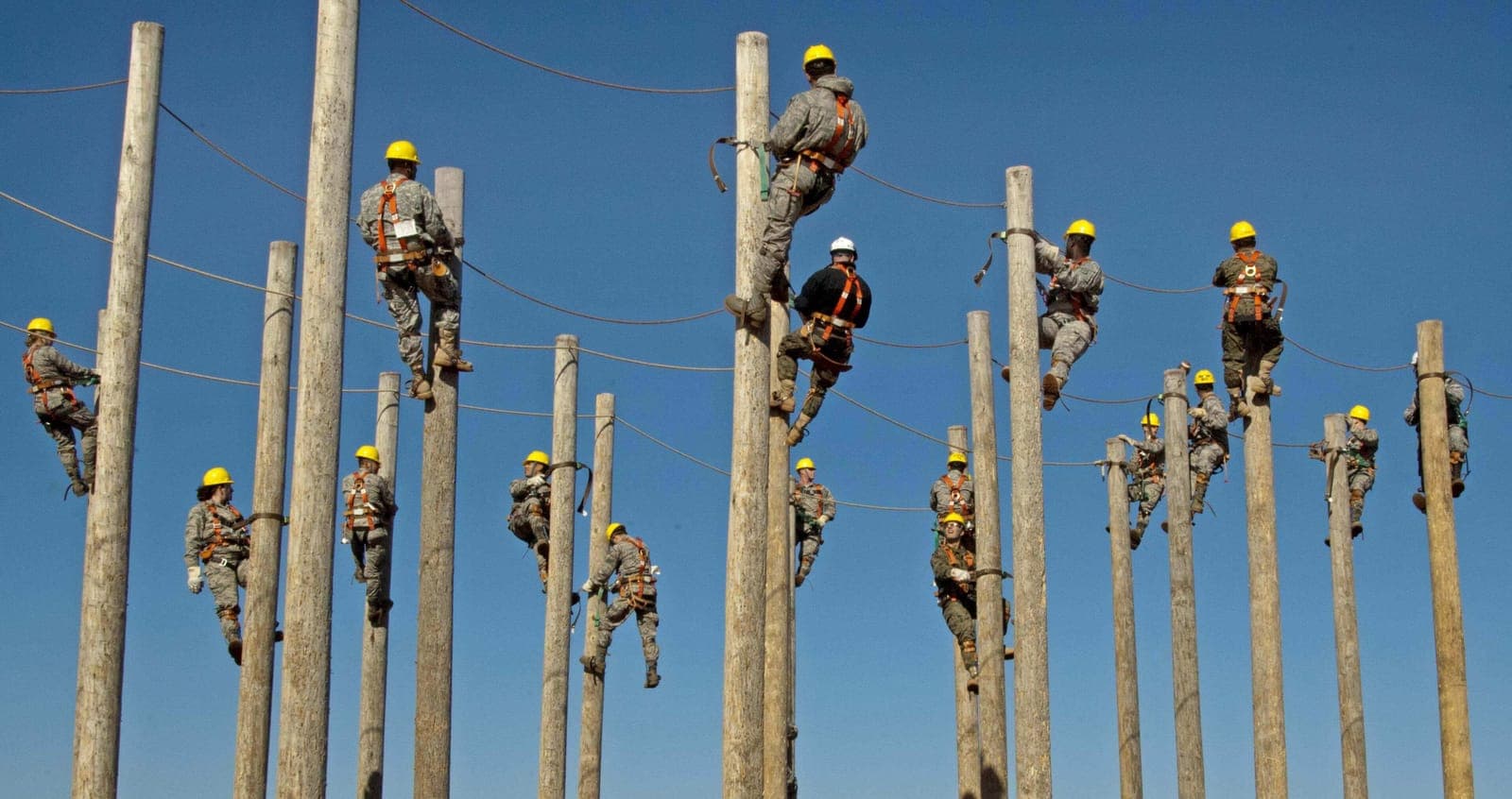
- Installs, maintains, and repairs energized and de-energized electrical distribution systems and components. Installs, maintains, and repairs interior, exterior, overhead, underground electrical power distribution systems and components such as capacitor banks, vacuum and air break switches, breakers, transformers, fuses, lighting fixtures, receptacles, and motors. Climbs utility poles and operates special purpose vehicles and equipment, including line maintenance and high reach trucks to inspect, maintain, and repair overhead distribution systems. Inspects powerline poles for pest damage, deterioration, and loose hardware. Inspects, tests, and services overhead line conductors and direct buried cables, and those in underground ducts and conduits. Troubleshoots malfunctions using technical orders, manufacturers' handbooks, local procedures, codes, and directives. Tests air samples in manholes for dangerous concentrations of combustible or toxic gases and oxygen deficiency.
- Maintains, inspects, and repairs special purpose electrical systems. Inspects, maintains, and repairs fixed and portable airfield lighting systems including runway, threshold, approach, taxiway, visual glide slope, obstruction, and distance marker lights. Installs, maintains, and repairs cathodic protection and grounding systems, and voltage and current regulators. Installs, maintains, and repairs fire alarms and traffic system controls. Installs, maintains, and repairs electrical appliances.
- Maintains proficiency in cardiopulmonary resuscitation, first aid, pole top, aerial lift, and manhole rescue. Complies with safety and environmental regulations and practices.
- Advises on problems installing and repairing electrical power distribution and special purpose electrical systems. Solves maintenance problems by studying layout drawings, wiring and schematic diagrams, and analyzing construction and operating characteristics. Uses meters, testing devices, indicators, and recorders to locate equipment, distribution, and motor controller malfunctions and faults. Diagnoses malfunctions and recommends repair procedures necessary to correct defective equipment. Develops and establishes maintenance and operating procedures to ensure maximum efficiency.
- Performs planning activities. Performs facility surveys. Surveys proposed work to determine resource requirements. Prepares cost estimates for in-service work. Applies engineered performance standards to plan and estimate jobs. Coordinates plans and other activities.
Specialty qualifications
Knowledge. Knowledge is mandatory of: principles of electricity and electronics, including computation and measurement of common properties (resistance, inductance, capacitance, voltage, and current); transformers and regulator operations and connection; grounding and lightning protection systems; working on high and low voltage energized lines; applications of safety requirements related to installation and maintenance of electrical distribution systems; principles of fire; cathodic protection systems; airfield lighting systems; reading electrical schematics and one-line diagrams; rescue and resuscitation of electrical shock victims; and environmental regulations.
Education. For entry into this specialty, completion of high school with courses in science, mathematics, and shop mechanics is desirable.
Training. The following training is mandatory for award of the AFSC indicated:
- 3E031. Completion of Electrical Systems Apprentice Course J3ABR3E031 01AC
- 3E071. Completion of Advanced Control Systems Cybersecurity Course (AFIT WENG 270) Note: Highly recommended for ANG and AFRES.
Experience. The following experience is mandatory for award of the AFSC indicated:
- 3E051. Qualification in and possession of AFSC 3E031. Also, experience in functions such as climbing poles; installing, maintaining, and repairing electrical systems and components; and airfield lighting systems and components.
- 3E071. Qualification in and possession of AFSC 3E051. Also, experience performing or supervising functions such as climbing poles; installing, maintaining, and repairing electrical systems; and airfield lighting systems and components.
Other. The following are mandatory as indicated:
- For entry into this specialty:
- Must possess a valid state driver’s license to operate government motor vehicles (GMV) in accordance with AFI 24-301, Vehicle Operations.
- Freedom from fear of heights.
- See attachment 4 for additional entry requirements.
- For entry, award, and retention, normal color vision as defined in AFI 48-123, Medical Examinations and Standards.
- For award and retention of these AFSCs, must maintain local network access IAW AFI 17-130, Cybersecurity Program Management and AFMAN 17-1301, Computer Security.
- For retention of the AFSC if awarded 3 skill level, 2 years of lack of recent performance AFSC is withdrawn IAW AFMAN 36-2100
- For retention of the AFSC if awarded 5 skill level, 4 years of lack of recent performance then downgraded to 3 skill level and then 2 more years of non performance AFSC is withdrawn IAW AFMAN 36-2100.
- For retention of the AFSC if awarded 7 or 9 skill level, 6 years of lack of recent performance then downgraded to 3 skill level and then 2 more years of non performance AFSC is withdrawn IAW DAFMAN 36-2100.
Civilian career paths
Comparable civilian careers for this field pay roughly $31,760 to $85,340 per year (median salaries; varies by role and location):
- Construction and Building Inspectors: $62,860
- Electric Motor, Power Tool, and Related Repairers: $46,590
- Electrical and Electronic Engineering Technologists and Technicians: $67,550
- Electrical and Electronic Equipment Assemblers: $36,390
- Electrical and Electronics Drafters: $62,100
- Electrical and Electronics Installers and Repairers, Transportation Equipment: $70,200
- Electrical and Electronics Repairers, Commercial and Industrial Equipment: $62,010
- Electrical and Electronics Repairers, Powerhouse, Substation, and Relay: $85,340
- Electrical Power-Line Installers and Repairers: $75,030
- Electricians: $56,900
- First-Line Supervisors of Mechanics, Installers, and Repairers: $70,240
- Helpers--Electricians: $33,840
- Helpers--Installation, Maintenance, and Repair Workers: $31,760
- Maintenance and Repair Workers, General: $40,850
- Security and Fire Alarm Systems Installers: $50,940
- Telecommunications Line Installers and Repairers: $58,870
ASVAB requirements
To qualify for 3E0X1, you need:
Enter your scores in the AFSC explorer and this section will check each requirement for you.
Entry requirements
Medical profile (PULHES)ShowHide
PULHES scale: lower numbers mean a stricter medical standard. Tap a letter for what it measures.
Vision requirementsShowHide
Medical disqualifiersShowHide
These screened conditions disqualify a candidate for this AFSC:
Physical requirementsShowHide
Security & backgroundShowHide
Where you could be stationed
Stateside (35)
- Altus, Oklahoma
- Barksdale, Louisiana
- Beale, California
- Bolling, District Of Columbia
- Cannon, New Mexico
- Creech, Nevada
- Davis-Monthan, Arizona
- Dover, Delaware
- Dyess, Texas
- Ellsworth, South Dakota
- F E Warren, Wyoming
- Fairchild, Washington
- Grand Forks, North Dakota
- Holloman, New Mexico
- Hurlburt Field, Florida
- JB Andrews, Maryland
- JB Charleston, South Carolina
- JB Langley-Eustis, Virginia
- JBSA Lackland, Texas
- JBSA Randolph, Texas
- Joint Base Lewis-McChord, Washington
- Joint Base McGuire-Dix-Lakehurst, New Jersey
- Little Rock, Arkansas
- Luke, Arizona
- Malmstrom, Montana
- McConnell, Kansas
- Minot, North Dakota
- Moody, Georgia
- Mountain Home, Idaho
- Nellis, Nevada
- Scott, Illinois
- Seymour Johnson, North Carolina
- Shaw, South Carolina
- Travis, California
- Whiteman, Missouri
Overseas (21)
- Andersen, Guam
- Aviano, Italy
- Bellows, Hawaii
- Coronel Enrique S, Honduras
- Daegu AB, South Korea
- Eareckson, Alaska
- Eielson, Alaska
- Incirlik AB, Turkey
- JB Elmendorf-Rich, Alaska
- JB Prl Hbr-Hickam, Hawaii
- Kadena, Japan
- Kunsan, South Korea
- Lajes, Portugal
- Lakenheath, United Kingdom
- Mildenhall, United Kingdom
- Misawa, Japan
- Osan AB, South Korea
- Ramstein, Germany
- Shape, Belgium
- Spangdahlem AB, Germany
- Yokota, Japan
Badges & identifiers
Duty badges
The occupational badge worn by Airmen in this career field.
- Civil Engineer Badge
Duty identifiers
Special duty patches and identifiers associated with this AFSC.
- ELEC Duty Identifier
Degrees & training plan
While serving in 3E0X1 you can earn an associate degree through the Community College of the Air Force:
- Electronic Systems Technology
- Career Field Education & Training Plan (CFETP)View CFETP (PDF, opens in a new tab)
The CFETP is the official Air Force document describing this career field's full training pipeline, from tech school through advanced skill levels.
Videos, Reddit & resources
3E0X1 videos(12)
These do not reflect official U.S. Air Force views and may contain inaccuracies — negative opinions are often overrepresented online.
Air Force Electricians - 3E0X1 - Electrical Systems
Airman Vision · 8/10/2025
1 of 12 videos
Reddit discussions(9)
These do not reflect official U.S. Air Force views and may contain inaccuracies — negative opinions are often overrepresented online.
Official links & resources(4)
Researching other jobs too? Every career field's videos and discussions are collected the same way — browse all AFSCs.
Frequently asked questions
- What ASVAB score do you need for Electrical Systems (3E0X1)?
- You need Mechanical 43+ and Electrical 45+ on the ASVAB to qualify for 3E0X1.
- Where can Electrical Systems Airmen get stationed?
- 3E0X1 Airmen serve at 56 bases: 35 stateside and 21 overseas, including Andersen, Guam, Aviano, Italy, Bellows, Hawaii.
- How long is tech school for Electrical Systems?
- Tech school for 3E0X1 runs about 99 days at Sheppard, Texas.
Where this data comes from
Most of the data on this page comes from the Air Force Enlisted Classification Directory (AFECD) and recruiter TTMS readouts, which are no longer released publicly. Pulling it together and keeping it accurate takes real time, so I update these pages as often as I can.
Requirements do change between updates. Before you make any decisions, confirm the details with your recruiter. They always have the latest word.