3E7X1 · Support
Fire Protection
Also known as: Fire Fighter, Crash Fire Rescue, Aircraft Fire Fighter, Aircraft Rescue Fire Fighting, ARFF, Fire Dawgs
Last updated
At a glance
- ASVAB minimums
- G 57
- Security clearance
- Secret
- Tech school
- Goodfellow AFB, Texas · 68 days
- Career field size
- 3,054 Airmen
- Possible bases
- 42 stateside · 20 overseas
- Civilian equivalent pay
- $31k–$94k
- Special warfare / operational
- U.S. citizenship required
Table of ContentsShow
What does the Fire Protection career field do?
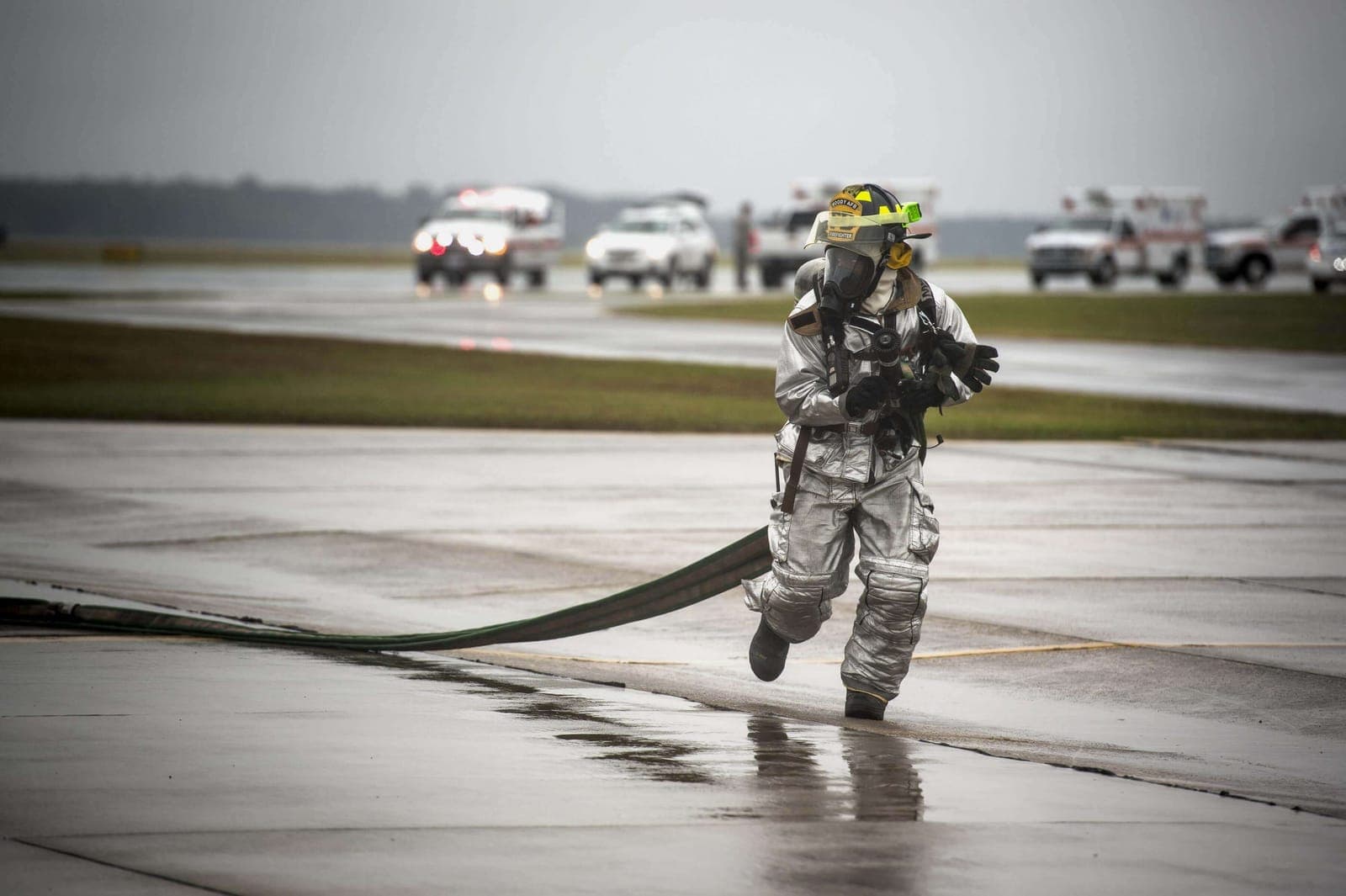
Protects people, property, and the environment from fires and disasters. Provides fire prevention, firefighting, rescue, and hazardous material responses. Related DoD Occupational Subgroup: 149500.
Duties and responsibilities
- Plans, organizes, and directs all fire protection activities. Analyzes fire protection operations, determines trends and problems, and formulates corrective measures. Provides fire protection guidance. Coordinates fire protection support agreements and pre-incident plans. Executes and enforces the Fire Department Occupational Safety and Health Program. Conducts and evaluates training on specialized fire protection equipment and procedures. Performs inspections and organizational maintenance on fire protection vehicles, equipment, and protective clothing. Manages and operates fire alarm communications centers. Supports the electrical power production function with resetting aircraft arresting systems.
- Provides fire prevention guidance. Performs project reviews to ensure fire safety feature adequacy. Inspects facilities and identifies fire hazards and deficiencies. Determines fire extinguisher distribution requirements and performs inspections and maintenance. Establishes public relations and conducts fire prevention awareness and educational training.
- Controls and extinguishes aircraft, structure, wild land, and miscellaneous fires. Establishes an emergency operations incident command system. Drives and operates fire apparatuses, specialized tools, and equipment. Conducts hose evolutions and pump operations and protects exposures. Preserves and protects emergency scene evidence. Investigates fires to determine origin and cause.
- Effects entry into aircraft, structures, and other enclosures. Shuts down engines, safeties ejection systems, and isolates utilities. Conducts search and rescue operations. Administers emergency first aid.
- Protects people and the environment from hazardous material releases.
Specialty qualifications
Knowledge. Knowledge is mandatory of: fire department mission and organization; safety requirements and objectives; fire alarm and communications; fire behavior; portable fire extinguishers; personal protective clothing and equipment; forcible entry, ventilation, ropes, ladders, fire hose appliances, and streams; foam fire streams; fire control, salvage, overhaul, emergency medical care, and cardiopulmonary resuscitation (CPR); rescue; water supplies and sprinklers; hazardous materials; fire prevention and public fire education; and fire cause determination.
Education. For entry into this specialty, completion of high school with courses in chemistry, general science, and mathematics is desirable.
Training.
- For award of AFSC 3E731, completion of Fire Protection Apprentice X8ABR3E731 0A1A course is mandatory.
- For award of AFSC 3E771, completion of Fire & Emergency Services Flight Management course WMGT 427 is mandatory for Active Duty and highly recommended for ANG and AF Reserves.
- For award of AFSC 3E791 completion of Fire & Emergency Services Flight Leadership course WMGT 527 is mandatory for Active Duty and highly recommended for ANG and AF Reserves.
Experience. The following experience is mandatory for award of the AFSC indicated:
- 3E751. Qualification in and possession of AFSC 3E731. Also, minimum rank of SrA/E-4, experience operating firefighting tools and equipment, extinguishing fires, rescuing personnel, and performing emergency medical care and CPR.
- 3E771. Qualification in and possession of AFSC 3E751. Also, experience performing or supervising fire protection functions.
- 3E791. Qualification in and possession of AFSC 3E771. Also, experience managing fire protection functions.
Other. The following are mandatory as indicated:
- For entry into this specialty:
- See attachment 4 for entry requirements.
- For entry, award, and retention of this specialty and these AFSCs:
- No record of pyrophobia, acrophobia, or claustrophobia.
- Ability to speak distinctly.
- Must possess a valid state driver’s license to operate government motor vehicles (GMV) in accordance with AFI 24-301, Vehicle Operations.
- Normal color vision as defined in AFI 48-123, Medical Examinations and Standards.
- AFSCs 3E711/31/51/71 must meet physical standards according to AFI 48-123 and National Fire Protection Association (NFPA) 1582, Standard on Comprehensive Occupational Medical Program for Fire Departments.
- For award and retention of these AFSCs:
- Specialty requires routine access to Tier 3 (T3) information, systems, or similar classified environments.
- Completion of a current T3 Investigation required IAW DoDM 5200.02, AFMAN 16-1405, Air Force Personnel Security Program is mandatory.
- Must maintain local network access IAW AFI 17-130, Cybersecurity Program Management and AFMAN 17-1301, Computer Security
- For retention of the AFSC if awarded 3 skill level, 2 years of lack of recent performance AFSC is withdrawn IAW AFMAN 36-2100.
- For retention of the AFSC if awarded 5 skill level, 4 years of lack of recent performance then downgraded to 3 skill level and then 2 more years of non performance AFSC is withdrawn IAW AFMAN 36-2100.
- For retention of the AFSC if awarded 7or 9 skill level, 6 years of lack of recent performance then downgraded to 3 skill level and then 2 more years of non performance AFSC is withdrawn IAW AFMAN 36-2100.
- Must maintain certification in Cardiopulmonary Resuscitation (CPR) and National Registry Emergency Medical Responder (NREMR) IAW DAFI 32-2001, Fire and Emergency Services Program (F&ES).
- Must maintain a current and passing respirator fit test. At all times will maintain no hair growth between the skin and the facepiece sealing surface, such as stubble beard growth, beard, mustache, or sideburns which cross the respirator sealing surface IAW with OSHA - [29 CFR 1910.134(g)(1)(i)(A)], Appendix A to § 1910.134, DAF 52-201. No shaving waivers are authorized to maintain 3E7X1 AFSC. NOTE: Award of the entry level without a completed T3 Investigation is authorized provided an interim Secret security clearance has been granted according to DoDM 5200.02, AFMAN 16-1405.
Civilian career paths
Comparable civilian careers for this field pay roughly $30,640 to $94,240 per year (median salaries; varies by role and location):
- Emergency Management Directors: $76,250
- Emergency Medical Technicians: $36,650
- Fire Inspectors and Investigators: $64,610
- Fire-Prevention and Protection Engineers: $94,240
- Firefighters: $52,500
- First-Line Supervisors of Firefighting and Prevention Workers: $78,870
- Forest and Conservation Technicians: $38,940
- Forest and Conservation Workers: $30,640
- Forest Fire Inspectors and Prevention Specialists: $42,150
- Foresters: $63,980
- Hazardous Materials Removal Workers: $45,270
- Occupational Health and Safety Specialists: $76,340
- Paramedics:$36,650
- Public Safety Telecommunicators: $43,290
- Training and Development Specialists: $62,700
ASVAB requirements
To qualify for 3E7X1, you need:
Enter your scores in the AFSC explorer and this section will check each requirement for you.
Entry requirements
Medical profile (PULHES)ShowHide
PULHES scale: lower numbers mean a stricter medical standard. Tap a letter for what it measures.
Vision requirementsShowHide
Medical disqualifiersShowHide
These screened conditions disqualify a candidate for this AFSC:
Physical requirementsShowHide
Security & backgroundShowHide
Where you could be stationed
Stateside (42)
- Altus, Oklahoma
- Barksdale, Louisiana
- Beale, California
- Cannon, New Mexico
- Columbus, Mississippi
- Davis-Monthan, Arizona
- Dover, Delaware
- Dyess, Texas
- Edwards, California
- Eglin, Florida
- Ellsworth, South Dakota
- F E Warren, Wyoming
- Fairchild, Washington
- Grand Forks, North Dakota
- Hill, Utah
- Holloman, New Mexico
- Hurlburt Field, Florida
- JB Andrews, Maryland
- JB Charleston, South Carolina
- JB Langley-Eustis, Virginia
- JBSA Lackland-Kelly, Texas
- JBSA Randolph, Texas
- Joint Base McGuire-Dix-Lakehurst, New Jersey
- Keesler, Mississippi
- Laughlin, Texas
- Little Rock, Arkansas
- Luke, Arizona
- MacDill, Florida
- Malmstrom, Montana
- Maxwell, Alabama
- McConnell, Kansas
- Minot, North Dakota
- Moody, Georgia
- Mountain Home, Idaho
- Nellis, Nevada
- Scott, Illinois
- Seymour Johnson, North Carolina
- Shaw, South Carolina
- Travis, California
- Tyndall, Florida
- USAF Academy, Colorado
- Whiteman, Missouri
Overseas (20)
- Andersen, Guam
- Aviano, Italy
- Chievres, Belgium
- Coronel Enrique S, Honduras
- Curacao, Curacao
- Daegu AB, South Korea
- Eielson, Alaska
- Incirlik AB, Turkey
- JB Elmendorf-Rich, Alaska
- JB Prl Hbr-Hickam, Hawaii
- Kadena, Japan
- Kunsan, South Korea
- Lakenheath, United Kingdom
- Mildenhall, United Kingdom
- Misawa, Japan
- Moron, Spain
- Osan AB, South Korea
- Ramstein, Germany
- Spangdahlem AB, Germany
- Yokota, Japan
Badges & identifiers
Duty badges
The occupational badges worn by Airmen in this career field.
- Civil Engineer Badge
- Fire Protection Shield, Firefighter Badge
Duty identifiers
Special duty patches and identifiers associated with this AFSC.
- FIRE Duty Identifier
Degrees & training plan
While serving in 3E7X1 you can earn an associate degree through the Community College of the Air Force:
- Fire Science
- Career Field Education & Training Plan (CFETP)View CFETP (PDF, opens in a new tab)
The CFETP is the official Air Force document describing this career field's full training pipeline, from tech school through advanced skill levels.
Videos, Reddit & resources
3E7X1 videos(12)
These do not reflect official U.S. Air Force views and may contain inaccuracies — negative opinions are often overrepresented online.
Best Jobs in the Air Force: Fire Protection (3E7X1)
Geopolitical Realist · 11/18/2025
1 of 12 videos
Reddit discussions(10)
These do not reflect official U.S. Air Force views and may contain inaccuracies — negative opinions are often overrepresented online.
Official links & resources(4)
Researching other jobs too? Every career field's videos and discussions are collected the same way — browse all AFSCs.
Frequently asked questions
- What ASVAB score do you need for Fire Protection (3E7X1)?
- You need General 57+ on the ASVAB to qualify for 3E7X1.
- Where can Fire Protection Airmen get stationed?
- 3E7X1 Airmen serve at 62 bases: 42 stateside and 20 overseas, including Andersen, Guam, Aviano, Italy, Chievres, Belgium.
- Does 3E7X1 require a security clearance?
- Yes — Fire Protection requires a Secret clearance.
- How long is tech school for Fire Protection?
- Tech school for 3E7X1 runs about 68 days at Goodfellow AFB, Texas.
Where this data comes from
Most of the data on this page comes from the Air Force Enlisted Classification Directory (AFECD) and recruiter TTMS readouts, which are no longer released publicly. Pulling it together and keeping it accurate takes real time, so I update these pages as often as I can.
Requirements do change between updates. Before you make any decisions, confirm the details with your recruiter. They always have the latest word.