2W1X1 · Logistics & Maintenance
Aircraft Armament Systems
Last updated
At a glance
- ASVAB (any one path)
- M 60
- orE 45
- Security clearance
- SecretTop Secret for some positions
- Tech school
- Sheppard, Texas · 45 days
- Career field size
- 6,083 Airmen
- Possible bases
- 32 stateside · 19 overseas
- Civilian equivalent pay
- $38k–$121k
- U.S. citizenship required
Table of ContentsShow
- What does the Aircraft Armament Systems career field do?
- Duties and responsibilities
- Specialty qualifications
- Civilian career paths
- ASVAB requirements
- Entry requirements
- Where you could be stationed
- Badges & identifiers
- Degrees & training plan
- Specialties (shred-outs)
- Videos, Reddit & resources
- Frequently asked questions
What does the Aircraft Armament Systems career field do?
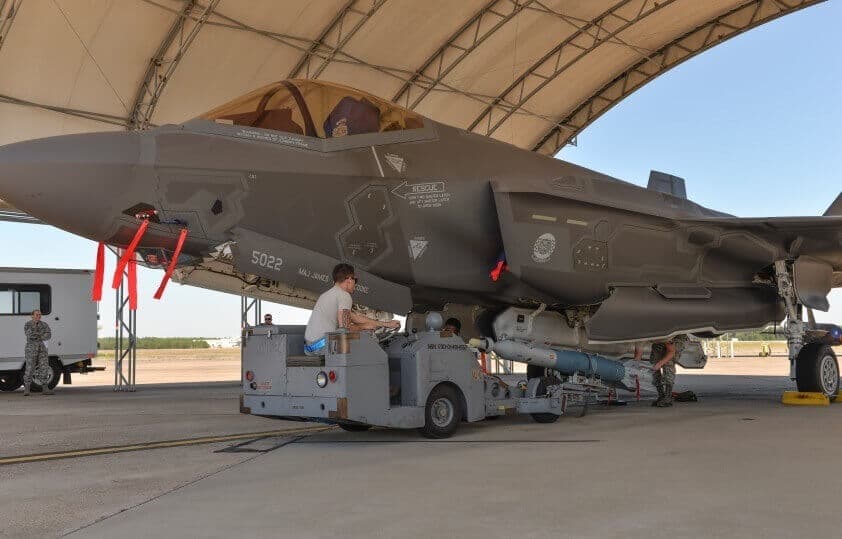
Loads and unloads nuclear and nonnuclear munitions, explosives, and propellant devices on aircraft. Manages, controls, maintains, and installs aircraft bomb, rocket, and missile release, launch, suspension, and monitor systems; guns and gun mounts; and related munitions handling, loading, and test equipment. Related DoD Occupational Subgroup: 164600.
Duties and responsibilities
- Loads, unloads, and positions munitions on aircraft. Loads, positions, performs safing operations, and unloads munitions. Uses handling, loading, and checkout procedures and equipment. Tests suspension, launch, and release systems for retentive locking, and manual or electrical release. Analyzes malfunctions. Performs functional checks of launch and suspension systems. Prepares munitions and inspects post loading weapons. Operates handling and loading equipment, and mates munitions with aircraft release, launch, and suspension systems. Loads and services aircraft gun systems. Tests electrical and electronic circuitry for continuity, voltage, and proper operation. Tests for unwanted electrical signal or power before connecting electrically actuated explosives and propellants. Installs ground safety devices on munition and gun system components to prevent inadvertent detonation, launching, or firing. Inserts and removes impulse cartridges associated with fuel tanks and pylons. Adjusts and installs fuses, boosters, and delay elements in conventional munitions.
- Inspects, repairs, and maintains aircraft release, launch, suspension, and monitor systems; aircraft guns; and related equipment. Operates, inspects, and performs operator maintenance on related munitions handling, loading, and test equipment. Examines for visual defects and proper installation of systems components such as munitions ejector racks, loading and suspension devices, shackles, rocket pods, pylons, aircraft ammunition, boosters, and feed chutes. Boresights and performs after-firing inspection of aircraft guns. Examines aircraft guns for defects. Analyzes malfunctions of munitions launch, release, suspension, and monitor systems, and associated handling and loading equipment. Disassembles, repairs, or replaces mechanical, electrical, electronic, and pneudraulic mechanisms of launch and release systems, and aircraft gun systems. Removes, disassembles, and inspects parts and subassemblies for damage, rust, corrosion, or acceptable clearances and tolerances. Makes adjustments and applies lubricants and preservatives. Performs serviceability tests on aircraft guns, gun systems, and munitions associated suspension equipment.
- Performs armament systems maintenance functions. Modifies munitions launch, release, suspension, and monitor systems to improve efficiency. Determines probable effect of modifications on future maintenance and operational problems.
- Plans, organizes, and directs aircraft armament systems maintenance activities. Establishes and evaluates performance and training standards, maintenance controls, and procedures. Checks methods and techniques used to load and unload munitions on aircraft, to repair and maintain aircraft release and gun systems, and to maintain, repair, and modify associated equipment. Ensures compliance with policies, directives, and safety procedures. Analyzes productivity and work quality. Evaluates operational efficiency of aircraft guns and munitions systems and recommends modification.
Specialty qualifications
Knowledge. Knowledge is mandatory of: electricity; principles of physics, mechanics, electronics, and ballistics applying to munitions launch, release, suspension, fusing, and arming systems, and aircraft gun systems; use of precision measuring tools and equipment; interpreting schematics and wiring diagrams; concepts and application of maintenance directives; nuclear and nonnuclear munitions loading and safety procedures; and proper handling, use, and disposal of hazardous waste and materials.
Education. For entry into this specialty, completion of high school or General Education Development equivalency is mandatory. Also, completion of courses in mechanics or basic electronics is desirable.
Training. The following training is mandatory for award of the AFSC indicated:
- AFSC 2W131X. Completion of a suffix specific basic aircraft armament systems course.
- AFSC 2W191. Completion of the Advanced Aircraft Armament Systems course J3AZR2W191 0A1A, PDS Code 08E (effective 31 March 2013). NOTE: Mandatory for Air Reserve Component (ARC).
Experience. The following experience is mandatory for award of the AFSC indicated:
- 2W151. Qualification in and possession of AFSC 2W131C/E/F/J/K/L/N/Q or Z. Also, experience loading and unloading munitions, or maintaining, repairing, and modifying munitions launch, release, suspension, or aircraft gun systems.
- 2W171. Qualification in and possession of AFSC 2W151. Also, experience performing or supervising functions such as loading and unloading munitions, or maintaining, repairing, and modifying munitions launch, release, suspension, or aircraft gun systems.
- 2W191. Qualification in and possession of AFSC 2W171. Also, experience managing and controlling functions such as loading and unloading munitions, or maintaining, repairing, and modifying munitions launch, release, suspension, or aircraft gun systems.
Other. The following are mandatory as indicated:
- See attachment 4 for additional entry requirements.
- For entry, award, and retention of these AFSCs:
- Must not have chronic mental health conditions.
- Normal depth perception as defined in AFI 48-123, Medical Examinations and Standards.
- Normal color vision as defined in AFI 48-123.
- No fear working around nuclear weapons or components, nor have an identifiable negative opinion of the role of nuclear weapons within our nation’s strategic deterrent mission.
- Retraining into the 2W1XX career field within the Air Force is restricted to the grades of E-7 and below with less than 15 years of total federal military service (Satisfactory service for ARC).
- Must maintain eligibility to deploy and mobilize worldwide. Of the three assignment limitation codes, C-1, C-2, and C-3, those coded C-1, or C-2 with approved waivers for PCS/Deployment are acceptable provided they can perform the core tasks the core tasks of AFSC 2W1X1.
- For award and retention of these AFSCs, must maintain local network access IAW AFI 17-130, Cybersecurity Program Management and AFMAN 17-1301, Computer Security.
- Specialty requires routine access to Tier 3 (T3) information, systems, or similar classified environments. For award and retention of AFSCs 2W1XX, completion of a current T3 Investigation required IAW DoDM 5200.02, AFMAN 16-1405, Air Force Personnel Security Program, is mandatory. Additionally, certain positions within combat-coded units (e.g. Wing Weapons Manager, Armament Flight Chief, Weapons Section Chief) and Headquarters Functional Staff require routine access to Tier 5 (T5) Top Secret/Sensitive Compartmented Information (TS/SCI) material. For these positions, completion of a current T5 Investigation in accordance with DoDM 5200.02, AFMAN 16-1405 is required. NOTE: Award of the entry level without a completed T3 Investigation is authorized provided an interim Secret security clearance has been granted according to DoDM 5200.02, AFMAN 16-1405.
Civilian career paths
Comparable civilian careers for this field pay roughly $37,560 to $121,220 per year (median salaries; varies by role and location):
- Administrative Services Managers: $98,890
- Aerospace Engineering and Operations Technologists and Technicians: $68,570
- Aircraft Cargo Handling Supervisors: $53,610
- Aircraft Mechanics and Service Technicians: $66,440
- Aircraft Structure, Surfaces, Rigging, and Systems Assemblers: $53,160
- Aviation Inspectors: $78,400
- Career/Technical Education Teachers, Postsecondary: $55,620
- Electrical and Electronic Engineering Technologists and Technicians: $67,550
- Electrical and Electronics Repairers, Commercial and Industrial Equipment: $62,010
- Electro-Mechanical and Mechatronics Technologists and Technicians: $59,800
- Equal Opportunity Representatives and Officers: $71,100
- Explosives Workers, Ordnance Handling Experts, and Blasters: $48,510
- Facilities Managers: $98,890
- First-Line Supervisors of Helpers, Laborers, and Material Movers, Hand: $54,870
- First-Line Supervisors of Material-Moving Machine and Vehicle Operators: $54,870
- First-Line Supervisors of Mechanics, Installers, and Repairers: $70,240
- First-Line Supervisors of Production and Operating Workers: $62,850
- General and Operations Managers: $103,650
- Hazardous Materials Removal Workers: $45,270
- Human Resources Managers: $121,220
- Industrial Production Managers: $108,790
- Industrial Truck and Tractor Operators: $37,560
- Maintenance and Repair Workers, General: $40,850
- Maintenance Workers, Machinery: $50,100
- Operating Engineers and Other Construction Equipment Operators: $49,770
- Security Management Specialists: $77,420
- Security Managers: $98,890
- Training and Development Managers: $115,640
- Training and Development Specialists: $62,700
- Transportation, Storage, and Distribution Managers: $96,390
ASVAB requirements
2W1X1 has 2 qualification paths — you only need to meet one:
Enter your scores in the AFSC explorer and this section will check each requirement for you.
Entry requirements
Medical profile (PULHES)ShowHide
PULHES scale: lower numbers mean a stricter medical standard. Tap a letter for what it measures.
Vision requirementsShowHide
Medical disqualifiersShowHide
These screened conditions disqualify a candidate for this AFSC:
Education prerequisitesShowHide
Security & backgroundShowHide
Where you could be stationed
Stateside (32)
- Barksdale, Louisiana
- Buckley, Colorado
- Cannon, New Mexico
- Creech, Nevada
- Dane Co Regional, Wisconsin
- Davis-Monthan, Arizona
- Dyess, Texas
- Edwards, California
- Eglin, Florida
- Ellsworth, South Dakota
- Fort Worth NAS Jr, Texas
- Hill, Utah
- Holloman, New Mexico
- Homestead, Florida
- Hurlburt Field, Florida
- JB Langley-Eustis, Virginia
- JBSA Randolph, Texas
- Kingsley, Oregon
- Kirtland, New Mexico
- Luke, Arizona
- March, California
- McEntire, South Carolina
- Minot, North Dakota
- Montgomery, Alabama
- Moody, Georgia
- Mountain Home, Idaho
- Nellis, Nevada
- Scott, Illinois
- Seymour Johnson, North Carolina
- Shaw, South Carolina
- Tyndall, Florida
- Whiteman, Missouri
Overseas (19)
- Andersen, Guam
- Aviano, Italy
- Buchel, Germany
- Eielson, Alaska
- Ghedi, Italy
- Gwangju, South Korea
- JB Elmendorf-Rich, Alaska
- JB Prl Hbr-Hickam, Hawaii
- Kadena, Japan
- Kleine Brogel, Belgium
- Kunsan, South Korea
- Lakenheath, United Kingdom
- Mildenhall, United Kingdom
- Misawa, Japan
- Osan AB, South Korea
- Ramstein, Germany
- Spangdahlem AB, Germany
- Volkel, Netherlands
- Yokota, Japan
Badges & identifiers
Duty badges
The occupational badges worn by Airmen in this career field.
- Maintenance Badge
- Missile Badge
Duty identifiers
Special duty patches and identifiers associated with this AFSC.
- WPNS Duty Identifier
Degrees & training plan
While serving in 2W1X1 you can earn an associate degree through the Community College of the Air Force:
- Aircraft Armament Systems Technology
- Career Field Education & Training Plan (CFETP)View CFETP (PDF, opens in a new tab)
The CFETP is the official Air Force document describing this career field's full training pipeline, from tech school through advanced skill levels.
2W1X1 specialties (shred-outs)
This career field splits into 9 specialties — you may be assigned to one of these:
- 2W1X1CA-10Has its own entry requirements
- 2W1X1EF-15Has its own entry requirements
- 2W1X1FF-16Has its own entry requirements
- 2W1X1JF-35Has its own entry requirements
- 2W1X1KB-52/B-2Has its own entry requirements
- 2W1X1LB-1Has its own entry requirements
- 2W1X1NF-22Has its own entry requirements
- 2W1X1QRPA (MQ-1/MQ-9)Has its own entry requirements
- 2W1X1ZAll OtherHas its own entry requirements
Shred-outs share the 2W1X1 career path; where a specialty sets its own minimums or screens, they're noted above.
Videos, Reddit & resources
2W1X1 videos(12)
These do not reflect official U.S. Air Force views and may contain inaccuracies — negative opinions are often overrepresented online.
Why I Joined the Air Force (2W1 WEAPONS!)
The Beasts’ Locker room · 12/17/2025
1 of 12 videos
Reddit discussions(10)
These do not reflect official U.S. Air Force views and may contain inaccuracies — negative opinions are often overrepresented online.
Official links & resources(1)
Researching other jobs too? Every career field's videos and discussions are collected the same way — browse all AFSCs.
Frequently asked questions
- What ASVAB score do you need for Aircraft Armament Systems (2W1X1)?
- 2W1X1 has 2 qualification paths — you only need to meet one: Mechanical 60+; or Electrical 45+.
- Where can Aircraft Armament Systems Airmen get stationed?
- 2W1X1 Airmen serve at 51 bases: 32 stateside and 19 overseas, including Andersen, Guam, Aviano, Italy, Buchel, Germany.
- Does 2W1X1 require a security clearance?
- Yes — Aircraft Armament Systems requires a Secret clearance.
- How long is tech school for Aircraft Armament Systems?
- Tech school for 2W1X1 runs about 45 days at Sheppard, Texas.
Where this data comes from
Most of the data on this page comes from the Air Force Enlisted Classification Directory (AFECD) and recruiter TTMS readouts, which are no longer released publicly. Pulling it together and keeping it accurate takes real time, so I update these pages as often as I can.
Requirements do change between updates. Before you make any decisions, confirm the details with your recruiter. They always have the latest word.