

Summary
Operates equipment to produce diagnostic images and assists radiologist or physician with special procedures. Prepares equipment and patients for diagnostic studies and therapeutic procedures.
Performs technical and administrative imaging activities. Ensures health protective measures such as standard and transmission-based precautions and radiation protection are established and employed.
Assists the radiation oncologist. Manages diagnostic imaging functions and activities.
Technical School
Days: 340
Locations: Fort Sam Houston, Texas
Other Names
Rad Tech, X-Ray Tech, Radiology
Bonus
4-Year Bonus: None
6-Year Bonus: $5,000
Badge

Medical Badge
Duty Identifier
None
Clearance
None
Open Aptitude Category
General
AFSC Entry Requirements
Demographics
Males: 474
Females: 400
Total: 874
Community College of the Air Force Degree
4R0X1 - Diagnostic Imaging
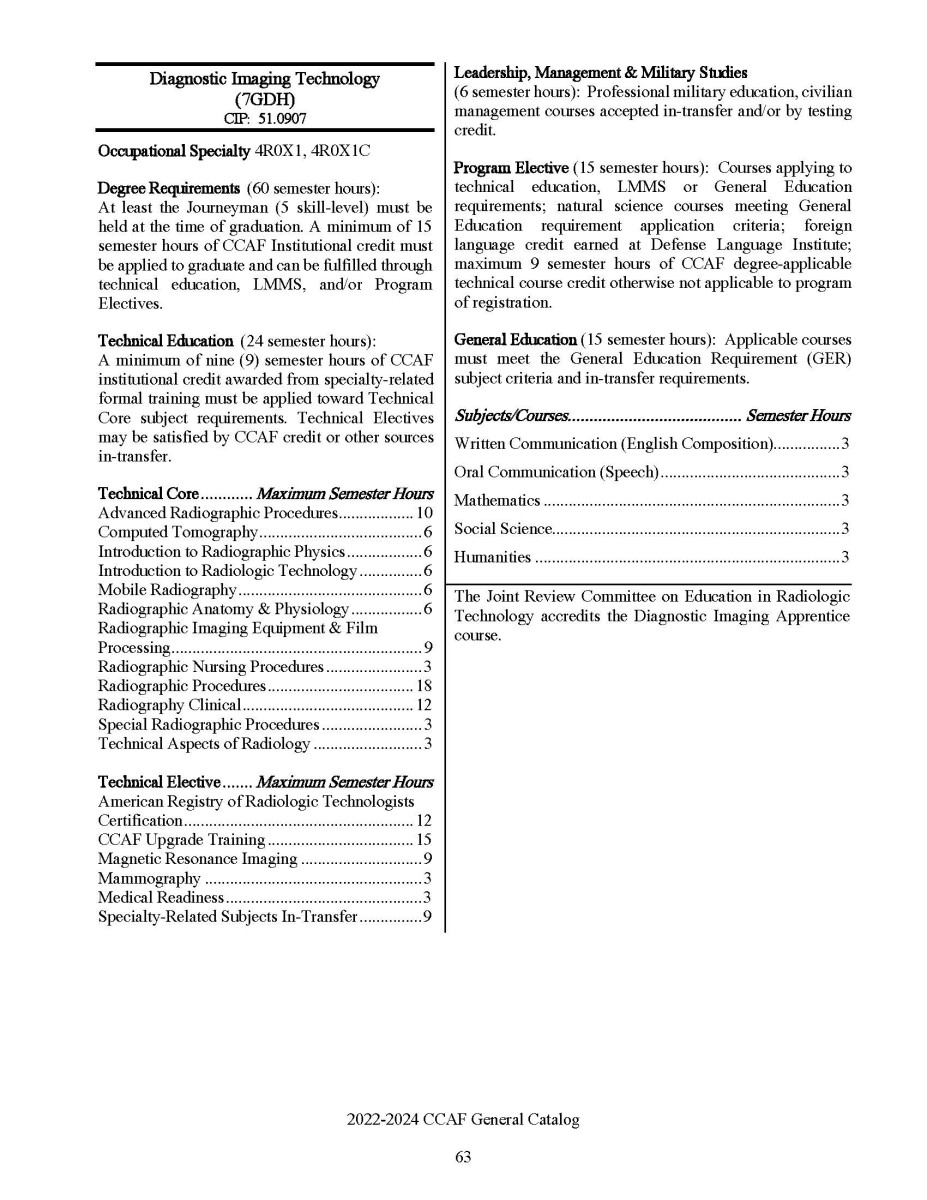
Diagnostic Imaging Technology
4R0X1A - Nuclear Medicine
Nuclear Medicine Technology
4R0X1B - Diagnostic Medical Sonography
Diagnostic Medical Sonography
4R0X1C - Magnetic Resonance Imaging
Diagnostic Imaging Technology
CCAF Degree Plan


AFSC YouTube Videos
AFSC Reddit Posts
Duties and Responsibilities
Operates fixed and portable radiographic equipment to produce routine diagnostic medical images. Computes techniques and adjusts control panel settings such as kilovoltage, milliamperage, exposure time, and focal spot size.
Positions patient to image desired anatomic structures. Selects image recording media, adjusts table or image receptor (cassette holder), aligns x-ray tube for correct distance and angle, and restricts radiation beam for maximum patient protection.
Exposes and processes images. Uses specialized equipment to perform nuclear medicine, mammography, sonography, computed tomography, and magnetic resonance imaging.
Selects imaging protocols and required accessories and makes adjustments based on the specific examination requirements. Records and processes the image. Manipulates the recorded image using computer applications.
Assists physicians with fluoroscopic, interventional, and special examinations. Instructs patients preparing for procedures. Prepares and assists with contrast media administration.
Maintains emergency response cart. Assists physician in treating reactions to contrast material. Prepares sterile supplies and equipment.
Operates accessory equipment such as automatic pressure injectors, and digital imagers, stereotactic biopsy devices, and vital signs monitoring equipment. Performs image subtraction and manipulation techniques.
Performs and supervises general diagnostic imaging activities. Cleans and inspects equipment and performs preventive maintenance.
Receives patients, schedules appointments, prepares and processes examination requests and related records, and processes images and reports. Enters and maintains data in picture archiving and communication system (PACS), radiology information systems (RIS) and hospital information system (HIS).
Assists with phase II didactic and performance training, evaluation and counseling of students, and maintenance of student academic records. Participates in formal research projects.
Establishes and maintains standards, guidelines, and practices. Composes protocols. Prepares routine positioning guides and technique charts.
Reviews images to ensure quality standards are met. Performs equipment quality control checks.
Monitors personnel to ensure protective procedures such as those in the As Low As Reasonably Achievable (ALARA) radiation safety, hazardous material communications, and Air Force occupational safety and health programs are followed.
Performs tests on radiation protection equipment. Assesses staff competence, and monitors appropriateness of care and completeness of examination requests.
Plans, organizes, and supervises diagnostic imaging activities. Analyzes workload and establishes production controls and performance standards for administrative and technical activities.
Coordinates on interdepartmental issues that interface with diagnostic imaging. Prepares and implements financial plan, and monitors and analyzes annual expenditures.
Prepares equipment purchase requests and justifications. Monitors equipment performance and preventive maintenance activities. Recommends new equipment procurement. Performs as the diagnostic imaging facility manger.
Specialty Qualifications
The following knowledge is mandatory for award of the AFSC indicated:
4R0X1/X1X:- Human anatomy and physiology.
- Medical terminology and ethics.
- Legal aspects of medicine.
- Healthcare accreditation standards.
- Radiation physics, biology, and protection.
- Basic electronics theory.
- Techniques of operating x-ray and specialized diagnostic imaging equipment.
- Radiographic positioning.
- Patient care and monitoring techniques.
- Image recording media and processing techniques.
- Quality control procedures.
- Aseptic and sterile techniques.
- Reactions to contrast media.
- Cardiopulmonary resuscitation.
- Methods of recording the fluoroscopic image.
- Patient and equipment safety budget preparation and execution.
- Medical records administration.
- Algebra.
- Nuclear physics.
- Clinical chemistry.
- Nuclear pharmacology.
- Nuclear Regulatory Commission regulations concerning use of radionuclides.
- Ultrasound physics.
- Techniques of operating specialized ultrasound components and equipment.
- Basic knowledge of vascular and abdominal anatomy (topical and cross-sectional), including normal variant anatomy, abnormal anatomy, and obstetric anatomy.
- Abnormal anatomy transducer characteristics, differences, and use.
- Magnetic physics, magnetism, magnetic safety, radio frequency, and magnetic physics.
- Techniques of operating MRI equipment.
- Advanced knowledge of cross-sectional anatomy applicable to MRI.
For entry into this specialty, completion of high school or general education development equivalency with successful completion of courses in algebra, and biology or general science are mandatory.
The following college course are required:
- English Composition I (3 credits). (AP exam English Composition (minimum score of 3) is accepted in place of English Composition I.)
- Speech (3 credits).
- Successful completion of high school or collegiate courses in chemistry and physics is desirable.
The following training is mandatory for award of the AFSC indicated:
- 4R031. Completion of Diagnostic Imaging Phase I and Phase II courses.
- 4R031A. Completion of the Nuclear Medicine Phase I and Phase II courses.
- 4R031B. Completion of a Diagnostic Medical Sonography Phase I and Phase II Courses.
- 4R031C. Completion of Magnetic Resonance Imaging Course.
The following experience is mandatory for award of the AFSC indicated:
- 4R051. Qualification in and possession of AFSC 4R031. Also, experience operating x-ray equipment, and producing and processing radiographs.
- 4R051A/B/C. Prior qualification in and possession of AFSC 4R031A/B/C respectively. Also, experience performing applicable shred (nuclear medicine, ultrasound, or magnetic resonance imaging) functions and activities.
- 4R071. Prior qualification in and possession of AFSC 4R051. Also, experience performing or supervising functions such as producing radiographs, assisting with fluoroscopy and special radiographic procedures.
- 4R071A/B/C. Prior qualification in and possession of AFSC 4R051A/B/C respectively. Also, experience performing or supervising nuclear medicine, ultrasound, or MRI functions and activities.
- 4R090. Prior qualification in and possession of AFSC 4R071, 4R071A, 4R071B, or 4R071C.
- Managing radiologic, nuclear medicine, ultrasound, or MRI functions and activities.
- Mandatory experience of medical service organization and function.
- Medical administrative procedures.
- Medical supply procedures.
- Medical equipment management procedures.
- Personnel management and administration.
- Nuclear Regulatory Commission regulations governing medical use of radioisotopes, applicable environmental protection standards.
- Management of non-military personnel.
- Applicable accreditation standards and inspection procedures.
- Preparation and execution of budgets.
The following are mandatory as indicated:
For entry into this specialty:
- A minimum age of 18 years prior to entry into technical training.
- For entry into 4R0X1A/B or C, prior qualification in and possession of AFSC 4R051/71.
- For award and retention of these AFSCs, must maintain local network access IAW AFI 17-130, Cybersecurity Program Management and AFMAN 17-1301, Computer Security.
Civilian Career Options
High Salary: $208,000
Low Salary: $35,850
- Cardiovascular Technologists and Technicians: $59,100
- Diagnostic Medical Sonographers: $75,920
- Endoscopy Technicians: $39,530
- Magnetic Resonance Imaging Technologists: $74,690
- Medical Assistants: $35,850
- Medical Dosimetrists: $44,090
- Nuclear Medicine Technologists: $79,590
- Radiation Therapists: $86,850
- Radiologic Technologists and Technicians: $61,900
- Radiologists: $208,000
***This information was retrieved from Veterans Job Matcher at CareerOneStop (www.careeronestop.org), sponsored by the U.S. Department of Labor, Employment and Training Administration.
Shreadouts
- 4R0X1A - Nuclear Medicine
- 4R0X1B - Diagnostic Medical Sonography
- 4R0X1C - Magnetic Resonance Imaging