

Summary
Supports mental health services in psychiatry, psychology, social work, family advocacy, substance abuse education, prevention, treatment, and aftercare, integrated operational support, and other mental health programs. Manages mental health service resources and activities.
Develops and/or implements appropriate treatment plans in agreement/coordination with patients and supervising providers. Performs specified mental health counseling. Reports and documents patient care.
Technical School
Days: 66
Locations: Fort Sam Houston, Texas
Other Names
None
Bonus
4-Year Bonus: None
6-Year Bonus: $5,000
Badge

Medical Badge
Duty Identifier
None
Clearance
None
Open Aptitude Category
Administrative
AFSC Entry Requirements
Demographics
Males: 410
Females: 409
Total: 819
Community College of the Air Force Degree
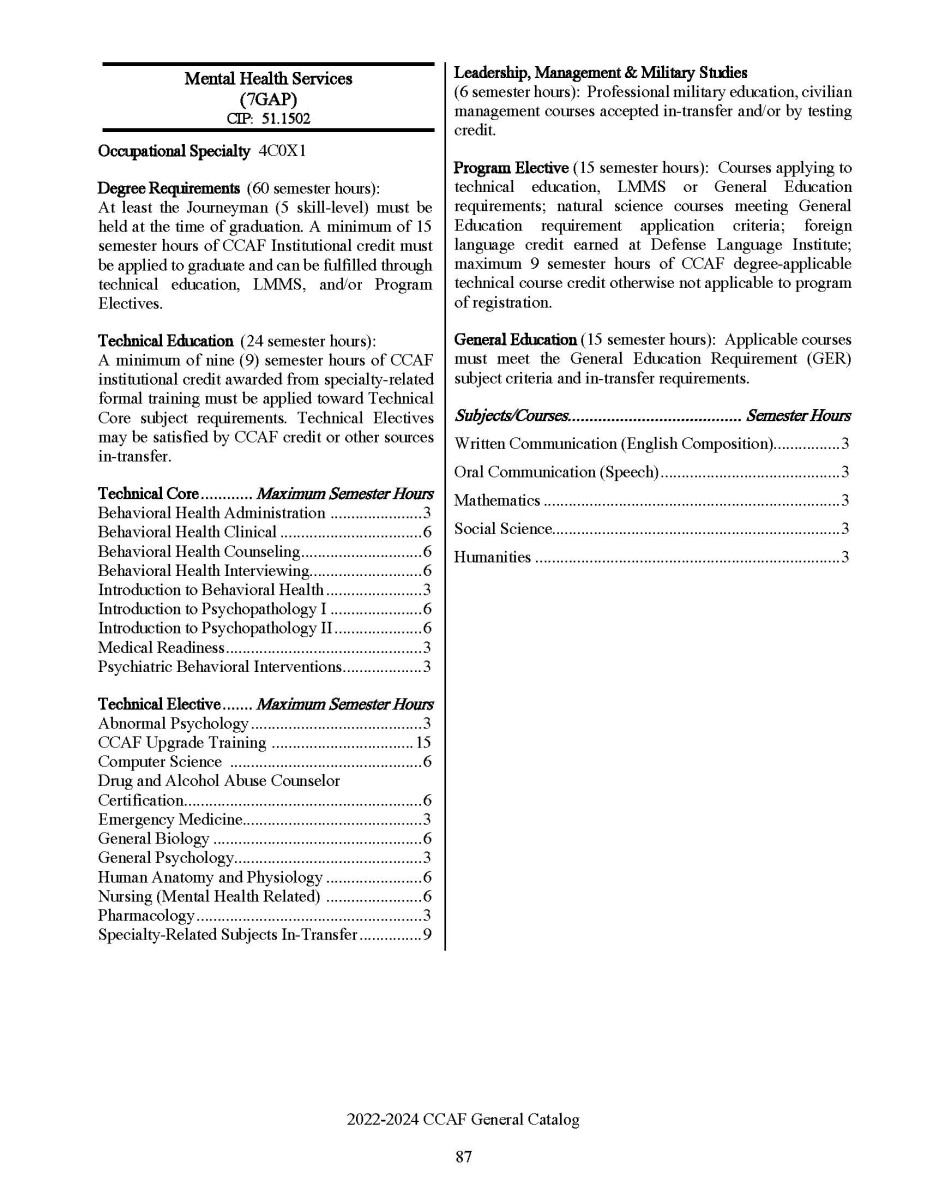
Mental Health Services
CCAF Degree Plan
AFSC YouTube Videos
AFSC Reddit Posts
Duties and Responsibilities
- Triage.
- Evaluating psychological, physiological, and social signs/symptoms.
- Mental status examinations.
- Obtaining and recording vital signs.
Performs assessment procedures, which include:
Clinical interviewing to gather biopsychosocial, mental health, and substance abuse histories.
Administering standardized psychological testing.
Using appropriate assessment tools to assist in identifying mental health and nursing diagnoses. Identifying patients’ strengths, needs, abilities and problems.
Performs patient counseling by utilizing trained skills to assist individuals, families, and groups in achieving treatment goals through:
- Exploration of problems.
- Maintaining therapeutic relationships.
- Examining attitudes and affective responses.
- Providing alternative solutions.
- Assisting in decision-making/disposition planning.
- Establishing and executing the treatment plan under the guidance/supervision of a Licensed/privileged provider.
- Coordinating and participating in treatment team meetings.
- Communicating high interest status and updates.
- Duty limitations.
- Providing safety recommendations to commanders and primary care providers.
- Coordinating patient’s mental health transition services.
Provides mental health and substance abuse outreach, prevention, and education. Identifies patient needs that can’t be met by the counselor or program and refers the patient to the appropriate support system.
Assists in, or arranges patient referral to public, private, and military community agencies. Documents the assessment results, treatment plans, reports, progress notes, discharge summaries and other patient care information.
Consults with other professionals and subject matter experts to assure comprehensive quality care for the patient. Contacts military and community agencies to obtain collateral information.
Utilizes their skills, expertise, and insight into emotional, behavioral, and social functioning to assist with improving health and human performance. Consults with unit leaders and unit members on topics relevant to adapting and responding to the unique operational and combat related challenges of their unit.
Employs primary and secondary prevention tactics to mitigate occupational and operational stressors, enhance resilience, prevent injury/illness, and facilitate access to the healthcare system when needed. Performs aeromedical evacuation procedures when needed.
Plans and supervises mental health service activities. Coordinates with appropriate agencies regarding specified care, treatment, prevention, rehabilitation, and administrative functions. Ensures staff provide for safe, ethical, and reliable patient care. Performs clinical supervision on subordinates in relation to their skill level.
Manages enlisted resources. Establishes priorities based on knowledge of interchangeable skills among assigned enlisted personnel.
Reviews procedures and requirements within specialty services to preclude duplication and to free personnel for more direct service work with patients. Defines requirements and utilizes emerging knowledge, research, and technology.
Integrates quality communications, fosters partnerships, ensures flexible and adaptive resourcing, optimizes force management and development, and empowers continuous process improvement. Establishes, maintains, and evaluates specific mental health, family advocacy, and substance abuse training programs.
Conducts in-service and readiness trainings. Schedules recurring training and conducts task evaluations. Ensures appropriate continuing education and clinical supervision requirements are met.
Performs Disaster Mental Health (DMH) and Combat and Operational Stress Control (COSC) activities. Provides psychological first aid to individuals and groups who may have had direct exposure to an all-hazard incident.
Prevents and manages battle related stress before, during, and after deployments. Supervises and assists with care of individuals experiencing acute and post-traumatic
stress reactions.
Supervises and performs administrative duties. Monitors preparation, maintenance, and disposition of mental health, family advocacy, and substance abuse electronic and paper copy treatment records.
Receives patients and schedules appointment. Evaluates and effectively manages mental health service activities.
Collects and updates administrative and statistical data. Conducts unit self- assessments.
Conducts 4C0X1 peer review processes. Compiles and prepares medical and administrative reports. Briefs patients on safety and evacuation procedures.
Specialty Qualifications
Knowledge is mandatory of:
- Psychiatry, psychology, social work, family advocacy, and nursing principles, procedures and theories.
- Confidentiality and legal aspects of patient care.
- Understanding of medical, nursing, and mental health terminology.
- Psychopathology.
- Adjustment mechanisms.
- Substance abuse pathology.
- Twelve Core Functions/Four Performance Domains for substance abuse counselor certification.
- Combat and disaster casualty care management.
- Communication processes.
- DMH, specialized mental health and nursing treatment techniques.
- Anatomy and physiology.
- Deviant and unacceptable behavior.
- Principles of interpersonal relationships.
- Counseling and interviewing techniques.
- Diagnostic nomenclature.
- Psychopharmacology.
- Administration and scoring of psychological tests.
- Medical and mental health ethics.
- Medical and clinical records administration.
- Principles of milieu therapy.
- Personnel, unit and clinic management.
- Budgeting and acquisition of supplies and equipment.
For entry into this specialty, completion of high school is mandatory. Completion of college courses in psychology, social or behavioral sciences such as psychology, counseling, substance abuse treatment, sociology, and marriage and family is desirable.
Training-
For award of AFSC 4C031, completion of the mental health service apprentice course is mandatory.
Experience-
The following experience is mandatory for award of the AFSC indicated:
- 4C051. Qualification in and possession of AFSC 4C031. A minimum of 9 months experience. Also, experience administering, scoring, and reporting psychological test results; interviewing patients to obtain biopsychosocial history, personal information; experience conducting briefings, and assisting professional staff to carry out prescribed treatment plan. Achievement of competency in all required tasks.
- 4C071. Qualification in and possession of AFSC 4C051. Also, experience supervising mental health service activities. Advanced experience interviewing patients, assisting in patient treatment, conducting mental health and substance abuse prevention and counseling.
- Completion of 6,000 hours of patient care within the 12 Core Functions/4 Performance Domains. Certified Alcohol and Drug Counselor (CADC) certification (SEI 475) is required for upgrade to 7-level.
- 4C091. Qualification in and possession of AFSC 4C071. Also, experience managing mental health service activities. CADC certification (SEI 475) is required for upgrade to 9-level. Note: AFRC and ANG members are not required to obtain their CADC certification. AFRC and ANG members are required to obtain and maintain appropriate certification such as the Mental Health Technician Certification or similar national/state certification.
The following are mandatory as indicated:
For entry into this specialty:
- Must complete the Minnesota Multiphasic Personality Inventory (MMPI) assessment.
- Must undergo a standardized entry interview with a career field manager approved 4C0X1 or any credentialed/privileged Mental Health provider.
- No history of psychiatric hospitalization.
- No evidence of emotional instability, impulsive behaviors or misconduct that is contrary to the standards of the mental health and substance abuse counseling profession (Including, but not limited to: alcohol/drug misuse, binge eating, intentional self-injury, antagonism, apathy, difficulty controlling/intense anger or sadness, etc.).
- No history or evidence of personality disorder, substance use disorder, or other significant disorders incompatible with the mental health or substance abuse profession.
- No evidence or history of civilian conviction, Letter of Reprimand, Article 15, or courts martial conviction as a result of illicit drug or alcohol use, driving under the influence/impaired, financial irresponsibility, promiscuity, physical or sexual assault or misconduct, or domestic violence.
- No evidence or history of disruptive conduct, behavior, attitude, or communication resulting in civilian conviction, Letter of Reprimand, Article 15, or courts martial conviction as a result of prejudice, discrimination, harassment, threats, or reprisal.
- No presence of speech impediment—must possess the ability to read aloud and speak distinctly.
- No unresolved mental health problems (Including, but not limited to: failure to engage in help-seeking behaviors, chronic mental health disorders, a pattern of relapse in symptoms/illness, unwillingness, or inability to overcome mental health disorder, or prolonged absence from one’s mental health duties due to risk associated to patients, self, or staff).
- No record of psychiatric hospitalization as a result of serious attempts at self-harm, threats to self or others, or self-mutilating behaviors.
- No evidence of emotional instability, impulsive behaviors or misconduct that is contrary to the standards of the mental health and substance abuse counseling profession (Including, but not limited to: a pattern of alcohol misuse, drug misuse, binge eating, intentional self-injury, antagonism, apathy, difficulty controlling/intense anger or sadness, etc.).
- No history or evidence of personality disorder or other significant disorders incompatible with the mental health or substance abuse profession.
- No evidence or history of civilian conviction, Article 15, or courts martial conviction as a result of illicit drug use; physical or sexual assault or misconduct; driving under the influence/impaired; or a pattern of--alcohol misuse, financial irresponsibility, promiscuity, or domestic violence.
- No evidence or history of disruptive conduct, behavior, attitude, or communication resulting in civilian, Article 15, or courts martial conviction as a result of prejudice, discrimination, harassment, threats, or reprisal. No history of a pattern of prejudice, discrimination, harassment, threats, or reprisal.
- No record of ethical misconduct (Including but not limited to: dual relationships, falsifying records, knowingly making incorrect health record entries, or HIPAA violations) that result in Article 15 or courts martial conviction. No history of a pattern of ethical misconduct.
- For Certified Alcohol and Drug Abuse Counselors (CADCs), no record of ethical misconduct or violations of AFI 44-119 or DHAPM 6025.13 resulting in revocation of CADC certification as determined by the Air Force Substance Abuse Counselor Certification Board.
- Must maintain local network access IAW AFI 17-130, Cybersecurity Program Management AFMAN 17-1301, Computer Security (COMPUSECC).
- Must obtain and maintain a secret or higher security clearance IAW DoDM 5200.02_AFMAN 16-1405, Air Force Personnel Security Program.
Civilian Career Options
High Salary: $208,000
Low Salary: $31,570
- Advanced Practice Psychiatric Nurses: $75,330
- Art Therapists: $57,310
- Child, Family, and School Social Workers: $48,430
- Clinical and Counseling Psychologists: $79,820
- Healthcare Social Workers: $57,630
- Marriage and Family Therapists: $51,340
- Mental Health and Substance Abuse Social Workers: $48,720
- Mental Health Counselors: $47,660
- Music Therapists: $57,310
- Probation Officers and Correctional Treatment Specialists: $55,690
- Psychiatric Aides: $31,570
- Psychiatric Technicians: $35,030
- Psychiatrists: $208,000
- Rehabilitation Counselors: $37,530
- Social and Human Service Assistants: $35,960
- Substance Abuse and Behavioral Disorder Counselors: $47,660
***This information was retrieved from Veterans Job Matcher at CareerOneStop (www.careeronestop.org), sponsored by the U.S. Department of Labor, Employment and Training Administration.
Shreadouts
None