

Summary
Performs explosive ordnance disposal (EOD) operations to protect personnel, resources, and the environment from the effects of hazardous explosive ordnance (EO), improvised explosive devices (IED) and weapons of mass destruction (WMD) which may include; incendiary, chemical, biological, radiological, and nuclear (CBRN) hazards.
Employs specialized tools, techniques, and personal protective equipment to detect/identify EOD objectives and to accomplish diagnostics, monitoring, evaluation, interrogation, mitigation, render safe, recovery, and disposal operations on ordnance/devices delivered, placed, or made dangerous by accident/incident or other circumstance.
Utilizes and maintains advanced equipment, such as, robotics, x-ray, landmine and CBRN detection equipment.
Transports demolition explosives and equipment to authorized disposal areas, fabricates explosive demolition charges, and disposes of hazardous devices, ordnance, and explosives.
EOD may be employed alone or as part of an AF, Joint, Interagency, or Coalition force, to support Combatant Commander and/or Air Force objectives.
Provides rapid response capability and operates in five geographic disciplines: mountain, desert, arctic, urban and jungle, day, or night, to include austere combat environments independent of an established airbase or its perimeter defenses in mounted, dismounted, and limited airborne/aerial insertion operations.
EOD at the five, seven, and nine level plan, organize, and direct EOD operations.
Technical School
Days: 169
Locations: Eglin, Florida, Sheppard, Texas
Other Names
EOD, Bomb Squad, Bomb Disposal
Bonus
4-Year Bonus: None
6-Year Bonus: $20,000
Badge

Medical Badge
Duty Identifier

EOD Duty Identifier
Clearance
None
Open Aptitude Category
None
AFSC Entry Requirements
Demographics
Males: 1208
Females: 39
Total: 1247
Community College of the Air Force Degree
Explosive Ordinance Disposal
CCAF Degree Plan
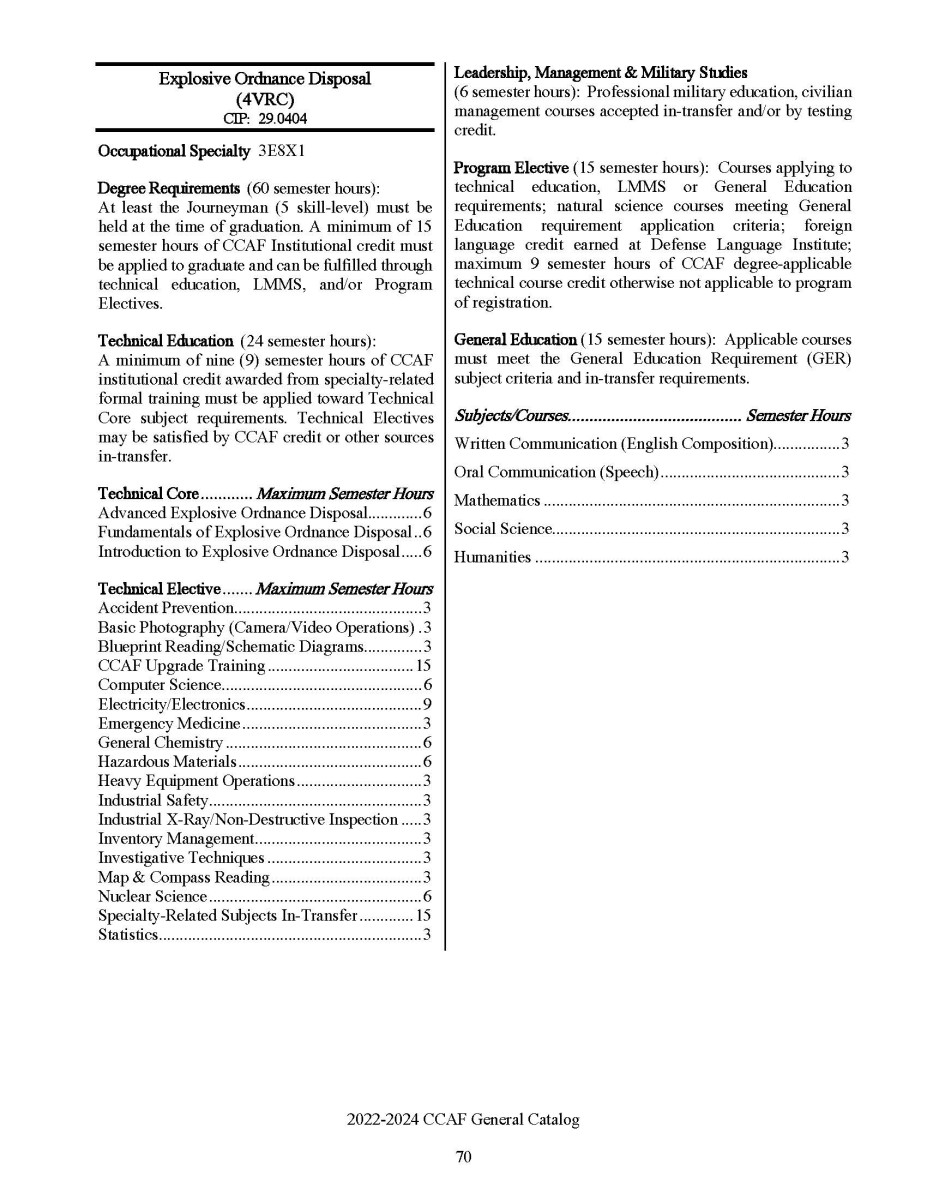
AFSC YouTube Videos
AFSC Reddit Posts
Duties and Responsibilities
Translates commander’s objectives/mission taskings into effective employment of EOD capability. Uses advanced technological and manual methods to perform long range/close-in reconnaissance, identification, assessment of ordnance/hazardous device conditions and filler materials, then advises commanders on recommended EOD actions and safe withdrawal distances.
- Recover/destroy weapon caches.
- Perform immediate actions to defeat.
- Emplaced IEDs.
- Conduct post-blast analysis of IED events.
- Provides military authorities with technical intelligence, analysis, and exploitation.
- Provide key insights to enable development of CIED tactics, techniques, and procedures to mitigate IED effectiveness.
Specialty Qualifications
Knowledge in:
- EOD flight organization.
- Applied principles of electronics, physics, chemistry and mechanics.
- Peacetime-wartime accident/incident response procedures.
- Operational principles for specialized EOD tools, equipment and personal protective equipment.
- Explosive and demolition procedures.
- Access and recovery operations.
- Explosive ordnance reconnaissance and assessment.
- Weapons technical intelligence.
- Post blast analysis.
- Protection of personnel and property.
- Render safe techniques.
- Dynamic charges and explosive entry tools.
- Range clearance operations.
- Proficiency, training and demolition range management.
- Treatment of explosives and related hazardous materials.
- Identification, safety precautions, render safe, and disposal fundamentals for U.S. and foreign munitions/aerospace systems.
- Identification, response planning, tactical considerations, render safe and disposal fundamentals for improvised explosive devices and homemade explosives.
- Procedural fundamentals for weapons of mass destruction response.
- Equipment and procedures for chemical/biological warfare and nuclear weapons.
- Airbase recovery operations.
- Deployment procedures.
- Movement by aircraft.
- Small arms and crew served weaponry.
- Joint service and special force support requirements.
- Combat operations.
For entry into this specialty, completion of high school or general educational development equivalency is mandatory. Courses in physics, mechanics, and basic electronic theory are desirable.
For AD and ANG personnel, completion of AFIT WMGT 570, Civil Engineer Superintendent Course is highly recommended.
For AFRC personnel refer to AFRCI 10-210, Air Force Reserve Command Prime Base Engineer Emergency Force (BEEF) Management, dated 14 Jan 14, para. 3.3 regarding completion of AFIT WMGT 570 course.
NOTE: For AD, ANG and AFRC personnel, this is not a skill level awarding course.
Training-
The following training is mandatory for award of the AFSC indicated:
- 3E831. Completion of the Explosive Ordnance Disposal apprentice course.
- 3E871. Completion of the Explosive Ordnance Disposal craftsman course.
- 3E891. Completion of the AFIT WMGT 570 Civil Engineer Superintendent Course is required for Active Duty. For ANG personnel, completion of AFIT WGMT 570, Civil Engineer Superintendent Course is highly recommended. For AFRC personnel refer to AFRCI 10-210, Air Reserve Command Prime Base Engineer Emergency Force (BEEF) Management, dated 14 Jan 14, para. regarding completion of AFIR WGMT 570 course.
Experience-
The following experience is mandatory for award of the AFSC indicated:
- 3E851. Qualification in and possession of AFSC 3E831. Also, experience operating EOD tools/equipment, executing aerospace system response, rendering safe munitions, removing, and treating hazardous unexploded ordnance or decontaminating activities.
- 3E871. Qualification in and possession of AFSC 3E851. Also, experience performing or supervising EOD functions and operations, such as, preparing operational orders/plans, training/organizing/equipping personnel, and conducting response activities.
- 3E891. Qualification in and possession of AFSC 3E871. Also, experience managing EOD functions or operations, such as, evaluating, planning, organizing and leading EOD activities in the fulfillment of the broad scope of EOD duties and responsibilities.
- Minimum height of 5’0”.
- Maximum height 6’6”.
- No record of Claustrophobia (fear of confined spaces).
- Minimum score of 54 required on EOD Predictive Selection Model composed of ASVAB subtests and Tailored Adaptive Personality Assessment System (TAPAS) facets.
- Must meet eligibility requirements IAW AFMAN 32-3001, Explosive Ordnance Disposal (EOD) Program, Attachment 6, Figure A6.1., New Accession Volunteer Letter.
- Must pass two components of the EOD Physical Ability and Stamina Test (PAST); the run 1.5 Miles in under 11 mins and pull-up (3 pull-ups in under 2 minutes).
- Candidates must complete the retraining volunteer letter found in AFMAN 32-3001.
- Must be eligible to obtain a valid state driver’s license to operate government motor vehicles (GMV) in accordance with AFI 24-301, Vehicle Operations.
- Passing color vision, as defined by correctly identifying at least 10 of 14 Ishihara Plates.
- Must maintain local network access IAW AFI 17-130, Cybersecurity Program Management and AFMAN 17-1301, Computer Security.
- Specialty requires an adjudicated Tier 3 (T3) clearance, with an initiated Tier 5 (T5) prior to attending Naval School Explosive Ordnance Disposal (NAVSCOLEOD). The T5 security clearance shall not be initiated until the T3 clearance is adjudicated. The T5 clearance is required due to training, assignments involving nuclear weapons, and United Stated Secret Service / Department of State Support.
- Minimum height of 5’0”.
- Maximum height 6’6”.
- No record of Claustrophobia (fear of confined spaces).
- Minimum score of 54 required on EOD Predictive Selection Model composed of ASVAB subtests and Tailored Adaptive Personality Assessment System (TAPAS) facets.
- Must meet eligibility requirements IAW AFMAN 32-3001, Explosive Ordnance Disposal (EOD) Program, Attachment 6, Figure A6.1., New Accession Volunteer Letter.
- Must pass two components of the EOD Physical Ability and Stamina Test (PAST); the run 1.5 Miles in under 11 mins and pull-up (3 pull-ups in under 2 minutes).
- Recommendation for AFSC entrance by the nearest EOD Flight Commander, Flight Chief, or ranking NCO IAW AFMAN 32-3001. EOD Air Force Career Field Manager approval is mandatory.
- Must be eligible to obtain a valid state driver’s license to operate government motor vehicles (GMV) in accordance with AFI 24-301, Vehicle Operations.
- Passing color vision, as defined by correctly identifying at least 10 of 14 Ishihara Plates.
- Must maintain local network access IAW AFI 17-130, Cybersecurity Program Management and AFMAN 17-1301, Computer Security.
- Specialty requires an adjudicated Tier 3 (T3) clearance, with an initiated Tier 5 (T5) prior to attending Naval School Explosive Ordnance Disposal (NAVSCOLEOD). The T5 security clearance shall not be initiated until the T3 clearance is adjudicated. The T5 clearance is required due to training, assignments involving nuclear weapons, and United Stated Secret Service / Department of State Support.
- Minimum height of 5’0”.
- Maximum height 6’6”.
- No record of Claustrophobia (fear of confined spaces).
- Minimum score of 54 required on EOD Predictive Selection Model composed of ASVAB subtests and Tailored Adaptive Personality Assessment System (TAPAS) facets.
- Must meet eligibility requirements IAW AFMAN 32-3001, Explosive Ordnance Disposal (EOD) Program, Attachment 6, Figure A6.1., New Accession Volunteer Letter.
- Must pass two components of the EOD Physical Ability and Stamina Test (PAST); the run 1.5 Miles in under 11 mins and pull-up (3 pull-ups in under 2 minutes).
- Candidates must complete the retraining volunteer letter found in AFMAN 32-3001.
- Must complete an EOD flight orientation visit with an operational Air Force EOD flight as prescribed in AFMAN 32-3001. If one is not located on station, the applicant's unit may fund a temporary duty to the nearest Air Force Base with an operational AF EOD Flight to complete the EOD orientation. The visit consists of up to 10 operational duty days to complete the EOD Orientation Checklist Retraining Checklist. Completed checklist, signed by the unit, should be sent to the supporting Force Support Squadron to initiate a Case Management System case to forward the information to HQ AFPC or HQ ARPC.
- Must be eligible to obtain a valid state driver’s license to operate government motor vehicles (GMV) in accordance with AFI 24-301, Vehicle Operations.
- Passing color vision, as defined by correctly identifying at least 10 of 14 Ishihara Plates.
- Must maintain local network access IAW AFI 17-130, Cybersecurity Program Management and AFMAN 17-1301, Computer Security.
- Specialty requires an adjudicated Tier 3 (T3) clearance, with an initiated Tier 5 (T5) prior to attending Naval School Explosive Ordnance Disposal (NAVSCOLEOD). The T5 security clearance shall not be initiated until the T3 clearance is adjudicated. The T5 clearance is required due to training, assignments involving nuclear weapons, and United Stated Secret Service / Department of State Support.
Note 2: The EOD flight orientation visit does not apply to AFRC personnel.
Civilian Career Options
High Salary: $115,640
Low Salary: $45,270
- Detectives and Criminal Investigators: $86,940
- Emergency Management Directors: $76,250
- Explosives Workers, Ordnance Handling Experts, and Blasters: $48,510
- Hazardous Materials Removal Workers: $45,270
- Occupational Health and Safety Specialists: $76,340
- Occupational Health and Safety Technicians: $53,340
- Training and Development Manager: $115,640
- Training and Development Specialists: $62,700
***This information was retrieved from Veterans Job Matcher at CareerOneStop (www.careeronestop.org), sponsored by the U.S. Department of Labor, Employment and Training Administration.
Shreadouts
None