

Summary
Manages physiological functions and activities. Performs in-flight duties as a Non-Career Enlisted Aviator (non-CEA). Performs aircrew functions and other mission specific qualification in-flight duties to include the airdrop of personnel and equipment/cargo.
Operates and monitors aircrew breathing and personnel oxygen systems. Develops a thorough understanding of Human Factors principles and fundamentals, analytic methods and techniques, performance processes, system design, sensation and perception, and cognitive psychology.
Operates and maintains aerospace physiology training devices included but not limited to altitude chambers, spatial disorientation trainers, reduced oxygen breathing devices (ROBD), centrifuge, unaided night vision trainers, Hypoxia Familiarization Trainers, and Parachute Operations Hypoxia Familiarization Trainers.
Instructs and observes personnel for physiological symptoms on simulated flights to altitude.
Instructs in a classroom and manages Aerospace Physiology assets. Trains aviators and parachutists in subjects related to physiology, to human factors, and aviation safety.
Other areas of responsibility include personal parachute program participation, Aerospace Physiology team training, High Altitude Intelligence Reconnaissance and Surveillance (HAISR) support program, and fighter aircrew acceleration training.
The hazards of high altitude and the dynamic mission and training environment demand a high degree of attention, focus, professionalism, knowledge, skill, discipline, coordination, and stress management to carry out related duties successfully and safely.
Technical School
Days: Varies
Other Names
Boom Operator
Bonus
4-Year Bonus: None
6-Year Bonus: $5,000
Badge

Operations Support Badge
Duty Identifier

PHYS Duty Identifier
Clearance
Confidential/Secret
Open Aptitude Category
General
AFSC Entry Requirements
Demographics
Unknown
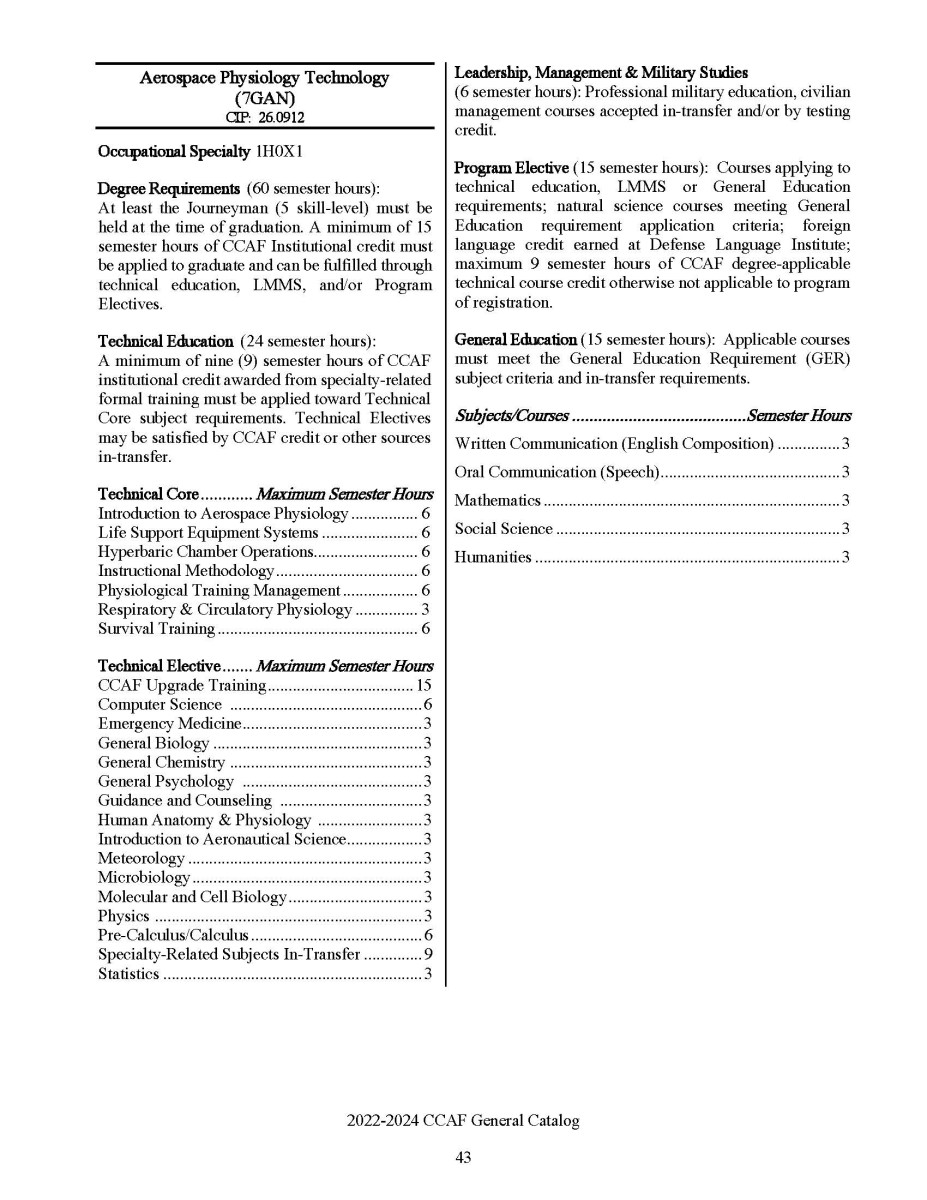
Community College of the Air Force Degree
Aerospace Physiology Technology
CCAF Degree Plan
AFSC YouTube Videos
AFSC Reddit Posts
Duties and Responsibilities
- Conducts classroom, practical, and operational training.
- Plans, organizes, directs, and conducts Aerospace Physiology training functions.
- Determines training schedules according to course control documents, directives, policies, and instructional principles.
- Uses lecture, demonstration and performance, guided discussion, case study, and time and circumstance instructional methodology.
- Provides instruction on the following subjects: Introduction to human factors in aviation, physiological effects of altitude, performance threats, physiology considerations of aircrew breathing systems, cabin pressurization and decompression, pressure breathing, vision, and unaided night vision, spatial disorientation, noise and vibration, principles of Crew Resource Management, attention management threats to Situational Awareness, acceleration, physiological considerations of aircraft egress, Barany chair, altitude chamber, and ROBD lecture.
- Instructs students in use of oxygen masks, full-pressure suits, antigravity suites, flight clothing, emergency and portable oxygen systems, night-vision goggles, and other high altitude protection equipment.
- Instructs and supervises students in fitting, adjusting, and maintaining breathing systems and other personal equipment, and use of oxygen regulators, and crew worn equipment.
- Conducts lectures, discussions, and demonstrations to indoctrinate flying, parachuting and non-flying warfighters on physical and physiological stresses and human performance implications of military aviation, and worldwide deployment environments.
- Administers tests on physiology topics covered in lectures and trainer indoctrination.
- Emphasizes the application of human factors principles with real-world scenarios and environments.
- Develops and implements programs designed to enhance safety, mission effectiveness, and provide just-in-time training to aircrew and support personnel on human performance/human factors issues.
- Discusses physiological factors involved in acceleration, exposure to thermal burden, pressurized cabins and rapid decompression, high altitude escape, vision, theory of operation for night vision devices, sensory illusions, and various in-flight oxygen emergencies.
- Establishes, supervises, and directs AP non-CEA training program.
- Evaluates non-CEA activities ensuring compliance with technical manuals, regulations, and work standards.
- Serves on or directs flight inspection teams to evaluate in-flight duties and operational programs.
- Plans, organizes, and coordinates flight activities with flying organizations.
- Directs standardization of physiological duties and ensures conformance with prescribed aircrew procedures.
- Inspects and evaluates in-flight Aerospace Physiology activities.
- Interprets and discusses evaluation findings and recommends action to correct deficiencies.
- Advises organizational commander or staff agencies on status of physiological activities and adequacy of equipment.
- Maintains universal aircraft qualification.
- Observe, evaluate, and assist with the unique physiological demands of the MWS.
- Observe, evaluate, and assist with human factors/human performance challenges within the MWS and/or mission set.
- Observe, evaluate, and assist with aircrew breathing systems and aircrew/MWS interface.
- Provide Operational Safety, Suitability, and Effectiveness (OSS&E) lessons learned to existing aircrew training platforms and human systems integration.
- Routinely accesses classified material in performance of duties.
- Individuals selected for the AP career field, inherently volunteer to enter qualification training to perform in-flight duties in an aircraft as non-rated aircrew members.
- Conducts cargo and personnel airdrops according to directives.
- Operates aircrew and parachutist breathing systems.
- Monitors and treats aircrew and parachutists of signs and symptoms of physiological impairment.
- Deploys and supports alerts in support of worldwide HAAMS requirements.
- Applies a thorough understanding of the physiological factors associated with high altitude airdrop operations.
- Applies a thorough understanding of the physical and physiological problems associated with a pressure suit including thermal 78 stress, body water balance, impaired circulation, fatigue, cramps, and general discomfort.
- Applies a thorough understanding of the role of the pressure suit to provide protection against the vacuum of space, as well as heat, cold, and possible radiation exposure 81.
- Operating self-regenerating oxygen supply capable of providing the pilot with a pressure suit seal and allowing for the removal of nitrogen in the human body to decrease the prevalence of Decompression Sickness 83.
- Fits, inspects, operates, and maintains full pressure suits, and associated equipment and support associated flight operations.
- Deploys and supports alerts in support of world-wide ISR requirements.
- Performs and assists in mishap investigations, prepares reports, and maintains records.
- Gathers and analyzes mishap data, identifies causes, recommends corrective actions, and develop training to prevent future mishaps.
- Performs/assists as human factors consultant for flight, occupational, weapon, and space mishap boards.
- Interacts with flight medicine, wing safety and other base agencies as human factors consultant.
- Utilizes the Air Force Safety Automated System (AFSAS) for promoting mishap prevention programs for all aviation assets and through the establishment of proactive aviation safety programs 94.
- Utilizes the Sleep, Activity, Fatigue and Task Effectiveness- Fatigue Avoidance Scheduling Tool (SAFTE-FAST) for predicting fatigue in aircrew pairing, rosters, and day-of operations schedules 96.
- Serves as SME for emergency parachuting techniques in support of high-altitude parachutists, Undergraduate Flying Training, and Aerospace Physiological Training program.
- Performs static line and/or military free fall (MTF) duties.
- Performs static line and/or MFF Jumpmaster duties.
- Schedules and operates altitude chambers to simulate changes in barometric pressure experienced in flying.
- Performs hazardous duty as inside observer during hypobaric chamber flights to ensure student safety and training effectiveness.
- Operates spatial disorientation devices to simulate sensory and visual misperceptions.
- Operates centrifuge for aircrew training.
- Operates and maintains the reduced oxygen breathing device (ROBD).
- Establishes routine storage, inspection, and maintenance procedures for aircrew flight equipment used by the physiology-training program.
- Uses various types of test equipment to conduct reliability testing on aircrew breathing systems and oxygen regulators.
- Observes students for signs of hypoxia, decompression sickness, and other physiological injury or illness.
- Inspects and evaluates aerospace physiology equipment and procedural activities.
- May function at HAF- MAJCOM, or FOA staff (including but not limited to, Operations, Safety, Human Systems Integration, etc.) in variety of functions (e.g., Air Force Career Field Manager, Force Development Manager AP, Force Manager AP Policy and Programs, Force Manager AP Operations, MAJCOM Functional Manager). Coordinates and manages AP program actions at Air Staff, MAJCOM, and FOA level.
Specialty Qualifications
Knowledge is mandatory of anatomy and physiology, and knowledge on the physiological effects of flight is highly desirable.
Education-For entry into this specialty, completion of high school or general educational development equivalency is mandatory. Additional courses in Science, Technology, Engineering, and Mathematics (STEM) are desirable.
Training-
The following training is mandatory for award of the AFSC indicated:
AFSC 1H031:
- Completion of the Aircrew Fundamentals Course (L3AQR1H011 00AB)
- Completion of the Aerospace Physiology Apprentice Course (L3ABP1H031 00AB)
- Completion of S-V85-A (Emergency Parachute and Water Survival Training)
- Completion of S-V97-A (Advanced SERE Skills Training)
- AFSC 1H051. Qualification in and possession of AFSC 1H031.
- Completion of the High-Altitude Airdrop Mission Support (HAAMS) course
- Completion of the USAF NVG Academic Instructor Course (NVGAIC)
- Minimum 6-flying hours while in UGT
- AFSC 1H071. Qualification in and possession of AFSC 1H051:
- Completion of the Aerospace Physiology Craftsman Course (L3ACP1H071 00AB)
- Completion of the Mishap Investigation Non-Aviation Course (MINA/WCIP059)
- Completion of the Aircraft Mishap Investigation Course (AMIC/WCIP05A)
- Completion of MAJCOM Functional Manager course
- Completion of Flight Chief course
- Qualification in and possession of AFSC 1H071, and 7-years’ experience in AFS.
The following is mandatory as indicated:
- Must meet Physical qualification for non-rated enlisted positions in accordance with DAFMAN 48-123, Medical Examinations and Standards, Initial Flying ClassI II (IFCIII) flight qualification exam.
- Must meet depth perception requirements as defined in DAFMAN 48-123.
- Qualification for aviation service according to AFMAN 11-402, Aviation and Parachutist Service.
- Members assigned to “X” prefix authorizations will maintain physical qualifications as non-career enlisted aviator according to AFMAN 48-123.
- Members assigned to “J” prefix authorizations will maintain physical qualifications as parachutist according to DAFMAN 48-123.
- All parachutists will maintain qualifications and currency requirements IAW AFMAN 10-3503, Personnel Parachute Program.
- Must maintain eligibility to deploy and mobilize worldwide.
- Must meet height requirements in accordance with DAFMAN 48-123.
- Must maintain local network access IAW AFI 17-130, Cybersecurity Program Management and AFMAN 17-1301, Computer Security.
- Specialty requires routine access to Tier 3 (T3) information, systems, or similar classified environments.
- Completion of a current T3 Investigation required IAW DoDM 5200.02, AFMAN 16-1405, Air Force Personnel Security Program.
Civilian Career Options
High Salary: $99,090
Low Salary: $35,850
- Career/Technical Education Teachers, Middle School: $62,270
- Career/Technical Education Teachers, Postsecondary: $55,620
- Career/Technical Education Teachers, Secondary School: $62,460
- Health Education Specialists: $56,500
- Health Specialties Teachers, Postsecondary $99,090
- Instructional Coordinators $66,970
- Medical Assistants: $35,850
- Occupational Health and Safety Specialists: $76,340
- Occupational Health and Safety Technicians: $53,340
- Training and Development Specialists: $62,700
***This information was retrieved from Veterans Job Matcher at CareerOneStop (www.careeronestop.org), sponsored by the U.S. Department of Labor, Employment and Training Administration.
Shreadouts
None
Assignments
Unknown