Can You Have A Tattoo in the Air Force?
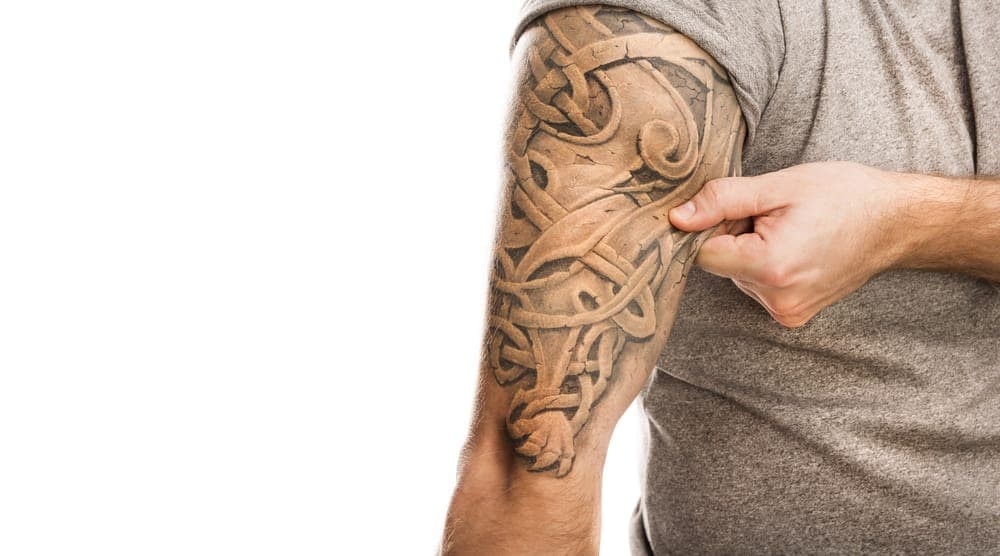
Table of ContentsShow
Joining the Air Force seems like the coolest idea in the world until your elderly family member says “oh, you can’t have that eyesore of a tattoo in the Air Force” or something along those lines!
Is there any truth in your well-meaning (but annoying) old aunt’s words?
In this article, we are going to be exploring the conundrum of tattoos and what they mean within the Air Force. We will be paying close attention to whether tattoos are allowed, and then looking at what kinds of tattoos are allowed and where on your body they can be.
So, if you have considered joining the Air Force but also want a tattoo (or even if you have one already), this article will be helpful for you!
What tattoos are not allowed in the Air Force?
The Air Force does not allow tattoos that are very visible such as on your face, neck, hands, wrists, and head. The rules have changed in recent years to include a little more allowance for tattoos, such as allowing tattoos when they cover less than 25% of the body and the removal of size stipulations.
Sleeves on the arm may also be allowed now. Tattoos on the lips, even if on the inside, are still considered visible and so they also incur a ban.
In terms of the design of the tattoos, the Air Force strictly bans any tattoo that is racist, sexist, homophobic, extremist, indecent in any way and any other tattoo that may be offensive. In our opinion, this is the right decision.
After all, the Air Force (as well as any other official police or military organization) should not allow for any form of discrimination in their employees, and a tattoo depicting such a thing is a sure sign that the person is a bad fit for such a role!
To be more specific, they ban anything that can be classed as obscene under guidelines set by the USAF. They also have a total ban on any tattoos that are associated or affiliated with gangs and gang activity. These banned tattoos are not allowed on any part of the body, even if they can be covered up!
Whilst hand tattoos are generally banned, the Air Force does make an exception for ring tattoos. There is an allowance for a ring tattoo on one finger on each hand.
This is to ensure that married personnel who have decided to mark their marriage with a tattoo instead of a ring do not need to be excluded.
Can you have a tattoo behind your ear in the Air Force?
No, it is highly unlikely that you will be able to have a tattoo behind your ear in the Air Force. Whilst it is covered by an ear and possibly hair, there is still a chance that the tattoo may be seen.
As it stands, any tattoo on the head or face is banned, and, seeing as a tattoo behind the ear is still technically on the head, it will not be allowed in the Air Force.
As well as a ban on tattoos behind the ear, the Air Force also has rules regarding piercings of any kind, especially visible piercings on the face or ears.
Of course, piercings can be taken out, but tattoos cannot be as easily removed unless you want to fork out for expensive laser removal (which may not even remove the whole piece).
Can the Air Force deny you for having a tattoo?
Yes. The Air Force can deny you for having a tattoo if the tattoo in question exceeds their limits. For example, if you have visible tattoos on your face, head, eyelids, lips, hands, neck, and wrists, you will likely get denied as these areas are not allowed to be tattooed.
You may also get denied from the Air Force if you have a tattoo design that is prohibited. Prohibited tattoos include designs that may be racist or sexist. They may also include any tattoo that is extremist or supremacist or depicts any messages of this kind.
The Air Force also has a ban on any tattoo that is affiliated or connected to gangs and gang culture. The Air Force also bans any tattoo that is affiliated with extremist religion, philosophies, and any religious blasphemy.
The Air Force also has a ban on branding tattoos in all areas, visible or not. If you have a tattoo that fits into any of these above descriptions then it is highly likely that you will get denied.
If you happen to have a tattoo that is in any way obscene, such as depicting an obscene or disturbing act, or if it falls under the USAF guidelines for obscenity, then you will also get denied.
The rules around tattoos are relaxed in many ways, but the Air Force quite rightly has a ban on any obscene and discriminatory tattoos, meaning you will not be allowed to join if you have them.
What happens if you get a tattoo before basic training?
If you get a tattoo before basic training, it will depend on what tattoo you have and where it is. If you get a tattoo that is on the Air Force banned list before you start your basic training, then it is highly likely that the Air Force will not let you start your training.
The banned list includes visible tattoos and obscene or discriminatory tattoos. If you were to get one of these banned tattoos before you finished your basic training, then you run a high risk of being booted out of the Air Force for disobeying the rules.
However, if the tattoo in question is within the allowed limits, you will likely be fine. You may just want to consider the healing time needed for a tattoo and how the training might affect it.
New tattoos are prone to infection and often need a few weeks of healing time. There may also be restrictions on how often you can shower with a very new tattoo, which may interfere with your training if you get sweaty or dirty.
Keep Reading

Does The Air Force Reserves Pay For Housing?
Does The Air Force Reserves Pay For Housing?

Is Air Force Basic Training Difficult?
Is Air Force Basic Training Difficult?
What is the Shortest Air Force Contract?
What is the Shortest Air Force Contract?
Which Branch Has the Best Drill Team?
Which Branch Has the Best Drill Team?